Industry-Verified Manufacturing Data (2026)

Power Management Unit

Based on aggregated insights from multiple verified factory profiles within the CNFX directory, the standard Power Management Unit used in the Computer, Electronic and Optical Product Manufacturing sector typically supports operational capacities ranging from standard industrial configurations to heavy-duty production requirements.

Technical Definition & Core Assembly

A canonical Power Management Unit is characterized by the integration of Voltage Regulator (Buck Converter) and Low-Dropout Regulator (LDO). In industrial production environments, manufacturers listed on CNFX commonly emphasize Silicon (Semiconductor) construction to support stable, high-cycle operation across diverse manufacturing scenarios.

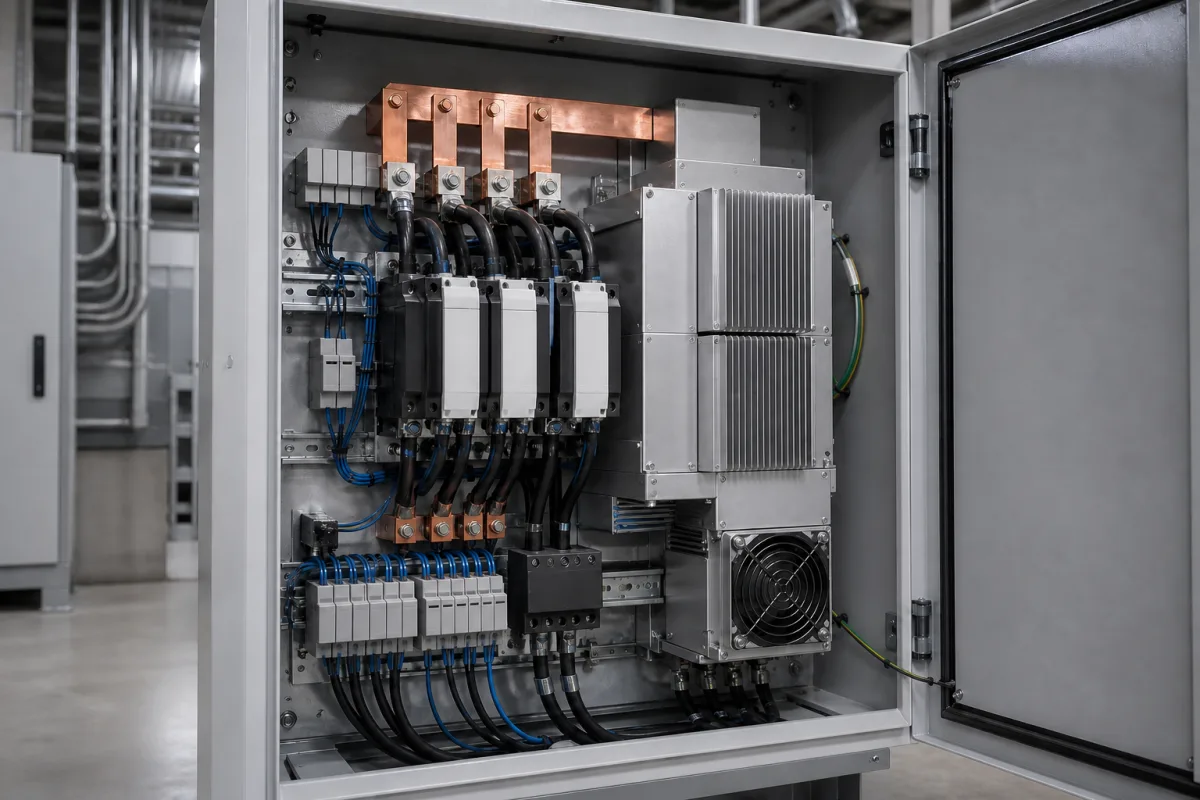
Integrated circuit within an MCU that regulates, distributes, and manages power supply to various subsystems.
Product Specifications

Technical details and manufacturing context for Power Management Unit

Definition
A Power Management Unit (PMU) is a critical component embedded within a Microcontroller Unit (MCU) responsible for the efficient and reliable management of electrical power. Its primary role is to receive an input voltage, condition it (e.g., regulate, step-down, filter), generate multiple stable voltage rails required by the MCU's core, memory, I/O interfaces, and peripherals, and implement power-saving modes (like sleep, idle, deep sleep) to minimize energy consumption. It ensures stable operation, protects against voltage fluctuations, and is essential for battery-powered and energy-sensitive applications.
Working Principle
The PMU typically uses switching regulators (e.g., buck converters) for high efficiency and linear regulators (LDOs) for low-noise rails. It monitors input and output voltages, and based on commands from the MCU core or internal logic, it can enable/disable power domains, sequence power-up/power-down of subsystems to prevent latch-up, and dynamically adjust voltage levels (Dynamic Voltage and Frequency Scaling - DVFS) to match processing demands, thereby optimizing power consumption.
Common Materials
Silicon (Semiconductor), Copper (Interconnects), Dielectric Materials
Technical Parameters
  • Input Voltage Range (e.g., 2.7V to 5.5V), Output Voltage Rails (e.g., 1.2V for core, 3.3V for I/O), Maximum Output Current per rail, Power Conversion Efficiency, Quiescent Current in sleep modes. (V) Per Request
Components / BOM
  • Voltage Regulator (Buck Converter)
    Steps down the input voltage to a lower, regulated output voltage with high efficiency for high-current rails like the core.
    Material: Semiconductor (MOSFETs, controller IC)
  • Low-Dropout Regulator (LDO)
    Provides a clean, low-noise regulated voltage from a slightly higher input, typically for noise-sensitive analog circuits.
    Material: Semiconductor
  • Power-on-Reset (POR) / Brown-Out Detector (BOD)
    Monitors the supply voltage and generates a reset signal to the MCU core if the voltage falls below a safe operating threshold, ensuring reliable startup and operation.
    Material: Semiconductor (comparator, reference voltage)
  • Voltage Reference
    Generates a precise, stable voltage used as a benchmark by regulators, monitors, and ADCs within the PMU.
    Material: Semiconductor (bandgap reference circuit)
  • Control Logic / State Machine
    Manages the sequencing of power domains, handles mode transitions (active, sleep, deep sleep), and interfaces with the MCU core for commands.
    Material: Semiconductor (digital logic)
Engineering Reasoning
1.8-3.6 V input, 0.8-1.2 V output, -40 to 125°C ambient
Input voltage exceeds 4.0 V absolute maximum rating for >10 μs, or junction temperature >150°C
Design Rationale: Electromigration in aluminum interconnects at current densities >1.0×10⁶ A/cm², or thermal runaway in power MOSFETs when Rds(on) increases by 50% at 125°C
Risk Mitigation (FMEA)
Trigger Load dump transient reaching 40 V for 400 ms
Mode: Gate oxide breakdown in output MOSFETs, causing permanent short circuit
Strategy: Integrated TVS diode clamping at 28 V with 5 kW peak pulse power rating
Trigger Simultaneous switching of 8 digital cores drawing 2.5 A each within 10 ns
Mode: Inductive voltage spike on power rail exceeding 5.0 V, corrupting memory states
Strategy: On-die decoupling capacitors totaling 100 nF with 50 mΩ ESR, plus staggered core activation sequencing

Industry Taxonomies & Aliases

Commonly used trade names and technical identifiers for Power Management Unit.

Applied To / Applications

This component is essential for the following industrial systems and equipment:

Industrial Ecosystem & Supply Chain DNA

Complementary Systems
Downstream Applications
Specialized Tooling

Application Fit & Sizing Matrix

Operational Limits
current: Up to 500mA per output channel
voltage: 1.8V to 5.5V input range
temperature: -40°C to +125°C
Media Compatibility
✓ Consumer electronics (smartphones, tablets) ✓ Industrial automation systems ✓ Automotive control units
Unsuitable: High-voltage power distribution systems (>60V)
Sizing Data Required
  • Total system power budget (watts)
  • Number of required voltage domains
  • Peak current requirements per domain

Reliability & Engineering Risk Analysis

Failure Mode & Root Cause
Capacitor degradation
Cause: Electrolyte drying due to thermal stress from high ambient temperatures or poor ventilation, leading to reduced capacitance and eventual short-circuit or open-circuit failure.
Power MOSFET failure
Cause: Overheating from excessive current load, poor heat sinking, or switching transients, resulting in thermal runaway, gate oxide breakdown, or drain-source short.
Maintenance Indicators
  • Audible high-pitched whining or buzzing from inductors or transformers, indicating magnetic core saturation or winding issues
  • Visible bulging or leaking electrolytic capacitors, or discoloration/burning on PCB around power components
Engineering Tips
  • Implement predictive maintenance with thermal imaging to monitor hot spots on power semiconductors and capacitors, allowing proactive replacement before failure
  • Ensure proper derating of components (e.g., operate capacitors at ≤80% rated voltage, MOSFETs at ≤75% rated current) and maintain clean, dust-free cooling paths to reduce thermal stress

Compliance & Manufacturing Standards

Reference Standards
ISO 9001:2015 (Quality Management Systems) IEC 62368-1 (Audio/Video, Information and Communication Technology Equipment Safety) CE Marking (EU Compliance for Electrical Equipment)
Manufacturing Precision
  • Output Voltage Regulation: +/- 2% of nominal value
  • Thermal Performance: Operating temperature tolerance +/- 5°C from specified range
Quality Inspection
  • Electrical Safety Test (Dielectric Strength/Insulation Resistance)
  • Environmental Stress Screening (Temperature Cycling/Vibration Testing)

Factories Producing Power Management Unit

Verified manufacturers with capability to produce this product in China

✓ 95% Supplier Capability Match Found

P Project Engineer from Brazil Feb 18, 2026
★★★★★
"Standard OEM quality for Computer, Electronic and Optical Product Manufacturing applications. The Power Management Unit arrived with full certification."
Technical Specifications Verified
S Sourcing Manager from Canada Feb 15, 2026
★★★★★
"Great transparency on the Power Management Unit components. Essential for our Computer, Electronic and Optical Product Manufacturing supply chain."
Technical Specifications Verified
P Procurement Specialist from United States Feb 12, 2026
★★★★★
"The Power Management Unit we sourced perfectly fits our Computer, Electronic and Optical Product Manufacturing production line requirements."
Technical Specifications Verified
Verification Protocol

“Feedback is collected from verified sourcing managers during RFQ (Request for Quote) and factory evaluation processes on CNFX. These reports represent historical performance data and technical audit summaries from our B2B manufacturing network.”

19 sourcing managers are analyzing this specification now. Last inquiry for Power Management Unit from USA (1h ago).

Supply Chain Compatible Machinery & Devices

Industrial Smart Camera Module

Embedded vision system for industrial automation and quality inspection.

Explore Specs →
Industrial Wireless Power Transfer Module

Wireless power transfer module for industrial equipment applications

Explore Specs →
Industrial Smart Sensor Module

Modular industrial sensor with embedded processing and wireless connectivity

Explore Specs →
Surface Mount Resistor

Passive electronic component for current limiting and voltage division in circuits

Explore Specs →

Frequently Asked Questions

What is the primary function of a power management unit in an MCU?

The PMU regulates, distributes, and manages the power supply to various subsystems within the microcontroller, ensuring stable voltage levels and monitoring for power anomalies like brown-outs.

How does a buck converter differ from an LDO in this PMU?

A buck converter efficiently steps down higher input voltages with switching technology, ideal for high-current loads, while an LDO provides low-noise, linear regulation for sensitive analog circuits with minimal voltage dropout.

Why are power-on-reset and brown-out detection critical in this PMU?

POR ensures the MCU starts correctly from a known state when power is applied, and BOD monitors for voltage drops below safe thresholds, preventing data corruption or erratic behavior during power fluctuations.

Can I contact factories directly on CNFX?

CNFX is an open directory, not a transaction platform. Each factory profile provides direct contact information and production details to help you initiate direct inquiries with Chinese suppliers.

Get Quote for Power Management Unit

Request technical pricing, lead times, or customized specifications for Power Management Unit directly from verified manufacturing units.

Your business information is encrypted and only shared with verified Power Management Unit suppliers.

Thank you! Your message has been sent. We'll respond within 1–3 business days.

Need to Manufacture Power Management Unit?

Connect with verified factories specializing in this product category

Add Your Factory Contact Us
Previous Product
Power Management Circuit
Next Product
Power Regulation Circuit