Industry-Verified Manufacturing Data (2026)

Protection Circuitry

Based on aggregated insights from multiple verified factory profiles within the CNFX directory, the standard Protection Circuitry used in the Computer, Electronic and Optical Product Manufacturing sector typically supports operational capacities ranging from standard industrial configurations to heavy-duty production requirements.

Technical Definition & Core Assembly

A canonical Protection Circuitry is characterized by the integration of Protection IC / Analog Front-End (AFE) and MOSFET Switches. In industrial production environments, manufacturers listed on CNFX commonly emphasize Printed Circuit Board (PCB) construction to support stable, high-cycle operation across diverse manufacturing scenarios.

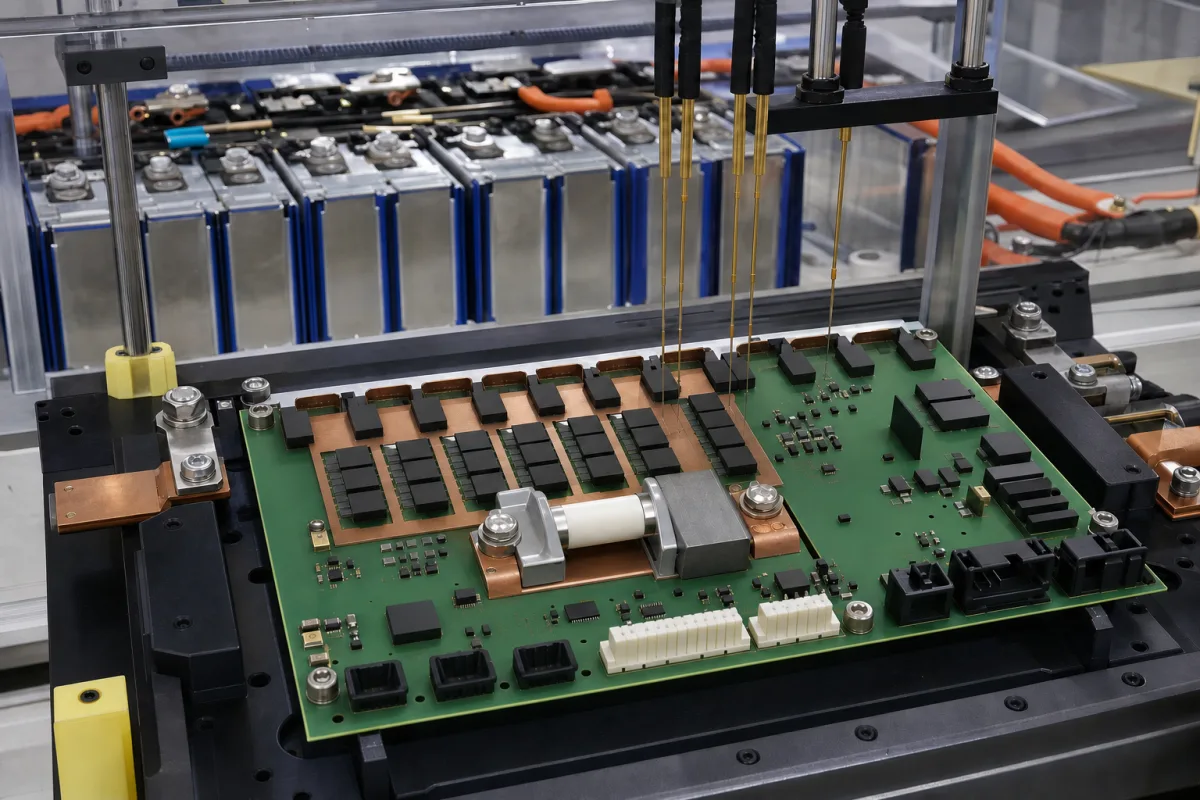
Electronic circuit within a Battery Management System (BMS) that monitors and protects battery cells from unsafe operating conditions.
Product Specifications

Technical details and manufacturing context for Protection Circuitry

Definition
A critical electronic subsystem within a Battery Management System (BMS) responsible for continuously monitoring key battery parameters such as voltage, current, and temperature. Its primary role is to detect and respond to potentially hazardous conditions like overcharge, over-discharge, overcurrent, and short circuits by disconnecting the battery from the load or charger to prevent damage, thermal runaway, or failure, thereby ensuring the safety, longevity, and reliable operation of the battery pack.
Working Principle
The circuitry uses precision sensors (e.g., voltage dividers, shunt resistors, thermistors) to measure cell voltages, pack current, and temperature. These analog signals are conditioned and compared against predefined safe thresholds by integrated circuits (ICs) such as protection ICs or analog front-ends (AFEs). If a parameter exceeds its limit (e.g., overvoltage), the IC's logic output triggers solid-state switches (like MOSFETs) to open the charge or discharge path, isolating the battery. Some circuits include a latch function that requires a reset condition (e.g., connection to a charger) to restore operation.
Common Materials
Printed Circuit Board (PCB), Semiconductor ICs (Protection IC/AFE), MOSFETs, Passive Components (Resistors, Capacitors), Copper Traces
Technical Parameters
  • Overvoltage protection threshold per cell (V) Customizable
Components / BOM
  • Protection IC / Analog Front-End (AFE)
    Monitors cell voltages and temperature, compares them to set thresholds, and generates control signals for the MOSFET switches.
    Material: Semiconductor Silicon
  • MOSFET Switches
    Act as electronically controlled switches in the charge and discharge paths; opened by the IC to isolate the battery during a fault.
    Material: Semiconductor (Silicon/GaN)
  • Current Sense Resistor (Shunt)
    Provides a small, precise voltage drop proportional to the pack current for overcurrent detection.
    Material: Manganin or Constantan Alloy
  • PCB
    Provides the physical platform and electrical interconnections (traces) for all electronic components.
    Material: FR-4 Glass Epoxy
Engineering Reasoning
2.5-4.2 V per cell, -40 to 85°C ambient temperature, 0-100% state of charge
Cell voltage exceeding 4.25 V or dropping below 2.0 V, temperature exceeding 90°C, current exceeding 1.5× rated capacity
Design Rationale: Electrolyte decomposition at >4.25 V causing gas generation and thermal runaway, lithium plating at <2.0 V causing internal short circuits, Arrhenius law thermal acceleration of degradation at >90°C
Risk Mitigation (FMEA)
Trigger MOSFET gate oxide breakdown at 15 V overvoltage
Mode: Protection MOSFET permanent conduction causing uncontrolled discharge
Strategy: Zener diode clamping at 12 V gate-source voltage with 100 Ω series resistance
Trigger Current sense resistor thermal coefficient mismatch of 50 ppm/°C
Mode: Overcurrent protection threshold drift causing premature cutoff at -20°C
Strategy: Four-terminal Kelvin connection with 0.1% tolerance metal foil resistors

Industry Taxonomies & Aliases

Commonly used trade names and technical identifiers for Protection Circuitry.

Applied To / Applications

This component is essential for the following industrial systems and equipment:

Industrial Ecosystem & Supply Chain DNA

Complementary Systems
Downstream Applications
Specialized Tooling

Application Fit & Sizing Matrix

Operational Limits
pressure: Atmospheric (sealed enclosure typical)
other spec: Voltage Range: 2.5V to 5.0V per cell, Current Sensing: ±100A typical
temperature: -40°C to +85°C (operational), -55°C to +125°C (storage)
Media Compatibility
✓ Lithium-ion battery cells ✓ Lithium-polymer battery packs ✓ Stationary energy storage systems
Unsuitable: High-vibration industrial machinery without additional mechanical protection
Sizing Data Required
  • Number of battery cells in series
  • Maximum continuous discharge current
  • Required protection features (over-voltage, under-voltage, over-current, short-circuit)

Reliability & Engineering Risk Analysis

Failure Mode & Root Cause
Contact Welding
Cause: High inrush currents or sustained overloads causing contacts to fuse together, preventing proper circuit opening and compromising protection functionality.
Coil Burnout
Cause: Voltage spikes, sustained overvoltage conditions, or excessive ambient temperatures degrading insulation and causing open circuits in relay or contactor coils.
Maintenance Indicators
  • Audible buzzing or chattering from relays/contactors indicating loose connections, low voltage, or mechanical binding
  • Visible discoloration, charring, or melted insulation on wiring, terminals, or components indicating overheating and potential insulation breakdown
Engineering Tips
  • Implement regular infrared thermography scans to detect abnormal heating patterns in connections and components before catastrophic failure occurs
  • Install properly sized surge protection devices and maintain clean, stable power supply to prevent voltage transients that degrade protective components

Compliance & Manufacturing Standards

Reference Standards
ISO 13849-1: Safety of machinery - Safety-related parts of control systems ANSI/UL 508: Standard for Industrial Control Equipment DIN EN 60204-1: Safety of machinery - Electrical equipment of machines
Manufacturing Precision
  • Component Placement: +/-0.1mm on PCB
  • Insulation Resistance: >100 MΩ at 500V DC
Quality Inspection
  • High-Potential (Hi-Pot) Test: Dielectric strength verification
  • Functional Safety Test: Performance verification under fault conditions

Factories Producing Protection Circuitry

Verified manufacturers with capability to produce this product in China

✓ 92% Supplier Capability Match Found

S Sourcing Manager from United States Mar 01, 2026
★★★★★
"The Protection Circuitry we sourced perfectly fits our Computer, Electronic and Optical Product Manufacturing production line requirements."
Technical Specifications Verified
P Procurement Specialist from United Arab Emirates Feb 26, 2026
★★★★☆
"Found 40+ suppliers for Protection Circuitry on CNFX, but this spec remains the most cost-effective. (Delivery took slightly longer than expected, but technical support was excellent.)"
Technical Specifications Verified
T Technical Director from Australia Feb 23, 2026
★★★★★
"The technical documentation for this Protection Circuitry is very thorough, especially regarding technical reliability."
Technical Specifications Verified
Verification Protocol

“Feedback is collected from verified sourcing managers during RFQ (Request for Quote) and factory evaluation processes on CNFX. These reports represent historical performance data and technical audit summaries from our B2B manufacturing network.”

11 sourcing managers are analyzing this specification now. Last inquiry for Protection Circuitry from Poland (1h ago).

Supply Chain Compatible Machinery & Devices

Industrial IoT Gateway

Edge computing device connecting industrial equipment to cloud platforms.

Explore Specs →
Modular Industrial Edge Computing Device

Rugged computing platform for industrial data processing at the network edge

Explore Specs →
Industrial Smart Camera Module

Embedded vision system for industrial automation and quality inspection.

Explore Specs →
Industrial Wireless Power Transfer Module

Wireless power transfer module for industrial equipment applications

Explore Specs →

Frequently Asked Questions

What is the primary function of protection circuitry in a Battery Management System?

The primary function is to continuously monitor battery cell parameters like voltage, current, and temperature, and to disconnect the battery via MOSFET switches if unsafe conditions are detected to prevent damage or hazards.

What are the key components in a protection circuitry BOM?

Key components include a Protection IC or Analog Front-End (AFE) for monitoring, MOSFET switches for disconnection, a current sense resistor (shunt) for current measurement, and a PCB to integrate all elements.

How does protection circuitry enhance battery safety in electronic devices?

It prevents overcharge, over-discharge, overcurrent, and short circuits by automatically cutting off power when thresholds are exceeded, thereby extending battery life and reducing risks of fire or failure.

Can I contact factories directly on CNFX?

CNFX is an open directory, not a transaction platform. Each factory profile provides direct contact information and production details to help you initiate direct inquiries with Chinese suppliers.

Get Quote for Protection Circuitry

Request technical pricing, lead times, or customized specifications for Protection Circuitry directly from verified manufacturing units.

Your business information is encrypted and only shared with verified Protection Circuitry suppliers.

Thank you! Your message has been sent. We'll respond within 1–3 business days.

Need to Manufacture Protection Circuitry?

Connect with verified factories specializing in this product category

Add Your Factory Contact Us
Previous Product
Projection Lens Assembly
Next Product
Protection IC / Analog Front-End (AFE)