Editorial Technical Reference

Vision Camera

This page explains how Vision Camera is classified within Computer, Electronic and Optical Product Manufacturing. Technical values and manufacturer relationships are research references; confirm the current specification and supplier evidence for each order.

Technical Definition & Core Assembly

An optical imaging device that captures visual data for machine vision applications within sensing systems.

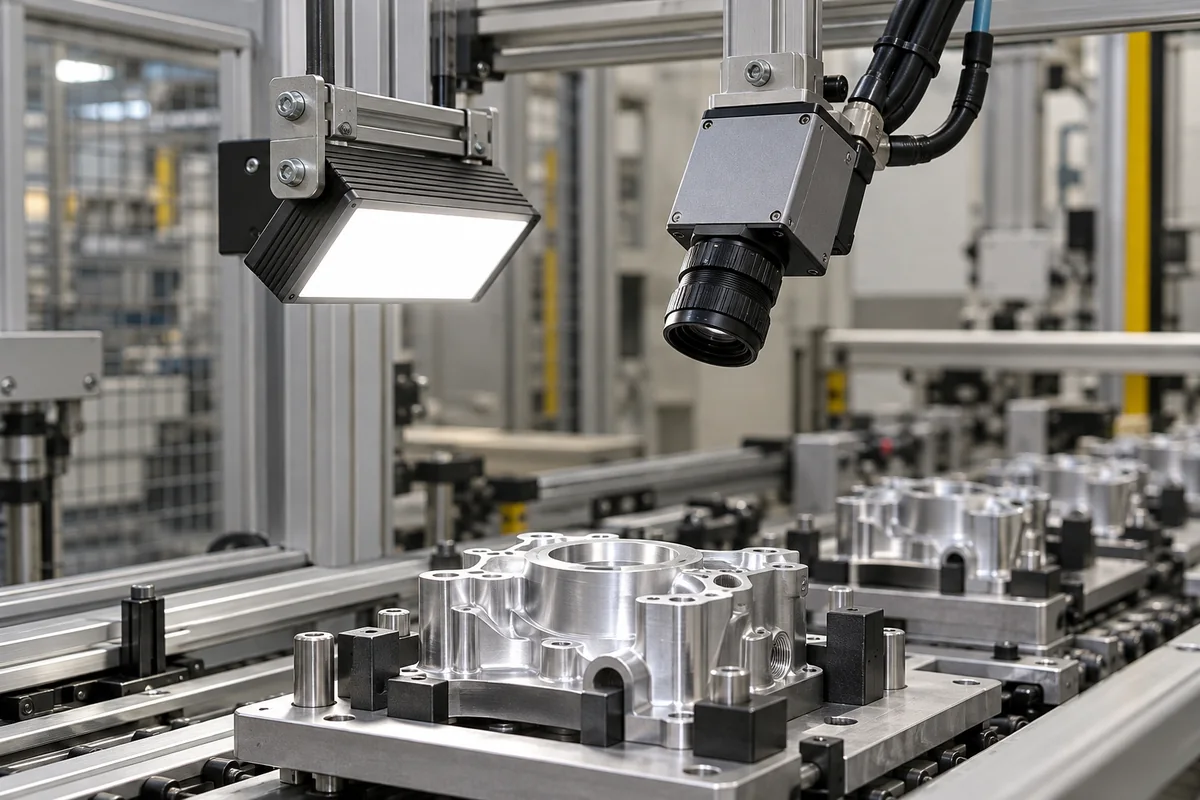
Representative product image. Confirm appearance and specifications with the manufacturer.

Product Specifications

Technical details and manufacturing context for Vision Camera

Definition
The Vision Camera is a specialized component used in sensing systems to acquire high-quality visual information for automated inspection, measurement, guidance, and recognition tasks. It converts optical images into digital signals that can be processed by computer vision algorithms. The camera typically employs a lens system to focus light onto an image sensor, commonly CMOS or CCD, which converts photons into electrical signals. These signals are then digitized and processed to create a digital image representation for analysis by vision processing systems. Key parameters include sensor resolution ranging from 0.4 to 12 megapixels, frame rates from 30 to 250 fps, and pixel sizes from 2.2 to 12 micrometers. Interfaces available are GigE, USB3.0, and Camera Link. The operating temperature range is -40 to 85°C, with storage temperature also -40 to 85°C, and humidity range of 20-80% RH (non-condensing). Ingress protection ratings vary from IP54 to IP65 per IEC 60529, suitable for dusty or wet environments. Supply voltage is 12-24 V DC, with power consumption between 2.5 and 10 W. Lens mounts include C, CS, and M12. Weight ranges from 50 to 500 g, and dimensions vary from 29 x 29 x 30 mm to 60 x 60 x 70 mm. Materials used include optical glass, silicon sensors, aluminum alloy housing, and electronic components. These specifications are typical ranges; actual values must be confirmed with the manufacturer for specific models and applications. The camera is designed for integration into industrial vision systems, and its performance should be verified against the intended use case.
Working Principle
The Vision Camera operates by using a lens system to focus incoming light onto an image sensor, typically CMOS or CCD. The sensor converts photons into electrical charges, which are then read out and digitized by analog-to-digital converters. The resulting digital signal is processed to form a digital image, which can be analyzed by computer vision algorithms for tasks such as inspection, measurement, and guidance. The camera's performance is influenced by sensor resolution, pixel size, and frame rate, which determine the level of detail, sensitivity, and speed of image acquisition. The interface (GigE, USB3.0, or Camera Link) facilitates data transfer to a processing unit. Environmental factors such as temperature and humidity can affect sensor stability, so the camera is designed to operate within specified ranges. Ingress protection ratings indicate resistance to dust and water, important for industrial environments.
Common Materials
Optical glass, Silicon sensor, Aluminum alloy housing, Electronic components
Technical Parameters
ParameterTypical rangeNotes & selection driver
Sensor Resolution0.4–12 MPHigher resolution for fine detail inspection
Frame Rate30–250 fpsHigher for high-speed applications
Pixel Size2.2–12 µmSmaller for higher sensitivity
InterfaceGigE, USB3.0, Camera LinkGigE for long distance, USB3 for convenience
Operating Temperature-40–85 °COutside range may cause sensor drift
Storage Temperature-40–85 °CNon-operating condition
Humidity20–80 % RHNon-condensing
Ingress ProtectionIP54–IP65IP65 for dusty/wet environmentsIEC 60529
Supply Voltage12–24 V DCPoE available on some models
Power Consumption2.5–10 WHigher for high-speed models
Lens MountC, CS, M12C-mount for industrial lenses
Weight50–500 gDepends on housing and lens
Dimensions (W x H x D)29 x 29 x 30 – 60 x 60 x 70 mmCompact for tight spaces

Ranges are indicative industry figures for RFQ preparation, not a supplier commitment. Confirm every value and standard with the legal manufacturer before ordering.

Components / BOM
  • Image Sensor
    Converts optical images into electrical signals
    Material: Silicon
  • Lens Mount
    Secures and aligns the optical lens to the camera body
    Material: Aluminum alloy
  • Processing Board
    Processes raw sensor data into digital images
    Material: Fiberglass PCB with electronic components
  • Housing Part
    Protects internal components from environmental factors
    Material: Aluminum alloy with protective coating

Applied To / Applications

This component is essential for the following industrial systems and equipment:

Industrial Ecosystem & Supply Chain Structure

Complementary Systems
Downstream Applications
Specialized Tooling

Application Fit & Sizing Matrix

Operational Limits
pressure: 0 to 1 bar (atmospheric)
other spec: IP67 ingress protection, 0-100% relative humidity (non-condensing)
temperature: -10°C to 50°C
Media Compatibility
✓ Clean air environments ✓ Dry industrial atmospheres ✓ Non-corrosive gas streams
Unsuitable: High-pressure liquid immersion or abrasive slurry flows
Sizing Data Required
  • Field of view (FOV) required
  • Working distance from target
  • Minimum feature resolution needed

Reliability & Engineering Risk Analysis

Failure Mode & Root Cause
Sensor degradation
Cause: Accumulation of dust, debris, or contaminants on the lens or sensor surface, leading to reduced image clarity, focus issues, or complete failure due to environmental exposure without proper sealing or cleaning.
Electrical/connection failure
Cause: Vibration, thermal cycling, or moisture ingress causing loose connections, cable damage, or corrosion in power/data interfaces, resulting in intermittent operation or total loss of signal transmission.
Maintenance Indicators
  • Blurry, distorted, or flickering images indicating lens contamination or sensor malfunction
  • Intermittent connectivity or complete loss of video feed, often accompanied by error messages or audible electrical arcing in severe cases
Engineering Tips
  • Implement regular cleaning schedules with appropriate lens-safe materials and ensure environmental sealing (IP-rated enclosures) to protect against dust, moisture, and chemical exposure.
  • Use vibration-dampening mounts, secure cable management with strain relief, and perform periodic inspections of connectors and wiring for signs of wear or corrosion.

Indicative industry ranges for design and RFQ preparation. Confirm the exact figures and applicable standard with the manufacturer before specifying.

Compliance & Manufacturing Standards

Applicable Standards
ISO 12233:2017 (Photography - Electronic still picture imaging - Resolution and spatial frequency responses) IEC 62471:2006 (Photobiological safety of lamps and lamp systems) CE Marking (EU conformity for health, safety, and environmental protection)

Quoted from the published standard.

Manufacturing Precision
  • Lens focal length: +/- 1%
  • Sensor alignment flatness: 0.05mm
Quality Inspection
  • Modulation Transfer Function (MTF) test for optical resolution
  • Environmental stress screening (temperature, humidity, vibration)

Manufacturers of Vision Camera

4 companies list this product among what they make. Company figures are quoted from each company's own website; every card states where the relationship came from.

ChengZhou Technology
Guangdong, CN
Listed on the company's own website · profile compiled by CNFX from public sources
Dalian BaoSteel Metallurgy Group Co., Ltd.
Liaoning, CN
Listed on the company's own website · profile compiled by CNFX from public sources
Orbbec Inc.
Shenzhen, Guangdong, CN
Listed on the company's own website · profile compiled by CNFX from public sources
Top Vision
Shenzhen, Guangdong, CN
Listed on the company's own website · profile compiled by CNFX from public sources

Manufacturer listings support early research and capability understanding. They are not certification, ranking, or transaction guarantees.

Technical documentation
Request current drawings, revision history, and a signed specification sheet.
Manufacturing capability
Verify equipment lists, process limits, capacity, and representative production evidence.
Inspection readiness
Confirm test methods, calibrated equipment, sampling plans, and traceable reports.
Supplier transparency
Check the legal entity, factory address, ownership, certifications, and direct contacts.

CNFX does not score or rank suppliers. Buyers must verify all claims and documents with the legal manufacturer before ordering.

Supply Chain Compatible Machinery & Devices

Modular Industrial Edge Computing Device

This modular industrial edge computing device is a ruggedized system designed for deployment in harsh industrial environments to perform real-time data processing, analytics, and control functions at the network edge.

Explore Specs →
Industrial Smart Camera Module

The Industrial Smart Camera Module is a compact, self-contained vision processing unit designed for integration into industrial machinery and production lines.

Explore Specs →
Surface Mount Resistor

Passive electronic component for current limiting and voltage division in circuits

Explore Specs →
Surface Mount Capacitor

A surface mount capacitor is a fundamental electronic component used for energy storage, filtering, coupling, and decoupling in electronic circuits.

Explore Specs →

Frequently Asked Questions

What is the typical resolution range for this camera?

The sensor resolution ranges from 0.4 to 12 megapixels, depending on the model. Higher resolution is suitable for fine detail inspection, but the actual value must be confirmed for the specific model.

What interfaces are available for data transfer?

The camera supports GigE, USB3.0, and Camera Link interfaces. GigE is suitable for long-distance transmission, while USB3.0 offers convenience. The choice depends on the system architecture and distance requirements.

What are the environmental operating limits?

The operating temperature range is -40 to 85°C, storage temperature is also -40 to 85°C, and humidity is 20-80% RH non-condensing. Ingress protection ratings vary from IP54 to IP65 per IEC 60529, indicating resistance to dust and water. Always verify these limits for the specific model.

What lens mounts are supported?

The camera supports C, CS, and M12 lens mounts. C-mount is common for industrial lenses, while CS and M12 offer different flange distances and sizes. The appropriate mount depends on the lens and application requirements.

Data Basis

Editorial classification, named public sources where available, and source-reviewed manufacturer records.

Preliminary Technical Classification
This page supports structured research, RFQ preparation, and supplier evaluation. It does not replace buyer-led supplier qualification, standards review, or technical approval.
Buyer enquiry

Request manufacturing insight for Vision Camera

Ask for use case, specification boundaries, supplier type, and RFQ preparation information for this product.

Where it goes
Straight to the CNFX editorial desk, and to the manufacturer if this product is linked to a claimed profile. Nothing is broadcast to a supplier list.
Your details stay here
We do not sell or rent enquiry data, and we do not add you to a mailing list. Used only to answer this request.
No commission, no middleman
CNFX is a directory. We take no cut of any order and never negotiate on a supplier's behalf.
What we don't claim
A listing is not an endorsement. Qualify every supplier and verify every figure yourself before ordering.

Your business information is used only to process this request.

Thank you! Your message has been sent. We'll respond within 1–3 business days.
Sorry, we couldn't send your message. Please try again, or email us at contact@cnfx.com.

Need to Manufacture Vision Camera?

Compare manufacturer profiles with relevant product and process capability.

Previous Product
XY Positioning Stage
Last Product
Get QuotesChat