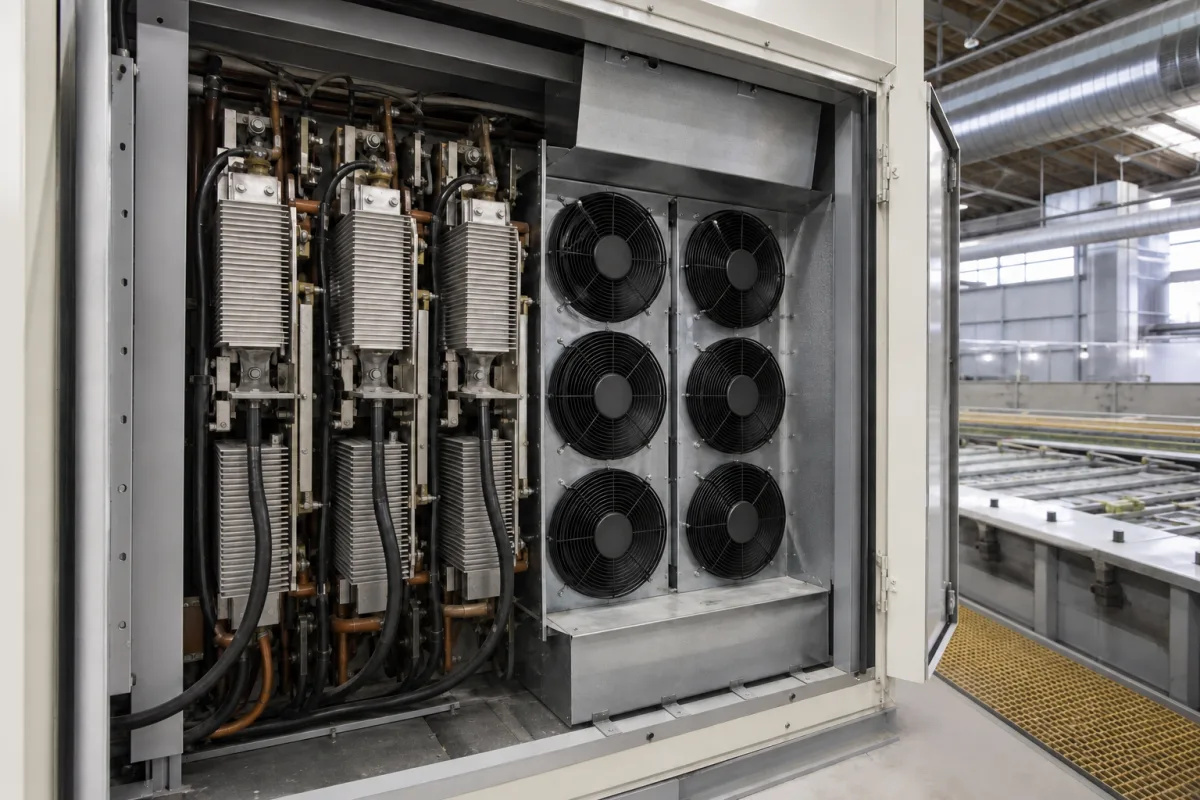
Rectifier heat sink and cooling system (water-cooled thyristor and diode heat sinks with air-over-water cabinet cooling)
Cooling for high-current plating and electrolysis rectifiers · water-cooled diode and SCR heat sinks, plumbing order, cooling-water quality, air-over-water cabinet cooling
In a plating, anodizing or electrolysis rectifier delivering thousands of amperes, the semiconductor losses are removed by copper heat sinks with water flowing through them, while fans push cabinet air across an air-to-water coil that cools the transformer. The decisions that matter are the flow per device and the order in which the heat sinks are piped, the purity of the water and whether it touches live metal, and how condensation and leaks are prevented inside the cabinet. Settle the rectifier's current and voltage, the plant water available (temperature, pressure, quality), and whether a closed secondary loop is needed.
The cooling subsystem inside high-current SCR and diode rectifiers for electroplating, anodizing and electrolysis: liquid-cooled heat sinks for thyristors and diodes, their plumbing, cooling-water quality, the air-to-water heat exchanger and fan that cool the transformer and cabinet, and closed-loop water-to-water units placed beside the rectifier. Aluminium heat sinks for electronics cooled by natural or forced air (extruded, die-cast, skived and machined) are covered on the Aluminium heat sink page, and extruded fin profiles sold by length are covered on the Aluminum extruded heat sink profile page. For sizing the rectifier itself — DC current and voltage, bridge and pulse number, transformer and busbars — see the Power supply unit (high-current DC rectifier cabinet for electroplating, anodizing and electrolysis) page. Plant chillers and cooling towers are outside this page.
CNFX editorial research · Sources checked October 12, 2026 · 5 sources
Water-cooled thyristor heat sinks: flow per device and series versus parallel piping
Advanced Energy's water-cooled thyristor stack, built for outputs above 2000 A and above 1500 kW per bridged rectifier at up to 690 V AC, cools each thyristor between two liquid-cooled heat sinks of copper alloy, connected with polyurethane hoses and stainless-steel fittings. Coolant flow is limited to 10 L/min (2.6 gpm) or less per thyristor. [1]
The same user guide ranks three ways of piping the heat sinks. All heat sinks in series, each inlet fed from the previous outlet, is the simplest and the lowest-performing, because the water warms as it passes each one. Piping only the two heat sinks of each thyristor in series improves it, and feeding every heat sink in parallel from a supply manifold to a return manifold gives the best performance. AE states that the stack's maximum current depends on the thyristor chosen, the plumbing configuration, water temperature and flow rate. [1]
Editorial calculation: water at 10 L/min is about 0.167 kg/s; with a specific heat of about 4.18 kJ/kg·K (assumed) and a 10 K rise from inlet to outlet, it carries 0.167 × 4.18 × 10 ≈ 7 kW. Three AE stacks make the six-thyristor B6C bridge the guide shows for DC output, so at the 10 L/min limit per thyristor the bridge would take up to 6 × 10 = 60 L/min. [1]
Two of the stack's heat sinks carry a normally-closed temperature switch that opens at 85 °C and can be wired to alarm or shut down. The hose fittings suit hose of 9.5 mm inside diameter with a minimum bend radius of 70 mm, and the hose is rated to a maximum operating pressure of 16 bar. [1] GD Rectifiers, which supplies water-cooled heat sinks for isolated-base thyristor, diode and IGBT modules, pressure tests them to 7 bar (100 psi) as standard. [5]
Ask for the flow and pressure drop per heat sink at your inlet temperature, the piping arrangement the current rating assumes, and where the over-temperature switches sit.
02
Cooling-water purity, live heat sinks and the closed secondary loop
Whether the water touches live metal decides how clean it must be. In Trystar's Series 30 plating and anodizing supply (6 to 100 V DC, 500 to 10,000 A), the diodes are on the low-voltage side of the main transformer and sit on all-copper water-cooled heat sinks with no isolation between the cooling water, the heat sink and the diode. The SCRs on the line side are electrically isolated from their copper heat sink and its water. Trystar states that all voltages above 100 V are isolated from the cooling water. [2]
AE asks for much purer coolant in its thyristor stack: salt content of 1 mg/L or less, deionized water, with up to 40% glycol. [1]
Where plant water cannot meet such limits, KraftPowercon's CoolKraft places a water-to-water heat exchanger between the raw water and the rectifier; the maker says the secondary circuit reduces concerns about water-quality supply. It is standardized for 1 to 30 kW installations, limits coolant to the power electronics to 35 °C with a minimum 10 °C difference between raw water and coolant, holds a 5 L expansion tank, is rated PN5 (5 bar design, 7.5 bar test) with 6 bar maximum on the cooling circuit, and can sit up to 70 m of pipe from the rectifier. The unit measures 870 × 500 × 610 mm, weighs 67 kg and is rated IP34 for +5 to +50 °C ambient. [3]
1500 maximum, stated in "micro-ohms" (confirm the unit with the maker)
Filtration
140 to 150 micron filter on the system (preferred)
Send the supplier a recent analysis of the plant water and state whether the rectifier will run on a closed deionized loop.
03
Transformer and cabinet: fan, air-to-water coil, condensation and leak shutdown
In Trystar's water-cooled version the transformer is not water-cooled directly: a direct-driven high-pressure axial fan circulates internal air through the main transformer and an air-to-water heat exchanger of copper water tubes and aluminium fins. [2]
Water flow is switched on and off by a solenoid valve to prevent condensation and save water; the cabinet and device temperatures are controlled by two solenoid valves on the inlet line operated by sensors inside the rectifier. The valve is interlocked with a leak detector, so water detected in the cabinet shuts the unit down and closes the valve. Over-temperature sensors on the diode and SCR heat sinks protect the devices if water flow becomes insufficient. [2]
For comparison, the air-cooled version of the same supply draws ambient air through the components with a fan and runs at full rating up to 40 °C ambient, with derating above that. Its devices are clamped to extruded heat sinks with less than 10 °C difference between device and heat sink, and the heat sink limits temperature rise to 40 °C at the specified airflow. [2] KraftPowercon describes water cooling as the more reliable choice when temperatures reach 40° or more or the air is dusty or contaminated, since the closed system avoids filter clogging and does not return heat to the room. [4]
04
Data for quoting a rectifier cooling system
Paste it into your enquiry below or into an email to a maker, then replace every bracket.
Rectifier: [DC current; DC voltage; SCR or diode; process — plating, anodizing, electrolysis]
Losses to remove: [kW, if known]
Plant water: [inlet temperature range; pressure; flow available; water analysis]
Loop: [direct plant water; closed deionized loop; water-to-water exchanger]
Heat sinks: [copper or aluminium; isolated or live; piping series or parallel]
Cabinet: [air-to-water coil; fan; enclosure rating]
Protection: [over-temperature switches; flow monitor; leak detector; solenoid valve]
Site: [ambient temperature; dust or corrosive fumes]
1 company lists this product among what they make. Company figures are quoted from each
company's own website; every card states where the relationship came from.
Lori
Manufacturing site to be confirmed for the order
Lists a high-power IGBT water-cooling heat sink with an embedded copper tube, naming inverters, welding machines and power-supply equipment among its applications, alongside liquid cold plates and skived-fin heat sinks.
Explore company information and manufacturing capabilities, then discuss the scope of your project with a relevant supplier.
Share this page
Compiled and source-reviewed by the CNFX editorial team.
Each manufacturer above links to the page on that company's own website where the product is listed, with the date we checked it. How we source and review
· Page last updated 13 October 2026
Buyer questions
How much water does a water-cooled thyristor need?
Advanced Energy limits its water-cooled thyristor stack to 10 L/min (2.6 gpm) or less per thyristor and says the current rating depends on plumbing, water temperature and flow. [1]
Can a plating rectifier be cooled with ordinary plant water?
Trystar sets limits such as pH 6.0 to 9.0, chloride ≤20 ppm and hardness ≤150 ppm for its Series 30; AE asks for deionized water with salt ≤1 mg/L, and a closed secondary loop such as KraftPowercon's CoolKraft separates raw water from the rectifier. [2][1][3]
Why are water-cooled rectifier heat sinks piped in parallel?
Because water warms as it passes each heat sink; AE rates all-in-series piping as the lowest-performing and parallel manifolds as the best. [1]
Sources and what still needs a direct check
Sources checked 2026-10-12. Advanced Energy, Trystar and KraftPowercon publish these figures for their own rectifier components and cooling units; GD Rectifiers states the test pressure of its water-cooled heat sinks.