Industry-Verified Manufacturing Data (2026)

Lithium-Ion Battery Module Assembly and Testing System

Based on aggregated insights from multiple verified factory profiles within the CNFX directory, the standard Lithium-Ion Battery Module Assembly and Testing System used in the Electrical Equipment Manufacturing sector typically supports operational capacities ranging from standard industrial configurations to heavy-duty production requirements.

Technical Definition & Core Assembly

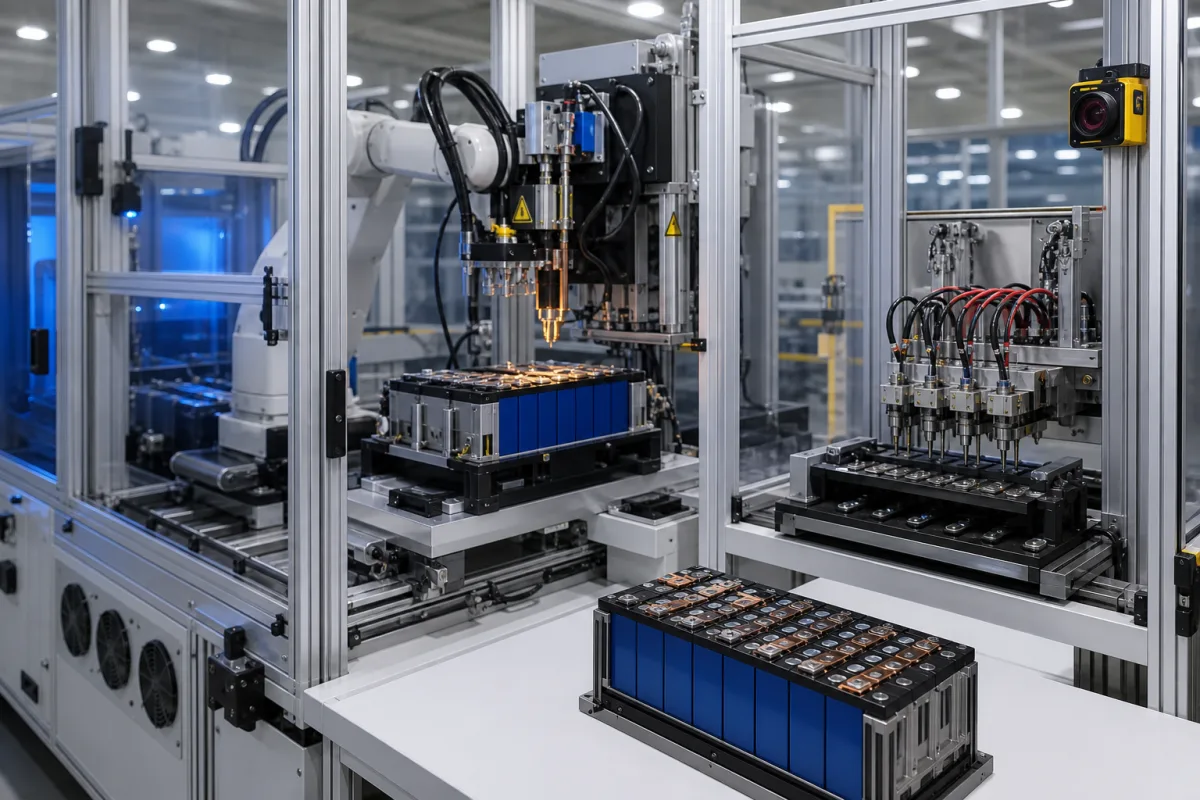
A canonical Lithium-Ion Battery Module Assembly and Testing System is characterized by the integration of Automated Cell Sorting Station and Robotic Welding Unit. In industrial production environments, manufacturers listed on CNFX commonly emphasize Stainless Steel construction to support stable, high-cycle operation across diverse manufacturing scenarios.

Integrated production line for assembling battery cells into modules with comprehensive testing
Product Specifications

Technical details and manufacturing context for Lithium-Ion Battery Module Assembly and Testing System

Definition
A fully integrated industrial production system designed for the automated assembly of individual lithium-ion battery cells into complete battery modules. This system coordinates multiple processes including cell sorting, busbar welding, module housing assembly, and electrical connection. It incorporates comprehensive testing stations for electrical performance, insulation resistance, and thermal management validation. The system ensures consistent module quality and meets high-volume production requirements for electric vehicles and energy storage applications.
Working Principle
Automated material handling transports cells through sequential stations where robotic systems perform precise assembly operations, followed by automated testing to verify electrical and safety parameters before final packaging.
Common Materials
Stainless Steel, Aluminum Alloy, Industrial Plastics, Copper Busbars
Technical Parameters
  • Maximum output rate under optimal conditions (modules/hour) Per Request
  • Supported electrical output range for assembled modules (V) Per Request
Components / BOM
Engineering Reasoning
2.5-4.2 V per cell, 0-45°C ambient temperature, 20-80% relative humidity
Cell voltage <2.0 V or >4.5 V, internal temperature >60°C, electrolyte decomposition at 4.3 V
Design Rationale: Lithium plating below 2.0 V, SEI layer breakdown above 4.3 V, thermal runaway initiation at 60°C due to Arrhenius kinetics (Q10≈2)
Risk Mitigation (FMEA)
Trigger Electrode misalignment >0.5 mm during stacking
Mode: Internal short circuit between anode and cathode
Strategy: Vision-guided robotic alignment with 0.1 mm precision using laser triangulation sensors
Trigger Electrolyte filling vacuum level <10^-3 mbar
Mode: Gas bubble entrapment causing dry spots and increased internal resistance
Strategy: Two-stage vacuum filling: 10^-4 mbar for 30 minutes followed by 500 mbar pressure differential injection

Industry Taxonomies & Aliases

Commonly used trade names and technical identifiers for Lithium-Ion Battery Module Assembly and Testing System.

Industrial Ecosystem & Supply Chain DNA

Complementary Systems
Downstream Applications
Specialized Tooling

Application Fit & Sizing Matrix

Operational Limits
pressure: Atmospheric to 1.5 bar (assembly pressure), 0-10 bar (testing pressure)
other spec: Humidity: 30-60% RH, Cleanroom Class: ISO 7 or better, Power: 380-480V 3-phase, 50/60Hz
temperature: 15-30°C (operating environment), 0-50°C (storage)
Media Compatibility
✓ Lithium-ion pouch cells ✓ Prismatic battery cells ✓ Cylindrical battery cells (18650/21700)
Unsuitable: Wet or corrosive environments (e.g., salt spray, acid exposure)
Sizing Data Required
  • Maximum module output (modules/hour)
  • Battery cell dimensions and configuration
  • Required testing protocols (electrical, thermal, safety)

Reliability & Engineering Risk Analysis

Failure Mode & Root Cause
Thermal runaway
Cause: Internal short circuit due to manufacturing defects, mechanical damage, or electrolyte decomposition leading to uncontrolled heat generation and potential fire/explosion
Capacity degradation
Cause: Solid electrolyte interface (SEI) layer growth, lithium plating, electrode material degradation, or electrolyte decomposition from improper charging protocols, high temperatures, or excessive cycling
Maintenance Indicators
  • Swelling or deformation of battery casing indicating gas buildup from internal chemical reactions
  • Abnormal heating during charging/discharging cycles or audible hissing/popping sounds from venting gases
Engineering Tips
  • Implement strict temperature control (15-25°C optimal) with active cooling systems and thermal monitoring to prevent accelerated degradation and thermal runaway triggers
  • Utilize smart battery management systems (BMS) with cell balancing, voltage/current regulation, and state-of-charge (SOC) optimization to prevent overcharging, deep discharging, and uneven cell wear

Compliance & Manufacturing Standards

Reference Standards
ISO 26262:2018 - Functional safety for road vehicles IEC 62133-2:2017 - Safety requirements for portable sealed secondary lithium cells and batteries UL 2580 - Standard for Batteries for Use in Electric Vehicles
Manufacturing Precision
  • Cell alignment tolerance: +/- 0.5mm
  • Busbar connection torque: +/- 10% of specified value
Quality Inspection
  • High-potential (hipot) insulation resistance test
  • Thermal runaway propagation test

Factories Producing Lithium-Ion Battery Module Assembly and Testing System

Verified manufacturers with capability to produce this product in China

✓ 93% Supplier Capability Match Found

P Project Engineer from Germany Feb 07, 2026
★★★★★
"Standard OEM quality for Electrical Equipment Manufacturing applications. The Lithium-Ion Battery Module Assembly and Testing System arrived with full certification."
Technical Specifications Verified
S Sourcing Manager from Brazil Feb 04, 2026
★★★★★
"Great transparency on the Lithium-Ion Battery Module Assembly and Testing System components. Essential for our Electrical Equipment Manufacturing supply chain."
Technical Specifications Verified
P Procurement Specialist from Canada Feb 01, 2026
★★★★★
"The Lithium-Ion Battery Module Assembly and Testing System we sourced perfectly fits our Electrical Equipment Manufacturing production line requirements."
Technical Specifications Verified
Verification Protocol

“Feedback is collected from verified sourcing managers during RFQ (Request for Quote) and factory evaluation processes on CNFX. These reports represent historical performance data and technical audit summaries from our B2B manufacturing network.”

17 sourcing managers are analyzing this specification now. Last inquiry for Lithium-Ion Battery Module Assembly and Testing System from India (23m ago).

Supply Chain Commonly Integrated Components

Stator Assembly

The stationary component of an electric motor that generates a rotating magnetic field when energized.

Explore Specs →
Wire Tensioner

A device that applies and maintains precise tension on electrical wire during the winding process of transformers.

Explore Specs →
Wire Guide System

A precision mechanical system that guides and positions wire during the winding process on a transformer winding machine.

Explore Specs →
Counter System

A monitoring and control subsystem that tracks and records the number of winding turns during transformer coil production.

Explore Specs →

Frequently Asked Questions

What types of battery cells is this system compatible with?

The system accommodates a wide range of lithium-ion cell formats including prismatic, cylindrical, and pouch cells, with adjustable fixtures to handle various dimensions within the specified compatibility range.

How does the system ensure quality control during assembly?

Quality is maintained through automated cell sorting, precision robotic welding with vision systems, and comprehensive electrical testing including voltage, resistance, and insulation checks in the testing chamber.

What maintenance requirements does this production line have?

The system requires regular maintenance of robotic components, conveyor systems, and testing equipment. Stainless steel and aluminum construction minimizes corrosion, with recommended preventive maintenance every 500 operating hours.

Can I contact factories directly on CNFX?

CNFX is an open directory, not a transaction platform. Each factory profile provides direct contact information and production details to help you initiate direct inquiries with Chinese suppliers.

Get Quote for Lithium-Ion Battery Module Assembly and Testing System

Request technical pricing, lead times, or customized specifications for Lithium-Ion Battery Module Assembly and Testing System directly from verified manufacturing units.

Your business information is encrypted and only shared with verified Lithium-Ion Battery Module Assembly and Testing System suppliers.

Thank you! Your message has been sent. We'll respond within 1–3 business days.

Need to Manufacture Lithium-Ion Battery Module Assembly and Testing System?

Connect with verified factories specializing in this product category

Add Your Factory Contact Us
Previous Product
Lithium-Ion Battery Electrolyte Additive Package
Next Product
Load Sharing Controller