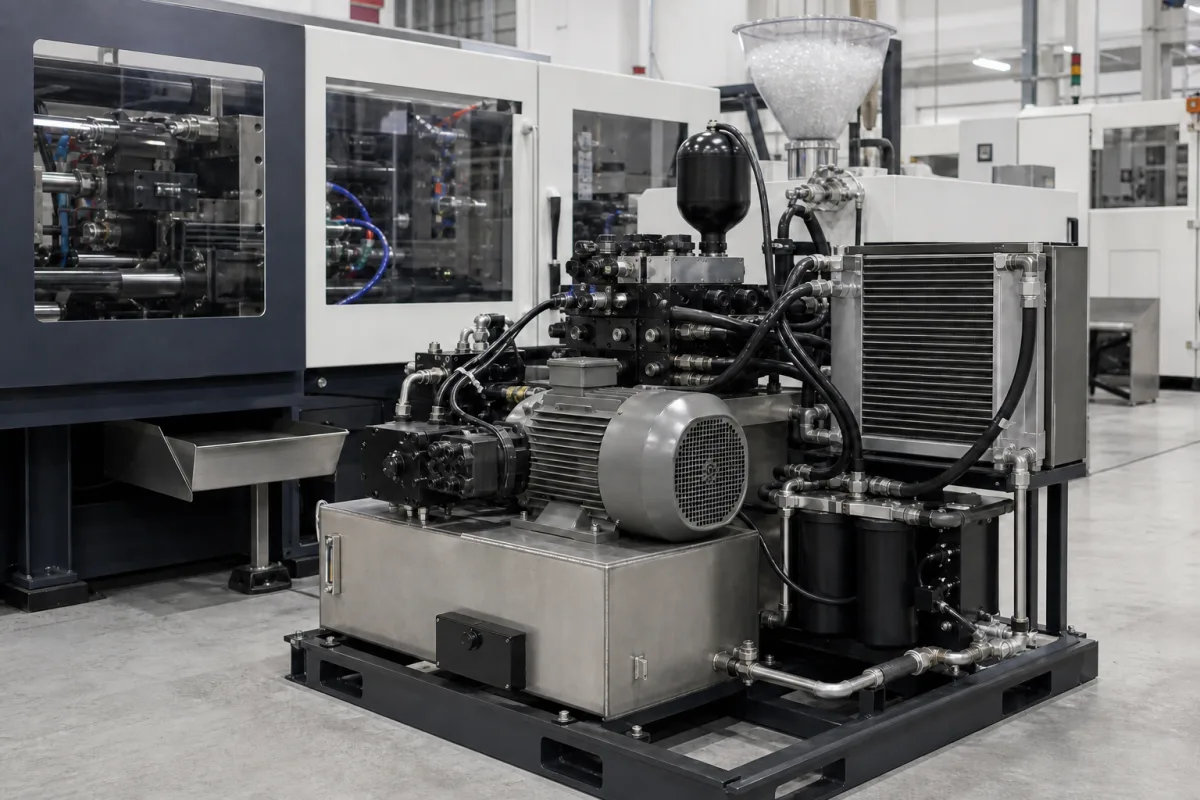
Hydraulic power system of an injection moulding machine: the shared pump unit, accumulator and manifolds that supply clamp, injection, screw drive and ejectors
The shared pump, motor, accumulator, manifolds and oil circuit that feed the clamp, injection, screw drive and ejectors of a hydraulic moulding machine · pump drive, accumulator charging limits, and heat and noise at the unit
On a hydraulic injection moulding machine the clamp cylinder, injection cylinder, hydraulic screw motor, ejectors and core pulls all draw from one hydraulic power system: an electric motor and pump on an oil reservoir, manifolds carrying the control valves for each circuit, in some designs a gas-charged accumulator, filters and an oil cooler. The unit has to answer demands that change from one phase of the cycle to the next, from high flow at low pressure while the mould closes to high pressure at almost no flow during hold, and it has to do so quickly enough that injection speed and pressure stay on their set values. Specifying it means choosing the pump drive, deciding whether an accumulator is needed and how it is charged, and sizing cooling and noise control for what the unit loses. The picture shows a unit of this kind beside a moulding machine: a motor and pump on a stainless reservoir, a valve block with a black bladder accumulator above it, an air-oil cooler, twin filter housings and hoses running to the machine.
Hydraulic power systems (power units) built into hydraulic and hybrid injection moulding machines, including machines for LED optics: the shared pump and motor set, the manifolds feeding clamp, injection, screw-drive and ejector circuits, gas-charged accumulators, reservoir, filtration and oil cooling. The injection axis alone, with its switchover and holding-pressure control and the energy measurements of injection drives, is covered on the Injection drive and control system page; complete machines with clamp-force and injection-unit sizing on the Injection moulding machine page; LED lens moulding machines on the LED lens injection moulding machine page; barrels and screws on the Injection unit barrel and screw page; general-purpose power packs on the Hydraulic power unit page; pumps as stand-alone components on the Hydraulic pump page.
CNFX editorial research · Sources checked October 13, 2026 · 3 sources
One pump set for every circuit: fixed pump at 100 %, swash-plate variable pump at 70 %, servo pump at 30 % of the energy
Voith compares three ways of driving the pump of a plastics injection moulding machine over the same machine cycle and gives each an energy figure relative to the fixed pump.
In Milacron's patent the pump feeds two manifolds, one carrying the injection-unit controls and one the clamp-unit controls; the injection side also drives a hydraulic extruder motor that turns the screw. [1] The patent reviews the older choices: a fixed pump on a fixed-speed motor must deliver flow for peak demand all the time, with the surplus pumped over relief valves; a fixed pump on a variable-frequency AC motor saves energy but cannot accelerate or decelerate quickly, which degrades frequency response and can vary shot weight, injection velocity and injection pressure; its own VISTA machines used a fixed-speed motor with an axial-piston swash-plate variable pump under pressure or flow compensation. [1] The invention drives the pump with a variable-speed motor, preferably brushless DC, whose speed the controller changes phase by phase to match the expected hydraulic load. [1]
Voith's servo pumps control pressure or flow directly, so classic valve control can be partly or wholly omitted; its IPS internal gear pumps for variable-speed drives reach 345 bar peak pressure and 252 cm³ per revolution, the IPVS for constant-speed drives 420 bar. Voith states that servo pumps reduce energy consumption by up to 70 % and the hydraulic system's total cost of ownership by up to 35 %. [2]
Give the cycle phase by phase: flow and pressure for mould close, clamp build-up, injection, hold, screw recovery, mould open and ejection, and the idle time between cycles.
02
The accumulator after the pump: filling the gap when valves open faster than the motor can follow
Milacron connects the pump output to a gas-charged accumulator through a check valve to improve transient response; HYDAC's bladder accumulator catalogue sets the charging limits such an accumulator must respect.
The accumulator's ballast is charged to an initial pressure; when line pressure exceeds it, oil flows in and compresses the ballast, and when line pressure falls below it, oil flows out. If the pump and motor lag behind the flow demanded by valves opening in the injection or clamp circuit, the accumulator makes up the difference, giving faster and more precise matching of delivery to demand. [1]
HYDAC bladder accumulators store energy by compressing nitrogen in a bladder; they must be charged only with nitrogen of at least Class 4.0 (filtration < 3 µm), never other gases. The pre-charge pressure is limited to p0 ≤ 0.9 × p1 with a permitted ratio p2 : p0 ≤ 4 : 1, where p1 is the lower and p2 the maximum operating pressure; these are maximum values, not for permanent load. The standard design is rated for −10 to +80 °C, and with a high p2/p0 ratio and rapid discharge the gas can cool below its permitted temperature and crack the bladder. [3]
Editorial calculation: with example values of 175 bar maximum and 100 bar minimum working pressure, the 4:1 limit needs a pre-charge of at least 43.75 bar (175 ÷ 4) and the 0.9 rule allows at most 90 bar. Taking 90 bar on an example 50 L accumulator and treating the gas as isothermal (an editorial simplification), the oil delivered between 175 and 100 bar is about 19.3 L (50 × 90 × (1/100 − 1/175)). [3]
State the injection flow and how long it must be held, the pressure band the accumulator works in, the bladder material for your oil and temperature, and how pre-charge will be checked.
03
Losses as heat and noise at the unit: 90 % pump efficiency, 45 dB(A), and less oil heating with demand-matched flow
Whatever the pump set does not turn into useful hydraulic work heats the oil, which the cooler then has to remove.
Milacron gives reduced hydraulic fluid heating, alongside lower energy use, as the reason for delivering only the flow needed to meet load conditions. [1] Voith gives an overall efficiency of over 90 % for its internal gear pumps, with overall efficiency that Voith says is “often 5 to 10% better than comparable pumps”, and noise emissions of 45 dB(A). [2]
Editorial calculation: a pump delivering an example 30 kW of hydraulic power at 90 % overall efficiency draws about 33.3 kW and loses about 3.3 kW as heat (30 ÷ 0.9 − 30), before valve, line and actuator losses are added; the oil cooler and reservoir have to carry that heat at the oil temperature the seals and the accumulator bladder allow (−10 to +80 °C for HYDAC's standard accumulator). [2][3]
State the cooling medium available (water temperature and flow, or air), the oil temperature limit, and the noise limit at the operator position.
04
Data for an injection moulding machine hydraulic power system enquiry
Paste it into your enquiry below or into an email to a maker, then replace every bracket.
Machine: [clamp tonnage; clamp stroke; hydraulic or hybrid]
Circuits served: [clamp; injection; screw motor; ejectors; cores]
Cycle: [flow and pressure per phase; idle time]
Pump drive: [fixed; variable displacement; servo pump]
Accumulator: [volume; p0; p1; p2; bladder material]
Motor and supply: [kW; voltage]
Reservoir and cooling: [L; water or air cooler; oil temperature]
Noise and energy targets: [dB(A); kWh per cycle]
Explore company information and manufacturing capabilities, then discuss the scope of your project with a relevant supplier.
Share this page
Compiled and source-reviewed by the CNFX editorial team.
Each manufacturer above links to the page on that company's own website where the product is listed, with the date we checked it. How we source and review
· Page last updated 13 October 2026
Buyer questions
How much energy does a servo pump save on an injection moulding machine?
Voith gives 30 % of a fixed-displacement pump's energy for its servo pump drive and 70 % for a variable-displacement pump at constant speed, over an injection moulding cycle. [2]
Why is there an accumulator on the hydraulic unit?
In Milacron's design it is connected after the pump through a check valve and supplies oil when valves open faster than the pump and motor can follow, improving transient response. [1]
How is a bladder accumulator pre-charged?
HYDAC requires nitrogen of at least Class 4.0, a pre-charge p0 no higher than 0.9 × the minimum operating pressure, and a ratio of maximum operating pressure to pre-charge no higher than 4:1. [3]
What pressures do servo-driven internal gear pumps reach?
Voith's IPS internal gear pumps for variable-speed drives reach 345 bar peak pressure and 252 cm³ per revolution. [2]
Sources and what still needs a direct check
Sources checked 2026-10-13. Three documents from three publishers: Cincinnati Milacron's European patent EP 0 464 286 B1 on an injection moulding machine with electro-hydraulic control, Voith's internal gear and servo pump page with its injection moulding drive comparison, and HYDAC's standard bladder accumulator catalogue section.