Editorial Technical Reference

Clamping Fixture

This page explains how Clamping Fixture is classified within Fabricated Metal Product Manufacturing. Technical values and manufacturer relationships are research references; confirm the current specification and supplier evidence for each order.

Technical Definition & Core Assembly

A mechanical device used to securely hold and position workpieces during welding operations.

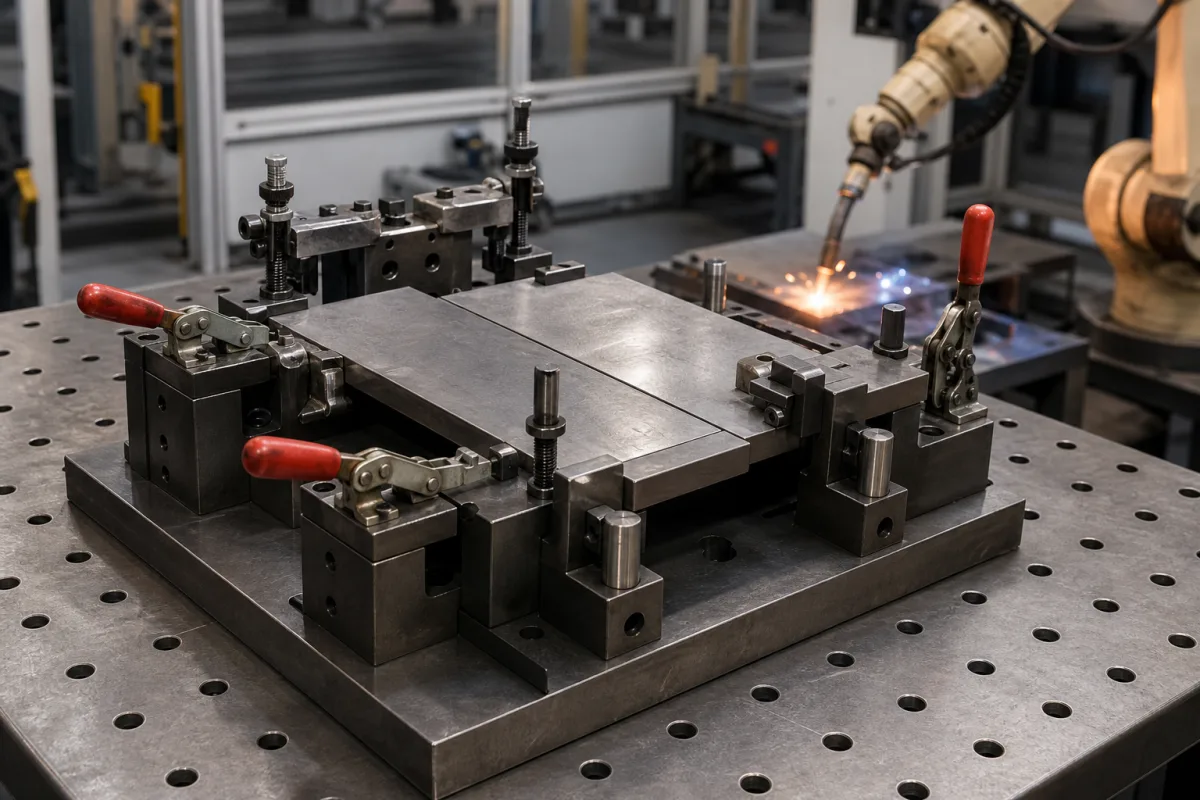
Representative product image. Confirm appearance and specifications with the manufacturer.

Product Specifications

Technical details and manufacturing context for Clamping Fixture

Definition
A clamping fixture is an essential component of a welding station designed to firmly secure metal workpieces in precise positions during welding processes. It ensures proper alignment, prevents movement due to thermal expansion or welding forces, and maintains consistent positioning for repeatable weld quality. These fixtures typically incorporate adjustable clamps, locators, and supports to accommodate various workpiece geometries and welding requirements. The fixture applies mechanical force through screw mechanisms, pneumatic cylinders, or hydraulic systems to hold workpieces against reference surfaces, resisting thermal distortion and vibration. Key parameters include clamping force (5–50 kN), jaw opening (50–300 mm), clamping stroke (10–50 mm), operating pressure (1.0–1.6 MPa), positioning accuracy (±0.05 mm), maximum operating temperature (200 °C), ingress protection (IP54–IP65 per IEC 60529), body material (Q235–Q345 per GB/T 700), and weight (15–60 kg). Materials on file are carbon steel and alloy steel. These values are directory reference ranges; verify model-specific values with the legal manufacturer or supplier. The fixture is used in fabricated metal product manufacturing, particularly for welding operations. Selection inputs include workpiece size, weight, required clamping force, and environmental conditions. Interfaces include mounting points for clamps and locators, and connections for pneumatic or hydraulic systems. Maintenance signals include reduced clamping force, visible wear on contact surfaces, or leaks in pneumatic/hydraulic lines. Failure boundaries include exceeding maximum operating temperature or pressure, which can cause deformation or loss of holding force. Always confirm standards and specifications with the supplier.
Working Principle
The clamping fixture operates by applying mechanical force through screw mechanisms, pneumatic cylinders, or hydraulic systems to hold workpieces against reference surfaces. It maintains positional stability during the welding process by resisting thermal distortion and vibration, ensuring accurate joint alignment and consistent weld bead placement. The fixture's design allows adjustment of clamping force and stroke to accommodate different workpiece sizes and weights. Proper operation requires setting the clamping force within the specified range (5–50 kN) and ensuring the operating pressure is within 1.0–1.6 MPa. The fixture's positioning accuracy of ±0.05 mm ensures repeatable weld quality. Regular inspection of wear and seal integrity is necessary to maintain performance.
Common Materials
Carbon Steel, Alloy Steel
Technical Parameters
ParameterTypical rangeNotes & selection driver
Clamping Force5–50 kNHigher force for heavy workpieces
Jaw Opening50–300 mmMax workpiece width
Clamping Stroke10–50 mmAdjustable for workpiece size
Positioning Accuracy±0.05 mmEnsures weld repeatability
Maximum Operating Temperature200 °CFor welding heat exposure
Ingress ProtectionIP54–IP65Dust and splash resistanceIEC 60529
Body MaterialQ235–Q345Carbon steel for strengthGB/T 700
Weight15–60 kgDepends on size and capacity

Ranges are indicative industry figures for RFQ preparation, not a supplier commitment. Confirm every value and standard with the legal manufacturer before ordering.

Components / BOM
  • Base Plate Part
    Provides structural foundation and mounting surface for all fixture components
    Material: Steel
  • Clamping Arm
    Applies holding force to secure the workpiece in position
    Material: Alloy Steel
  • Locating Pin Part
    Ensures precise positioning and repeatable placement of workpieces
    Material: Hardened Steel
  • Clamping Mechanism
    Generates and transmits clamping force through mechanical, pneumatic, or hydraulic means
    Material: Steel

Applied To / Applications

This component is essential for the following industrial systems and equipment:

Industrial Ecosystem & Supply Chain Structure

Complementary Systems
Downstream Applications
Specialized Tooling

Application Fit & Sizing Matrix

Operational Limits
pressure: Max clamping force: 5-50 kN (depending on model), workpiece pressure resistance: up to 100 MPa
other spec: Workpiece size range: 50-1000 mm, repeatability: ±0.05 mm, vibration tolerance: up to 5 g
temperature: -20°C to 200°C (operational), up to 500°C (short-term welding exposure)
Media Compatibility
✓ Carbon steel workpieces ✓ Stainless steel workpieces ✓ Aluminum alloy workpieces
Unsuitable: High-corrosion environments (e.g., salt spray, chemical baths) without protective coatings
Sizing Data Required
  • Workpiece dimensions and geometry
  • Required clamping force (based on welding process)
  • Welding process type and heat input

Reliability & Engineering Risk Analysis

Failure Mode & Root Cause
Wear-induced slippage
Cause: Abrasive wear on clamping surfaces due to repeated contact with workpieces, leading to reduced friction and loss of clamping force
Fatigue fracture
Cause: Cyclic loading from repeated clamping/unclamping operations causing stress concentration at design features like threads or sharp corners, ultimately leading to crack propagation
Maintenance Indicators
  • Visible scoring or galling on clamping surfaces indicating excessive wear
  • Audible clicking or popping sounds during operation suggesting component looseness or impending fracture
Engineering Tips
  • Implement regular surface inspection and reconditioning of clamping faces to maintain optimal surface finish and friction characteristics
  • Apply controlled torque during assembly and periodic retorquing of fasteners to prevent stress relaxation while avoiding over-tightening that accelerates fatigue

Indicative industry ranges for design and RFQ preparation. Confirm the exact figures and applicable standard with the manufacturer before specifying.

Compliance & Manufacturing Standards

Applicable Standards
ISO 2768-1: General tolerances for linear and angular dimensions ANSI B5.50: Machine Tools - Workholding Fixtures DIN 6325: Clamping Elements for Machine Tools

Quoted from the published standard.

Manufacturing Precision
  • Bore diameter: +/-0.01mm
  • Parallelism of clamping surfaces: 0.05mm
Quality Inspection
  • Dimensional verification with CMM (Coordinate Measuring Machine)
  • Hardness testing (Rockwell C scale) for clamping components

Manufacturers of Clamping Fixture

1 company lists this product among what they make. Company figures are quoted from each company's own website; every card states where the relationship came from.

CPWS®-China Precision Workholding System Inc
Taiwan, CN
Listed on the company's own website · profile compiled by CNFX from public sources

Manufacturer listings support early research and capability understanding. They are not certification, ranking, or transaction guarantees.

Technical documentation
Request current drawings, revision history, and a signed specification sheet.
Manufacturing capability
Verify equipment lists, process limits, capacity, and representative production evidence.
Inspection readiness
Confirm test methods, calibrated equipment, sampling plans, and traceable reports.
Supplier transparency
Check the legal entity, factory address, ownership, certifications, and direct contacts.

CNFX does not score or rank suppliers. Buyers must verify all claims and documents with the legal manufacturer before ordering.

Supply Chain Compatible Machinery & Devices

Hydraulic Cylinder Piston Rod

A hydraulic cylinder piston rod is a precision-machined, load-bearing component that converts hydraulic pressure into linear mechanical force.

Explore Specs →
Industrial Tube Bending Machine

An industrial tube bending machine is a CNC-controlled device designed to precisely bend metal tubes and pipes to specific angles and radii.

Explore Specs →
Precision Linear Motion Guide Rail

Precision linear guide component for smooth, accurate motion in industrial machinery

Explore Specs →
Precision Aluminum Extrusion Profile

Precision aluminum extrusion profiles are semi-finished structural components produced by forcing heated aluminum alloy through a shaped die.

Explore Specs →

Frequently Asked Questions

What is a clamping fixture used for?

A clamping fixture is used to securely hold and position metal workpieces during welding operations, ensuring proper alignment and preventing movement due to thermal expansion or welding forces.

What are the typical clamping force ranges?

The directory lists clamping force ranges from 5 to 50 kN, depending on the workpiece weight and required stability. Higher force is recommended for heavy workpieces.

What materials are commonly used for clamping fixtures?

Common materials include carbon steel and alloy steel, with body material grades such as Q235–Q345 per GB/T 700. These provide strength and durability.

How do I verify the specifications of a specific clamping fixture?

Always check the model-specific values for parameters like clamping force, jaw opening, and operating pressure with the legal manufacturer or supplier. Standards like IEC 60529 are references, not certifications.

Data Basis

Editorial classification, named public sources where available, and source-reviewed manufacturer records.

Preliminary Technical Classification
This page supports structured research, RFQ preparation, and supplier evaluation. It does not replace buyer-led supplier qualification, standards review, or technical approval.
Buyer enquiry

Request manufacturing insight for Clamping Fixture

Ask for use case, specification boundaries, supplier type, and RFQ preparation information for this product.

Where it goes
Straight to the CNFX editorial desk, and to the manufacturer if this product is linked to a claimed profile. Nothing is broadcast to a supplier list.
Your details stay here
We do not sell or rent enquiry data, and we do not add you to a mailing list. Used only to answer this request.
No commission, no middleman
CNFX is a directory. We take no cut of any order and never negotiate on a supplier's behalf.
What we don't claim
A listing is not an endorsement. Qualify every supplier and verify every figure yourself before ordering.

Your business information is used only to process this request.

Thank you! Your message has been sent. We'll respond within 1–3 business days.
Sorry, we couldn't send your message. Please try again, or email us at contact@cnfx.com.

Need to Manufacture Clamping Fixture?

Compare manufacturer profiles with relevant product and process capability.

Previous Product
Anodizing Tank Module
Next Product
Corrosion-Resistant Aluminum Alloy Sheet
Get QuotesChat