Welding fume extraction · Why extraction is expected for all welding, capture hood placement, duct velocity, recirculation and testing
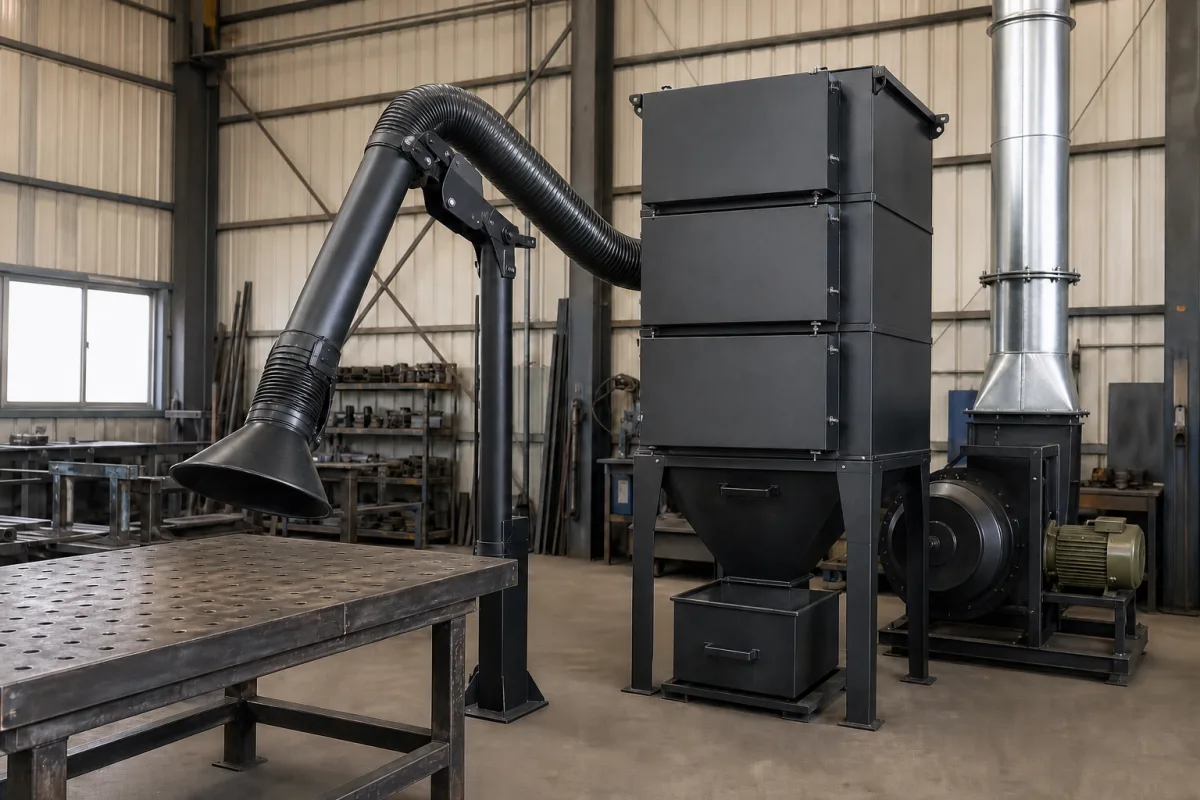
A welding fume extraction system captures fume at or near the arc with a hood on an adjustable arm, on-torch nozzle, booth or bench, carries it through ducting to a filter unit and fan, and discharges or returns the cleaned air; the installation pictured combines an extraction arm over a welding table with a cartridge filter unit and fan. Ask three things first: where the hood will sit relative to the arc during real work, what airflow and duct velocity the system holds at each hood, and how the filtered air is discharged or recirculated and the system tested.
Local exhaust ventilation for welding, cutting and similar hot-work fume: extraction arms and hoods, on-torch extraction, ducting, filter units and fans, mobile and centralised. General dust collectors for process dust, acid fume scrubbers and building ventilation are outside this page.
CNFX editorial research · Sources checked October 12, 2026 · 4 sources
HSE's 2019 safety alert reports new evidence from the International Agency for Research on Cancer that exposure to all welding fume, including mild steel welding fume, can cause lung cancer, with limited evidence for kidney cancer. Because general ventilation does not achieve the necessary control, HSE expects suitable engineering controls, for example local exhaust ventilation (LEV), for all welding indoors regardless of duration, supplemented by respiratory protective equipment where LEV alone is not adequate, and suitable RPE for welding outdoors. [1]
The alert adds that extraction also controls exposure to manganese in mild steel welding fume, which can cause neurological effects similar to Parkinson's disease, and that engineering controls must be correctly used, maintained and subject to thorough examination and test. HSE's welding guidance lists less-fume welding methods, LEV, RPE and PPE, maintained controls with good general ventilation, and training as the ways to control the risk, under the COSHH Regulations. [1][2]
Give the supplier the welding processes and materials, number of welding stations and how many run at once, the size of workpieces and how the welder moves along them, the layout and ceiling height, whether air may be recirculated, power supply, and the documents needed for commissioning and statutory testing.
02
Place the capture hood within its capture zone
HSE's LEV guide HSG258 explains that a capturing (captor) hood must generate enough airflow at the source to reach out and draw in the contaminated air, and that "for the great majority of sources requiring control, however, a capturing hood is much less effective than the designer intended" because the capture zone is too small, disrupted by draughts, or does not cover the working zone as the task moves. For linear work such as seam welding it advises keeping the working zone inside the capture zone with an adjustable hood or workstation. [3]
Its design principles for capturing hoods are to "locate as close to the source as possible, normally less than one hood diameter away"; to make the capture zone large enough to cover the working zone and mark it on the workstation or hood label; to flange the hood or give it a flared inlet; to avoid or suppress draughts; and to provide a visible display of adequate airflow, such as a manometer on the hood duct. [3]
Editorial calculation: for a 200 mm diameter hood on an extraction arm, that principle means keeping the arc within about 200 mm of the hood face, so the arm has to be repositioned as the welder moves along a long seam.
03
Size ducts, filtration and discharge
HSG258's Table 12 recommends a minimum duct velocity of about 10 m/s for condensing vapours, fume and smoke, against 5 m/s for gases and around 20 m/s for process dust, because particles settling in ducts reduce airflow and can block ducts. It asks for the supplier to state each hood's face velocity and static pressure, duct dimensions, transport velocity and volume flow, and the air cleaner and fan specifications. [3]
Editorial calculation: keeping 10 m/s in a 160 mm diameter duct needs at least π × 0.08² × 10 × 3,600 ≈ 724 m³/h; a branch serving a larger hood or more than one hood needs proportionally more.
HSG258 says recirculating extracted air saves energy but is acceptable only where the air is thoroughly cleaned; it is easier with particulate contaminants, low concentrations, small systems and lower-toxicity materials, and where filter failure could be dangerous the system should have monitoring and alarms, such as a pressure gauge for a blocked or failed filter. [3]
HSG258 requires LEV to have a user manual and logbook, with commissioning benchmarks such as pressure and velocity measurements recorded, and says employers must ensure thorough examination and testing of protective LEV at least every 14 months under COSHH, at shorter intervals where wear may degrade performance, with shorter legal intervals for some processes such as 6 months for grinding or polishing metal for more than 12 hours a week. [3]
04
Mobile extractors, welding-school systems, fume towers, cutting extraction and extraction tables on the linked sites
Listings include mobile welding fume extractors, fume extraction systems for welding schools, fume extraction towers, extraction for laser and plasma cutting, and welding tables with integrated extraction. Ask each supplier for the airflow and static pressure at each hood, the filter type and efficiency, the cleaning method, and whether the unit is meant to recirculate or discharge outside.
05
Check hood airflow against the US OSHA welding-zone table
Where US rules apply, OSHA's welding standard 29 CFR 1910.252(c) requires mechanical ventilation, for metals without a specific-material paragraph, in a space of less than 10,000 cubic feet (284 m³) per welder, a room with a ceiling under 16 feet (5 m), or confined or obstructed spaces, at a minimum of 2,000 cubic feet (57 m³) per minute per welder unless local exhaust hoods and booths or approved airline respirators are provided. A freely movable hood must hold 100 linear feet (30 m) per minute towards the hood in the welding zone with the hood at its farthest position from the arc; a fixed enclosure needs at least 100 feet per minute away from the welder. [4]
The table assumes a 3-inch (7.6 cm) wide flanged suction opening, with ducts sized to the nearest half inch at 4,000 feet per minute in the pipe. [4] Editorial calculation: 150 cfm is about 255 m³/h and 600 cfm about 1,019 m³/h (1 cfm = 1.699 m³/h), so moving the arc from 4–6 in to 10–12 in from the hood quadruples the airflow needed; 4,000 ft/min is about 20 m/s, twice the 10 m/s minimum HSG258 gives for fume. [3]
Welding zone from arc or torch
Minimum airflow (cfm)
Duct diameter (in)
4 to 6 in
150
3
6 to 8 in
275
3½
8 to 10 in
425
4½
10 to 12 in
600
5½
06
Hood or arm, airflow indicator, ducting, filter, fan and discharge
HSG258 asks for a visible display of adequate airflow, such as a manometer on the hood duct, so the indicator belongs in the order with the hood and arm rather than as an extra. [3]
Airflow per hood, static pressure, filter efficiency and class, noise, power and size for an extraction order
HSG258 gives the airflow, duct-velocity and filtration principles; noise, motor power, supply, temperature, IP rating, filter class, weight and dimensions have no published value here. [3]
Field
What it means and published values
Ask the supplier for
Airflow Capacity (m³/h)
Enough for each hood's capture zone and ≥10 m/s in ducts. [3]
3 companies list this product among what they make. Company figures are quoted from each
company's own website; every card states where the relationship came from.
Qingdao Power Space Environmental Protection Technology Co., Ltd.
Manufacturing site to be confirmed for the order
Lists mobile welding fume extractors, fume extraction systems for welding schools and fume extraction towers.
Explore company information and manufacturing capabilities, then discuss the scope of your project with a relevant supplier.
Share this page
Compiled and source-reviewed by the CNFX editorial team.
Each manufacturer above links to the page on that company's own website where the product is listed, with the date we checked it. How we source and review
· Page last updated 13 October 2026
Buyer questions
Does mild steel welding need fume extraction?
HSE's 2019 alert says all welding fume, including mild steel, can cause lung cancer and expects engineering controls such as LEV for all indoor welding. [1]
How close must the extraction hood be?
HSG258 says to "locate as close to the source as possible, normally less than one hood diameter away". [3]
How often must welding LEV be tested?
HSG258 says the maximum time between tests is set in COSHH and "for most systems this is 14 months". [3]
How much airflow does OSHA require at a movable welding hood?
US OSHA's 29 CFR 1910.252 table requires 150 cfm with the arc 4 to 6 inches from a 3-inch flanged opening, rising to 600 cfm at 10 to 12 inches, to hold 100 feet per minute in the welding zone. [4]
Sources and what still needs a direct check
Sources checked 2026-10-12. HSE is Great Britain's workplace health and safety regulator; its alert, welding guidance and HSG258 describe what it expects under COSHH. US OSHA's 29 CFR 1910.252(c) is cited for the US welding-zone airflow table.