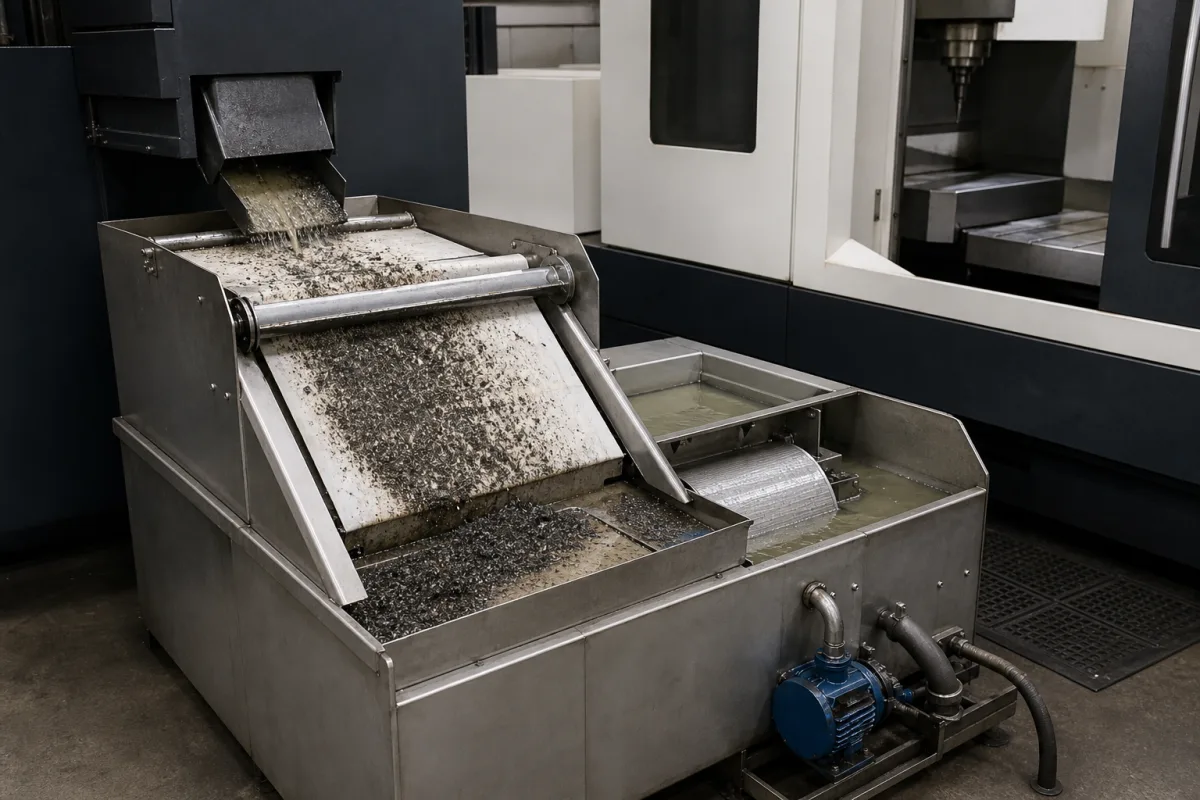
Self-cleaning drum filtration unit for machine-tool coolant (permanent metal mesh or wedge-wire drum)
Permanent-media drum filter for machine-tool coolant · mesh hole size against filtration precision, the cake that does the fine filtering, clog-triggered rotation and scraping, flow per drum
A drum filtration unit sits in or beside a machine tool's coolant tank and passes the dirty coolant through a cylindrical drum covered with a permanent metal cloth, perforated sheet or wedge-wire screen. The particles held back form a cake on the drum; when it clogs, the drum or a scraper turns, jets or blades clear the surface, and a dredge or conveyor carries the sludge out. Check three things first: which mesh opening the drum carries and the particle size that gives for your machining, how the unit detects clogging and cleans itself, and the flow it handles with your coolant, neat oil or water-mixed.
Self-cleaning drum filters with permanent media for machine-tool coolant: mesh and wedge-wire drums, gravity (depth-pressure) and vacuum drums, clog sensing, back-jets and scrapers, sludge dredges, and flow ratings per drum. Chip conveyors, including separator conveyors with a built-in drum, are covered on the Chip conveyor for CNC machine tools page; the complete machine-side tank, pump and filter set is covered on the Coolant system for CNC machine tools page. Paper-band filters and cyclone separators, which use disposable media or centrifugal separation, are outside this page.
CNFX editorial research · Sources checked October 12, 2026 · 5 sources
#60, #90 or #110 mesh: drum hole size against the particle size held back
Noritake's drum filter for cutting coolant rotates a drum-shaped filter mesh immersed in the dirty tank and is described as removing particles of about 60 µm. Its mesh chart separates the hole in the cloth from the precision achieved: #60 mesh with 250 µm holes filters up to 100 µm for general grinding; #90 with 160 µm holes gives 80–100 µm where processing precision is needed or multiple materials are machined; #110 with 135 µm holes reaches 60 µm for gun drills and gun reamers. [1]
Editorial calculation: on Noritake's chart the particle size held back is 40% of the hole size for #60 (100 ÷ 250) and about 44% for #110 (60 ÷ 135), so the rated precision is well below the hole size; ask which precision figure a supplier's mesh rating refers to. [1]
Henry Filters' patent for machine-tool coolant filters notes that the conventional element, a continuous wedge-shaped wire wrapped around a drum support, has elongated openings through which some elongated contaminants pass. It proposes instead a non-reticulated metal screen with minute openings in the range of 50 to 250 microns, preferably 120 microns, with a smooth surface for scrape cleaning. [4] Editorial note: if your chips are long and thin, ask whether the drum carries wedge wire, woven cloth or perforated sheet.
Give the supplier the machining process and material, the particle size the spindle, nozzles or gun drills will tolerate, the coolant type and viscosity, and the chip form, then ask for the mesh opening and the precision it gives in that coolant.
02
Let the cake build, then turn the drum: clog sensing, back-jets and scrapers
Losma describes its Spring drum filter as a fixed metal cloth that is not rotated while it filters: the deposited particles form the actual filter layer, up to 10–15 mm thick, and filtration improves as the layer builds. When the clean tank falls to its minimum level, a sensor starts the Autoclean cycle; the drum rotates, a countercurrent jet system washes the wire mesh, and a dredge scrapes the sludge from the tank bottom and carries it out. [2]
Losma offers the dredge in a magnetic version for ferromagnetic residue and a rotating magnetic disc ahead of the drum as pre-filtration, and states that the permanent cloth uses no consumable materials. [2]
Noritake's unit settles coolant in the dirty tank first; the coolant then passes through the rotating drum under the difference in liquid depth between dirty and clean tanks, and a conveyor belt in the dirty tank discharges the sediment at intervals. [1]
A Barnes Drill patent shows a vacuum version: the wedge-wire drum is held stationary in the dirty tank while a pump draws coolant through it; when the vacuum in the suction line builds up as the cake thickens, a sensor opens a valve so the pump feeds the machine from the clean tank, relieving the vacuum, and a scraper indexes around the drum to shave the cake in short arcs. [5]
03
Flow per drum: 300 to 1,000 L/min on one drum, up to 5,000 l/min per filter
Noritake rates each model on water-soluble coolant through #90 mesh and notes that the rate differs with #60 or #110 mesh; Losma gives separate ranges for neat oil and emulsion.
Editorial calculation: Losma's Spring range carries twice the emulsion flow of neat oil at both ends (50 against 25 l/min, 2,000 against 1,000 l/min), so state the coolant type when asking for a model. Noritake's 1,000 L/min is reached on a Ø300 mm drum in a 2,250 mm long unit and on a Ø400 mm drum in a 2,100 mm unit. [2][1]
Losma builds the Spring Compact with its clean tank welded to the filter as one block, processing only the coolant the machine needs and sized to the customer's requirement; Noritake asks buyers needing 1,000 L/min or more to contact sales. [3][1]
Send the coolant, machining and flow data together
Paste it into your enquiry below or into an email to a maker, then replace every bracket.
Machines: [type and number served; spindle or tool pressure]
Coolant: [neat oil or water-mixed; concentration; viscosity; temperature]
Flow: [L/min required; peak demand]
Contamination: [material machined; chip form; particle size to remove]
Drum: [mesh, perforated sheet or wedge wire; opening; gravity or vacuum]
Sludge: [dredge or conveyor; magnetic pre-separation; compactor]
Space: [footprint and height; tank volume]
Explore company information and manufacturing capabilities, then discuss the scope of your project with a relevant supplier.
Share this page
Compiled and source-reviewed by the CNFX editorial team.
Each manufacturer above links to the page on that company's own website where the product is listed, with the date we checked it. How we source and review
· Page last updated 13 October 2026
Buyer questions
Why does a drum filter hold back particles smaller than its mesh holes?
The deposited particles form a cake on the cloth that acts as the filter layer; Losma describes this layer as up to 10–15 mm thick, and Noritake's #110 mesh with 135 µm holes is rated to 60 µm. [2][1]
When does a self-cleaning drum filter clean itself?
In Losma's Spring, when the clean tank reaches its minimum level a sensor starts the drum rotating while back-jets wash the mesh; in Barnes Drill's vacuum design, a vacuum sensor triggers the scraper. [2][5]
Which mesh suits gun drilling?
Noritake assigns its #110 mesh, with 135 µm holes and filtration to 60 µm, to gun drills and gun reamers. [1]
Do wedge-wire drums let long chips through?
Henry Filters' patent states that the elongated openings of a wedge-wire drum let some elongated contaminants pass, and proposes a screen with 50–250 µm round openings. [4]
Sources and what still needs a direct check
Sources checked 2026-10-12. Noritake and Losma figures come from their own product pages; the two patents describe drum designs and screen openings rather than tested products.