Editorial Technical Reference

Powder Recovery System

This page explains how Powder Recovery System is classified within Fabricated Metal Product Manufacturing. Technical values and manufacturer relationships are research references; confirm the current specification and supplier evidence for each order.

Technical Definition & Core Assembly

A system that collects and recycles overspray powder from electrostatic powder coating booths to minimize waste and reduce material costs.
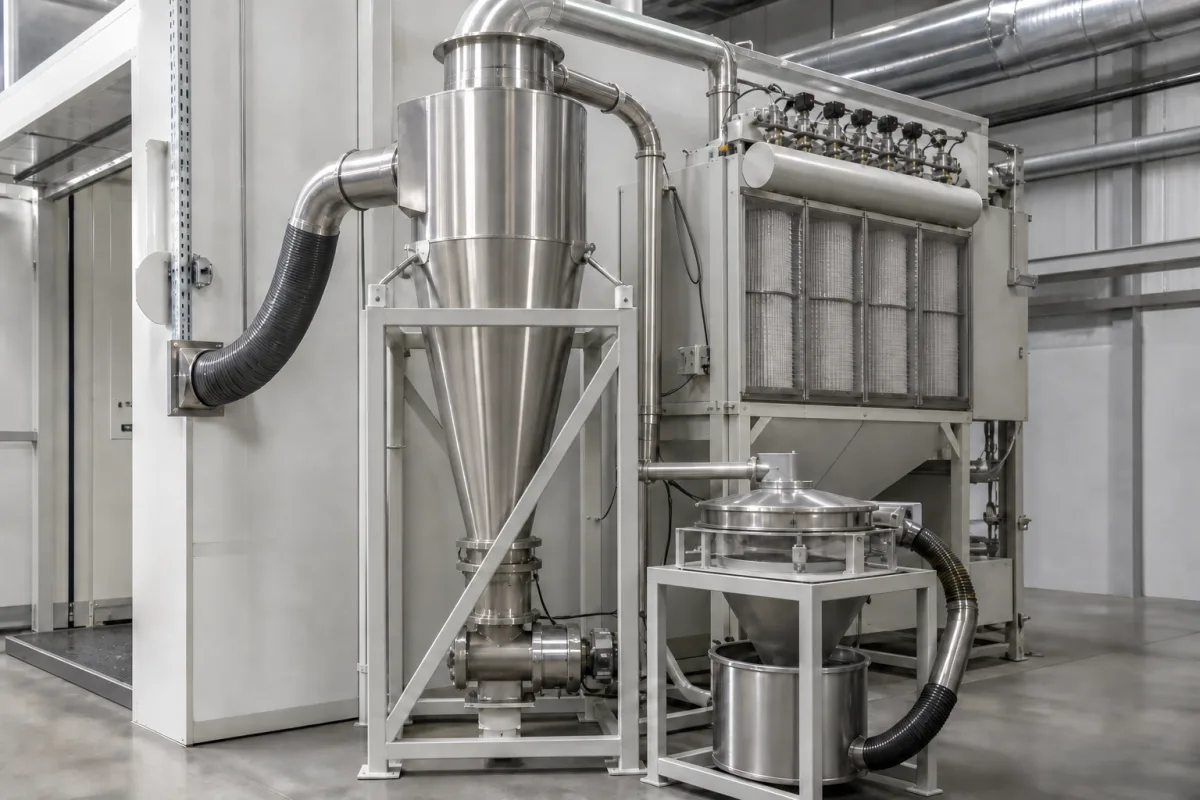
Representative product image. Confirm appearance and specifications with the manufacturer.

Product Specifications

Technical details and manufacturing context for Powder Recovery System

Definition
The Powder Recovery System is an integral component of an Electrostatic Powder Booth designed to capture overspray powder that does not adhere to the workpiece during the coating process. It efficiently collects the powder from the booth's air stream, separates it from the air, and typically returns it to the powder feed system for reuse, ensuring high material utilization and operational efficiency. The system is used in fabricated metal product manufacturing, where it helps reduce powder waste and material costs. It is available in configurations using galvanized steel or stainless steel (grades 304/316L) for corrosion resistance, and incorporates filter media such as polyester cartridge filters. Key parameters include a recovery efficiency of 95–98%, air flow rate of 3000–12000 m³/h, filter area of 30–150 m², filtration efficiency of 99.9% (ISO 16890), operating pressure of 0.5–0.8 MPa, power consumption of 5.5–22 kW, noise level of 70–85 dB(A) (ISO 3744), operating temperature of 0–40 °C, relative humidity ≤85%, ingress protection IP54–IP65 (IEC 60529), and weight of 500–2000 kg. These values are reference ranges and must be confirmed for the specific model and application. The system operates by drawing overspray powder into the exhaust fan, passing it through cyclones or cartridge filters to separate powder from air, and then conveying the collected powder back to the feed system. It is essential to verify model-specific values and standards with the legal manufacturer or supplier before procurement.
Working Principle
Overspray powder is drawn into the system via an exhaust fan. The powder-laden air passes through cyclones or cartridge filters where the powder particles are separated from the air stream by centrifugal force or filtration. The cleaned air is either recirculated into the booth or exhausted, while the collected powder is conveyed (often via a screw conveyor or vacuum system) to a sieve or fluidizing hopper for recycling back into the application process.
Common Materials
Galvanized steel, Stainless steel, Filter media (e.g., polyester cartridge filters)
Technical Parameters
ParameterTypical rangeNotes & selection driver
Recovery Efficiency95–98 %Higher efficiency reduces powder waste and cost.
Air Flow Rate3000–12000 m³/hMust match booth size and powder load.
Filter Area30–150 Larger area reduces pressure drop and extends filter life.
Filtration Efficiency99.9 %For fine powder particles, HEPA grade.ISO 16890
Operating Pressure0.5–0.8 MPaFor compressed air pulse cleaning.
Power Consumption5.5–22 kWDepends on fan size and motor rating.
Noise Level70–85 dB(A)Lower noise improves working environment.ISO 3744
Operating Temperature0–40 °COutside range may affect filter media.
Relative Humidity≤85 %High humidity can cause powder agglomeration.
Ingress ProtectionIP54–IP65Higher IP for dusty environments.IEC 60529
Material304/316LStainless steel for corrosion resistance.ASTM A240
Weight500–2000 kgAffects installation and floor loading.

Ranges are indicative industry figures for RFQ preparation, not a supplier commitment. Confirm every value and standard with the legal manufacturer before ordering.

Components / BOM
  • Cyclone Separator
    Uses centrifugal force to separate heavier powder particles from the air stream as a primary collection stage.
    Material: Galvanized steel
  • Cartridge Filter Bank
    Secondary filtration stage that captures fine powder particles; cleaned by pulse-jet technology.
    Material: Polyester filter media, steel housing
  • Exhaust Fan
    Creates negative pressure to draw powder-laden air from the booth into the recovery system.
    Material: Steel, aluminum
  • Screw Conveyor
    Transports collected powder from the filter hoppers to the recycling hopper or sieve.
    Material: Stainless steel

Applied To / Applications

This component is essential for the following industrial systems and equipment:

Industrial Ecosystem & Supply Chain Structure

Complementary Systems
Downstream Applications
Specialized Tooling

Application Fit & Sizing Matrix

Operational Limits
pressure: Up to 0.5 bar (7.25 psi) - maximum system pressure for pneumatic conveying
flow rate: 10-100 m³/h (353-3531 CFM) - typical booth exhaust air volume
temperature: Ambient to 50°C (122°F) - typical operating range for powder handling
slurry concentration: Not applicable - system handles dry powder, not slurry
Media Compatibility
✓ Thermoset epoxy powders ✓ Polyester/TGIC hybrid powders ✓ Polyurethane powders
Unsuitable: Wet paint or solvent-based coating environments
Sizing Data Required
  • Booth exhaust air volume (m³/h or CFM)
  • Powder application rate (kg/h or lb/h)
  • Desired recovery efficiency percentage

Reliability & Engineering Risk Analysis

Failure Mode & Root Cause
Filter media blinding
Cause: Fine powder accumulation and compaction on filter surfaces, often due to improper pulse-jet cleaning cycles, moisture ingress causing material agglomeration, or operating beyond design particulate loading capacity.
Fan impeller imbalance and wear
Cause: Abrasive particulate buildup on fan blades creating imbalance, combined with erosive wear from high-velocity powder streams, typically exacerbated by inadequate inlet filtration or irregular cleaning schedules.
Maintenance Indicators
  • Sustained increase in system differential pressure beyond normal operating range (typically 10-15% above baseline)
  • Unusual high-frequency vibration or rhythmic knocking sounds from fan/motor assembly during operation
Engineering Tips
  • Implement condition-based pulse-jet cleaning optimization using differential pressure trending rather than fixed time intervals, adjusting cleaning frequency based on actual filter loading to prevent both blinding and excessive wear
  • Install sacrificial wear plates in high-velocity duct elbows and utilize non-contact vibration monitoring on critical rotating components with automated alerts for early imbalance detection

Indicative industry ranges for design and RFQ preparation. Confirm the exact figures and applicable standard with the manufacturer before specifying.

Compliance & Manufacturing Standards

Applicable Standards
ISO 14644-1:2015 Cleanrooms and associated controlled environments ANSI/ASME B31.3 Process Piping DIN EN 1090-1 Execution of steel structures and aluminium structures

Quoted from the published standard.

Manufacturing Precision
  • Filter housing weld seam alignment: +/- 1.5mm
  • Fan impeller balance tolerance: G6.3 per ISO 1940-1
Quality Inspection
  • Pressure decay leak test on collection hopper
  • Particle count efficiency test per ISO 16890

Manufacturers of Powder Recovery System

Manufacturer profiles associated with Powder Recovery System.

Sourcing Powder Recovery System from China?
Tell us your specification and target quantity — we will match it against manufacturer records and come back with the factories that fit.
Request manufacturers We manufacture this

Manufacturer listings support early research and capability understanding. They are not certification, ranking, or transaction guarantees.

Technical documentation
Request current drawings, revision history, and a signed specification sheet.
Manufacturing capability
Verify equipment lists, process limits, capacity, and representative production evidence.
Inspection readiness
Confirm test methods, calibrated equipment, sampling plans, and traceable reports.
Supplier transparency
Check the legal entity, factory address, ownership, certifications, and direct contacts.

CNFX does not score or rank suppliers. Buyers must verify all claims and documents with the legal manufacturer before ordering.

Supply Chain Compatible Machinery & Devices

Metal Plate Rolling Machine

A metal plate rolling machine is a standalone industrial device used in fabricated metal product manufacturing to form flat metal plates into curved sections, cylinders, or cones.

Explore Specs →
Hydraulic Cylinder Piston Rod

A hydraulic cylinder piston rod is a precision-machined, load-bearing component that converts hydraulic pressure into linear mechanical force.

Explore Specs →
Industrial Tube Bending Machine

An industrial tube bending machine is a CNC-controlled device designed to precisely bend metal tubes and pipes to specific angles and radii.

Explore Specs →
Precision Linear Motion Guide Rail

Precision linear guide component for smooth, accurate motion in industrial machinery

Explore Specs →

Frequently Asked Questions

What is the primary function of a powder recovery system?

The primary function is to capture overspray powder that does not adhere to the workpiece during electrostatic powder coating, separate it from the air stream, and return it to the powder feed system for reuse, thereby minimizing waste and reducing material costs.

How does the system separate powder from air?

The system uses cyclones or cartridge filters. Cyclones use centrifugal force to separate larger particles, while cartridge filters (e.g., polyester) capture finer particles. The cleaned air is then recirculated or exhausted.

What materials are commonly used in construction?

Common materials include galvanized steel and stainless steel (grades 304/316L) for corrosion resistance, along with filter media such as polyester cartridge filters. The choice depends on the application and environmental requirements.

What parameters should be verified before purchasing?

Key parameters include recovery efficiency (95–98%), air flow rate (3000–12000 m³/h), filter area (30–150 m²), filtration efficiency (99.9% per ISO 16890), operating pressure (0.5–0.8 MPa), power consumption (5.5–22 kW), noise level (70–85 dB(A) per ISO 3744), operating temperature (0–40 °C), relative humidity (≤85%), ingress protection (IP54–IP65 per IEC 60529), and weight (500–2000 kg). Always confirm these with the manufacturer for your specific model.

Data Basis

Editorial classification, named public sources where available, and source-reviewed manufacturer records.

Preliminary Technical Classification
This page supports structured research, RFQ preparation, and supplier evaluation. It does not replace buyer-led supplier qualification, standards review, or technical approval.
Buyer enquiry

Request manufacturing insight for Powder Recovery System

Ask for use case, specification boundaries, supplier type, and RFQ preparation information for this product.

Where it goes
Straight to the CNFX editorial desk, and to the manufacturer if this product is linked to a claimed profile. Nothing is broadcast to a supplier list.
Your details stay here
We do not sell or rent enquiry data, and we do not add you to a mailing list. Used only to answer this request.
No commission, no middleman
CNFX is a directory. We take no cut of any order and never negotiate on a supplier's behalf.
What we don't claim
A listing is not an endorsement. Qualify every supplier and verify every figure yourself before ordering.

Your business information is used only to process this request.

Thank you! Your message has been sent. We'll respond within 1–3 business days.
Sorry, we couldn't send your message. Please try again, or email us at contact@cnfx.com.

Need to Manufacture Powder Recovery System?

Compare manufacturer profiles with relevant product and process capability.

Previous Product
Welding Positioner
Last Product
Get QuotesChat