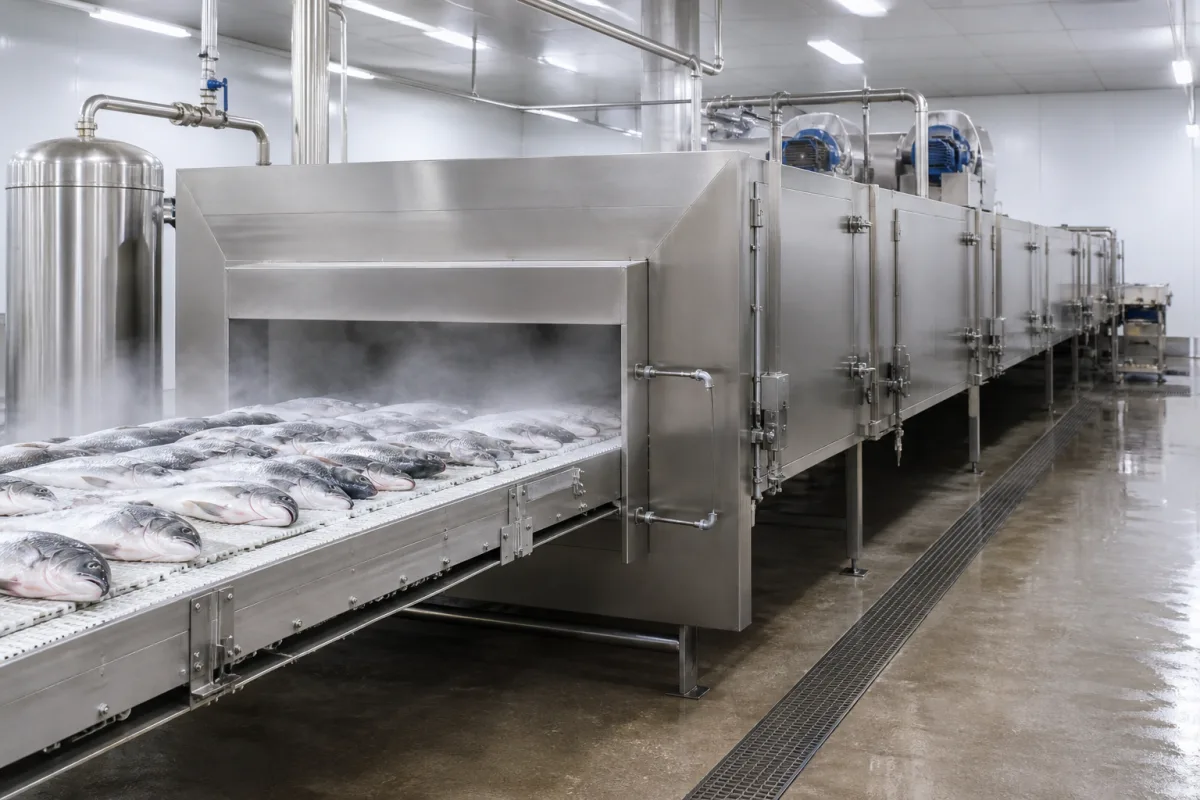
Cryogenic (liquid nitrogen or CO2) tunnel freezers for fish, shrimp and other seafood · capacity in kg/h, belt width and tunnel length, operating temperature, retention time, cryogen use per kg of product, oxygen-deficiency safety, hygienic design, comparison with mechanical air-blast tunnels
A cryogenic tunnel freezer carries fish, fillets, shrimp or other seafood on a stainless steel conveyor through an insulated tunnel where liquid nitrogen or carbon dioxide is sprayed and the cold gas is blown against the product, freezing it in minutes without compressors. Ask three things first: the capacity in kg/h for your product and the belt width and tunnel length that deliver it; how much cryogen it uses per kg of product and how supply will be stored; and how the plant will vent the gas and monitor oxygen.
Continuous liquid nitrogen and carbon dioxide tunnel freezers (straight-belt, IQF and multi-purpose tunnels) for fish, crustaceans and molluscs, including insulated freezing tunnels used for cryogenic freezing. Mechanical (ammonia or freon) air-blast tunnels, spiral freezers, plate freezers, brine freezers, cryogen storage tanks and cold stores are outside this page except where compared.
CNFX editorial research · Sources checked October 11, 2026 · 5 sources
FAO's Fisheries Technical Paper 340 describes the liquid nitrogen freezer: fish on a stainless steel conveyor first meet a counter-current flow of nitrogen gas at about −50 °C, which extracts up to 50 percent of the product heat, then pass under the liquid spray where freezing is completed, and a last stage gives a few minutes for temperature to equalise. It lists operating temperatures of −50 to −196 °C for liquid nitrogen and −50 to −70 °C for liquid carbon dioxide, and quotes freezing times of 5 minutes for shrimp meat and 12 minutes for a 500 g whole lobster in a liquid nitrogen spray. [1]
Air Products' Freshline MP cryogenic tunnel is built from 3 m modules in belt lengths of 6 to 15 m and belt widths of 720 or 1,220 mm; its table gives freezing capacities of 550–1,400 kg/h on the 720 mm belt and 900–2,300 kg/h on the 1,220 mm belt, electrical requirements of 9–29 kW and weights of about 4,000–11,000 kg, and notes that capacity depends on product and operating conditions. Linde's CRYOLINE MT tunnel runs on liquid nitrogen or carbon dioxide with usable belt widths of 0.6, 1.0 and 1.25 m, freezing belt lengths of 4.0 to 13.0 m, retention times from 0.5 to 65 minutes by model, a maximum product height of 100 mm, and up to 30 stored recipes. [2][3]
Cryogen use per kg depends on the freezing profile. In a patent test on golden pomfret of about 500 g in a cabinet liquid nitrogen freezer, freezing to a −18 °C core at a single −95 °C stage used 3.38 kg of liquid nitrogen per kg of fish, while two-stage profiles (−95 °C until a −5 °C core, then a warmer second stage) used 1.66–2.87 kg per kg. FAO adds that liquid nitrogen storage loses about 0.5 percent of contents a day and about 10 percent in tanker transfer, and that liquid nitrogen freezing can cost up to four times as much as conventional air blast freezing. [4][1]
Editorial calculation: on the Freshline MP 1,220 mm belt, 900 kg/h over 6 m and 2,300 kg/h over 15 m are both about 150 kg/h per metre of belt; on Linde's 13.0 m belt, retention times of 2.0 to 65 minutes correspond to belt speeds of about 13.0 ÷ 65 = 0.2 to 13.0 ÷ 2.0 = 6.5 m/min; and a 1,000 kg/h line at 1.66–3.38 kg/kg would draw about 1,660–3,380 kg of liquid nitrogen an hour. [2][3][4]
Give the supplier the species and product form (whole fish, fillets, shrimp, molluscs), piece size and thickness, infeed temperature, target core and average temperature, required kg/h and operating hours per day, IQF or block freezing, cryogen (liquid nitrogen or CO2) and supply pressure, available floor space, and ask for a guaranteed kg of cryogen per kg of product from a trial on your product.
02
Plan oxygen safety, venting and hygienic design
Nitrogen and carbon dioxide released from a tunnel displace oxygen. OSHA's permit-required confined space standard, 29 CFR 1910.146, defines a hazardous atmosphere to include oxygen below 19.5 percent or above 23.5 percent and an oxygen-deficient atmosphere as one below 19.5 percent by volume; its sewer-entry appendix advises monitors that sound an audible alarm below 19.5 percent oxygen. FAO states that high carbon dioxide levels in factory air are dangerous, so a carbon dioxide freezer must be vented and the gas discharged outside the building. [5][1]
Air Products describes the Freshline MP as opening vertically for cleaning, with a belt cleaning system fitted as standard, an optional assisted tunnel cleaning system, and a side-mounted exhaust below the belt with a duct cleaning system to avoid product contamination. Linde lists smooth surfaces that avoid food residues, a completely accessible interior for cleaning, frequency-controlled motors and downloadable production events for traceability on the CRYOLINE MT. [2][3]
Editorial note: ask each supplier how exhaust gas is ducted out of the building, where fixed oxygen sensors and alarms are placed in the freezer room, how the tunnel interlocks on low oxygen, and whether any pit or enclosure must be treated as a permit-required confined space for cleaning.
03
Compare cryogenic and mechanical freezing tunnels
FAO lists continuous air blast freezers at −35 to −40 °C air and liquid nitrogen freezers at −50 to −196 °C, and gives average freezing rates of 5 to 30 mm/h for quick freezing in a tunnel air blast or plate freezer against 100 to 1000 mm/h for freezing in liquefied gases such as nitrogen and carbon dioxide. A liquid nitrogen freezer needs no compressors, condensers or coolers, so maintenance and power are low and the freezer is small, but it needs space for the cryogen tank and tanker access and a guaranteed supply; FAO advises not considering one where supply cannot be guaranteed. With large carbon dioxide units, about 80 percent of the refrigerant can be reliquefied. [1]
When requesting quotations, ask each supplier for capacity tables for your product, cryogen consumption from a trial, belt and tunnel dimensions, cleaning method and time, exhaust and oxygen-monitoring arrangements, and installation drawings.
04
Belt, precooling zone, spray zone and oxygen alarm along a cryogen tunnel
Freezing rate, cryogen use per kg of fish and tunnel footprint
Cryogen consumption is the row to pin down: the only published figure here, 1.66–3.38 kg of liquid nitrogen per kg of pomfret, comes from a cabinet freezer test rather than a tunnel, so ask for a guaranteed figure from a trial on your own species.
Field
What it means and published values
Ask the supplier for
Freezing rate
FAO gives 100–1000 mm/h in liquefied gases, as average depth frozen per hour. [1]
Rate or time for your product.
Final product temperature
−18 °C core in a patent test; FAO cites −20 °C warmest part, −30 °C average. [4][1]
Core and average at exit.
Cryogen consumption
1.66–3.38 kg liquid nitrogen per kg fish in a cabinet test. [4]
Guaranteed kg/kg from a trial.
Conveyor speed range
Not stated as speed; retention 0.5–65 min by model. [3]
1 company lists this product among what they make. Company figures are quoted from each
company's own website; every card states where the relationship came from.
Shaoxing Shangyu Modern Refrigeration Machinery Co., Ltd.
Manufacturing site to be confirmed for the order
Its website has a product page for cryogenic tunnel freezers for fish and seafood.
Product scope checked 2026-10-12
Product page on own website · profile compiled by CNFX from public sources
Explore company information and manufacturing capabilities, then discuss the scope of your project with a relevant supplier.
Share this page
Compiled and source-reviewed by the CNFX editorial team.
Each manufacturer above links to the page on that company's own website where the product is listed, with the date we checked it. How we source and review
· Page last updated 13 October 2026
Buyer questions
How much liquid nitrogen does freezing fish use?
A patent test on 500 g golden pomfret measured 3.38 kg per kg at a single −95 °C stage and 1.66–2.87 kg per kg with two-stage profiles. [4]
How cold does a cryogenic tunnel run compared with a blast freezer?
FAO lists −50 to −196 °C for liquid nitrogen and −50 to −70 °C for CO2, against −35 to −40 °C for continuous air blast. [1]
What oxygen level is treated as hazardous?
OSHA's confined space standard treats oxygen below 19.5 percent or above 23.5 percent as a hazardous atmosphere. [5]
Sources and what still needs a direct check
Sources checked 2026-10-11. Two industrial gas suppliers' tunnel datasheets, an FAO fisheries technical paper, a granted patent with measured nitrogen use, and the OSHA regulation text; values for your line must come from the supplier's trial and drawings.