Industry-Verified Manufacturing Data (2026)

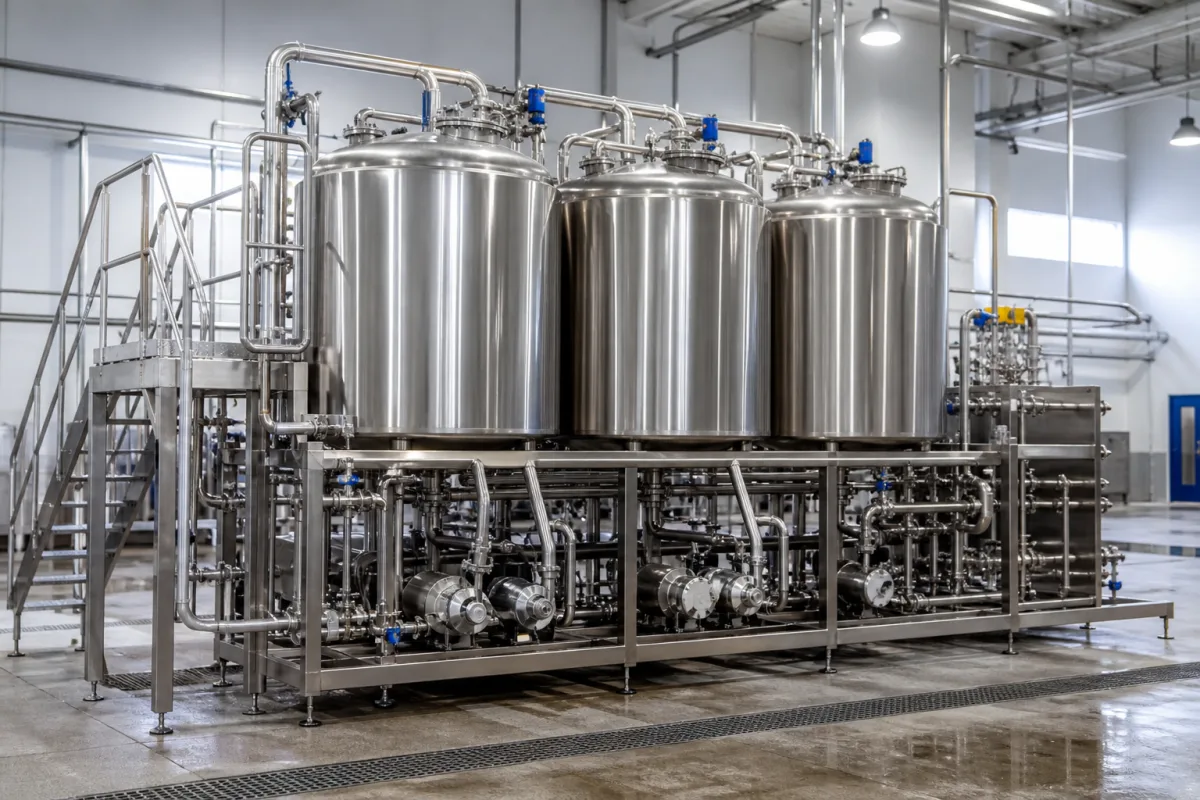
Cleaning Solution Tanks

Based on aggregated insights from multiple verified factory profiles within the CNFX directory, the standard Cleaning Solution Tanks used in the Food Manufacturing sector typically supports operational capacities ranging from standard industrial configurations to heavy-duty production requirements.

Technical Definition & Core Assembly

A canonical Cleaning Solution Tanks is characterized by the integration of Tank Shell/Body and Manhole/Cover. In industrial production environments, manufacturers listed on CNFX commonly emphasize Stainless Steel (e.g., 304, 316L) construction to support stable, high-cycle operation across diverse manufacturing scenarios.

Storage vessels within a CIP system that hold cleaning and sanitizing solutions for circulation during cleaning cycles.
Product Specifications

Technical details and manufacturing context for Cleaning Solution Tanks

Definition
Cleaning Solution Tanks are integral components of Clean-in-Place (CIP) systems, designed to store and supply the various chemical solutions (e.g., caustic, acid, sanitizer, rinse water) used to clean processing equipment without disassembly. They ensure a controlled, on-demand supply of cleaning agents to the spray devices and circulation loops that clean tanks, pipes, and other equipment surfaces.
Working Principle
The tanks store prepared cleaning solutions. During a CIP cycle, pumps draw solution from the appropriate tank, circulate it through the process equipment to be cleaned, and typically return it to the tank for reuse or disposal. Tanks may include features for heating, mixing, level sensing, and temperature control to maintain solution efficacy.
Common Materials
Stainless Steel (e.g., 304, 316L)
Technical Parameters
  • Nominal capacity or volume of the tank. (L) Customizable
Components / BOM
  • Tank Shell/Body
    Primary containment vessel for the cleaning solution.
    Material: stainless steel
  • Manhole/Cover
    Provides access for inspection, cleaning, and maintenance of the tank interior.
    Material: stainless steel
  • Level Sensor
    Monitors and controls the volume of solution in the tank (e.g., ultrasonic, capacitive).
    Material: stainless steel, electronics
  • Heating Jacket/Coil
    Heats the cleaning solution to the optimal temperature for chemical effectiveness (if applicable).
    Material: stainless steel
  • Agitator/Impeller
    Mixes the solution to maintain homogeneity and temperature uniformity (if applicable).
    Material: stainless steel
Engineering Reasoning
0.1-0.5 bar (vacuum to low positive pressure), 5-85°C temperature range
0.6 bar internal pressure (yield point of 316L SS at 85°C), -0.2 bar external pressure (collapse threshold)
Design Rationale: Stress corrosion cracking due to chloride ion concentration exceeding 25 ppm at temperatures above 60°C, combined with cyclic pressure loading exceeding 0.3 bar amplitude
Risk Mitigation (FMEA)
Trigger Caustic solution concentration exceeding 4% NaOH at temperatures above 75°C
Mode: Intergranular corrosion and wall thinning at weld heat-affected zones
Strategy: Installation of duplex stainless steel (UNS S32205) internal liners with 3.2 mm minimum thickness
Trigger Inadequate venting during drainage creating 0.15 bar vacuum
Mode: Tank implosion with permanent plastic deformation
Strategy: Dual redundant vacuum relief valves set at -0.05 bar with 25 mm diameter orifice

Industry Taxonomies & Aliases

Commonly used trade names and technical identifiers for Cleaning Solution Tanks.

Applied To / Applications

This component is essential for the following industrial systems and equipment:

Industrial Ecosystem & Supply Chain DNA

Complementary Systems
Downstream Applications
Specialized Tooling

Application Fit & Sizing Matrix

Operational Limits
pressure: 0 to 6 bar (gauge)
flow rate: Up to 100 m³/h
temperature: -10°C to 120°C
slurry concentration: Up to 20% solids by weight
Media Compatibility
✓ Caustic soda solutions (NaOH) ✓ Nitric acid-based sanitizers ✓ Peracetic acid (PAA) solutions
Unsuitable: Hydrofluoric acid (HF) or concentrated sulfuric acid (>90%)
Sizing Data Required
  • Required solution volume per CIP cycle (L)
  • Number of cleaning cycles per day
  • Maximum allowable hold-up time for solution stability

Reliability & Engineering Risk Analysis

Failure Mode & Root Cause
Corrosion-induced perforation
Cause: Chemical attack from acidic or alkaline cleaning solutions, especially at welds, seams, and liquid-air interfaces, accelerated by temperature fluctuations and impurities.
Structural fatigue cracking
Cause: Cyclic stress from repeated filling/draining, thermal expansion/contraction, and vibration from adjacent equipment, leading to crack initiation at stress concentrators like nozzles or support attachments.
Maintenance Indicators
  • Visible weeping or staining at welds/seams indicating active leakage
  • Unusual audible 'pinging' or cracking sounds during temperature changes, suggesting stress or corrosion under insulation
Engineering Tips
  • Implement routine ultrasonic thickness testing at high-risk areas (e.g., bottom plates, welds) to monitor corrosion rates and schedule proactive repairs before failure.
  • Install and maintain proper ventilation/degassing systems to minimize corrosive vapor accumulation above the liquid level, and use cathodic protection or liners if compatible with the cleaning solution.

Compliance & Manufacturing Standards

Reference Standards
ISO 9001:2015 - Quality management systems ASME BPE-2019 - Bioprocessing equipment DIN EN 13445 - Unfired pressure vessels
Manufacturing Precision
  • Wall thickness: +/-0.5mm
  • Surface roughness: Ra ≤ 0.8μm
Quality Inspection
  • Hydrostatic pressure test
  • Visual inspection for weld integrity

Factories Producing Cleaning Solution Tanks

Verified manufacturers with capability to produce this product in China

✓ 96% Supplier Capability Match Found

T Technical Director from Australia Jan 06, 2026
★★★★★
"The Cleaning Solution Tanks we sourced perfectly fits our Food Manufacturing production line requirements."
Technical Specifications Verified
P Project Engineer from Singapore Jan 03, 2026
★★★★☆
"Found 14+ suppliers for Cleaning Solution Tanks on CNFX, but this spec remains the most cost-effective. (Delivery took slightly longer than expected, but technical support was excellent.)"
Technical Specifications Verified
S Sourcing Manager from Germany Dec 31, 2025
★★★★★
"The technical documentation for this Cleaning Solution Tanks is very thorough, especially regarding technical reliability."
Technical Specifications Verified
Verification Protocol

“Feedback is collected from verified sourcing managers during RFQ (Request for Quote) and factory evaluation processes on CNFX. These reports represent historical performance data and technical audit summaries from our B2B manufacturing network.”

17 sourcing managers are analyzing this specification now. Last inquiry for Cleaning Solution Tanks from India (1h ago).

Supply Chain Compatible Machinery & Devices

Intelligent Food Grade Metal Detector

Automated metal contamination detection system for food processing lines.

Explore Specs →
Automated Food Packaging Integrity Tester

Automated system for non-destructive testing of food package seals and integrity.

Explore Specs →
Automated Food Moisture Analyzer

Automated system for precise moisture content measurement in food products

Explore Specs →
Automated Food Color Consistency Analyzer

Automated inline system for real-time color measurement and consistency control in food processing.

Explore Specs →

Frequently Asked Questions

What are the benefits of using stainless steel cleaning solution tanks in food manufacturing?

Stainless steel (304/316L) offers superior corrosion resistance, easy cleaning, and compliance with food safety standards, ensuring no contamination of cleaning solutions during CIP cycles.

How do agitators and heating elements improve CIP cleaning solution tank performance?

Agitators maintain solution homogeneity, while heating jackets/coils ensure optimal temperature for cleaning chemicals, enhancing cleaning efficiency and reducing cycle times in food processing facilities.

What specifications should I consider when selecting CIP cleaning solution tanks for food production?

Key specs include: stainless steel grade (304/316L for corrosion resistance), capacity, heating capability, agitator type, level sensor accuracy, and compliance with food industry regulations like FDA or EHEDG guidelines.

Can I contact factories directly on CNFX?

CNFX is an open directory, not a transaction platform. Each factory profile provides direct contact information and production details to help you initiate direct inquiries with Chinese suppliers.

Get Quote for Cleaning Solution Tanks

Request technical pricing, lead times, or customized specifications for Cleaning Solution Tanks directly from verified manufacturing units.

Your business information is encrypted and only shared with verified Cleaning Solution Tanks suppliers.

Thank you! Your message has been sent. We'll respond within 1–3 business days.

Need to Manufacture Cleaning Solution Tanks?

Connect with verified factories specializing in this product category

Add Your Factory Contact Us
Previous Product
Circulation Pumps
Next Product
Condensate Traps