Industry-Verified Manufacturing Data (2026)

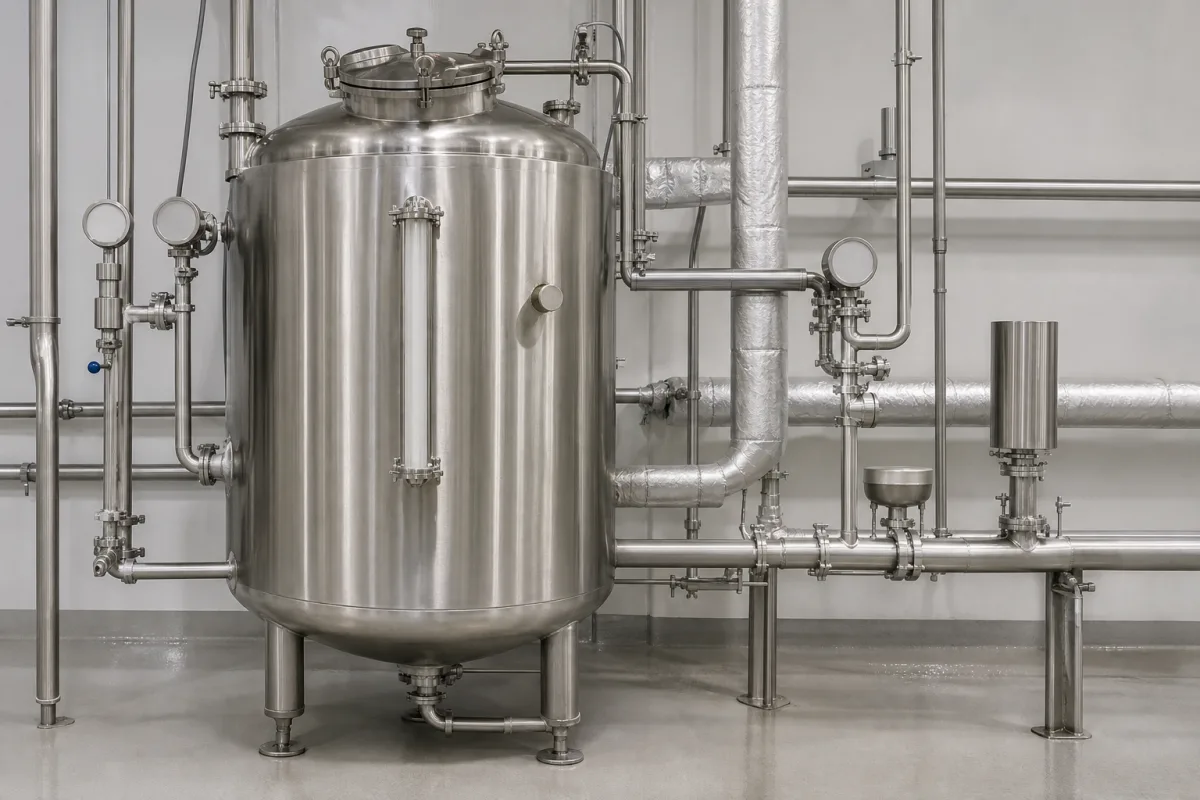
CIP Tank

Based on aggregated insights from multiple verified factory profiles within the CNFX directory, the standard CIP Tank used in the Food Manufacturing sector typically supports operational capacities ranging from standard industrial configurations to heavy-duty production requirements.

Technical Definition & Core Assembly

A canonical CIP Tank is characterized by the integration of Tank Shell and Agitator/Impeller. In industrial production environments, manufacturers listed on CNFX commonly emphasize Stainless Steel (AISI 304/316L) construction to support stable, high-cycle operation across diverse manufacturing scenarios.

A specialized tank that stores and supplies cleaning solutions for automated cleaning processes without disassembly.
Product Specifications

Technical details and manufacturing context for CIP Tank

Definition
The CIP Tank is a critical component within a Cleaning-in-Place (CIP) System, designed to hold and manage the cleaning agents (such as caustic, acid, and rinse water) used to sanitize process equipment internally. It serves as the central reservoir from which cleaning solutions are pumped through pipelines, vessels, and other equipment to remove soil, bacteria, and residues, ensuring hygiene and preventing cross-contamination in continuous production environments.
Working Principle
The tank stores prepared cleaning solutions at controlled temperatures. During a CIP cycle, pumps draw solution from the tank and circulate it under pressure through the system's piping network and process equipment. After use, spent solution may be recovered back to the tank for reuse or disposal. The tank often includes features for heating, mixing, and level monitoring to maintain solution efficacy.
Common Materials
Stainless Steel (AISI 304/316L)
Technical Parameters
  • Nominal capacity, typically ranging from small (e.g., 100L) to very large (e.g., 10,000L+) depending on system requirements. (L) Standard Spec
Components / BOM
  • Tank Shell
    Main structural body that contains the cleaning solution.
    Material: stainless steel
  • Agitator/Impeller
    Mixes cleaning solutions to maintain uniform concentration and temperature.
    Material: stainless steel
  • Heating/Cooling Jacket
    Controls the temperature of the solution via thermal fluid (e.g., steam, water) circulation.
    Material: stainless steel
  • Level Sensor
    Monitors the volume of solution in the tank to control filling, emptying, and pump operation.
    Material: stainless steel, electronics
Engineering Reasoning
0.5-6.0 bar
8.2 bar internal pressure
Design Rationale: Yield strength of 316L stainless steel (205 MPa) exceeded at 8.2 bar internal pressure in 2mm wall thickness cylindrical vessel (σ = P·r/t)
Risk Mitigation (FMEA)
Trigger Caustic solution concentration exceeding 4% NaOH at 85°C
Mode: Stress corrosion cracking initiating at weld seams
Strategy: Install conductivity sensors with automated dilution control maintaining <3.5% NaOH concentration
Trigger Thermal cycling between 20°C and 90°C exceeding 3 cycles/hour
Mode: Low-cycle fatigue failure at nozzle-to-shell junctions
Strategy: Implement temperature ramp rate control limiting ΔT to <10°C/minute with thermal buffer zones

Industry Taxonomies & Aliases

Commonly used trade names and technical identifiers for CIP Tank.

Applied To / Applications

This component is essential for the following industrial systems and equipment:

Industrial Ecosystem & Supply Chain DNA

Complementary Systems
Downstream Applications
Specialized Tooling

Application Fit & Sizing Matrix

Operational Limits
pressure: 0 to 3 bar (operating), 5 bar max (design)
flow rate: 10 to 200 m³/h (depending on pump and piping)
temperature: -10°C to 150°C (typical CIP solution range)
slurry concentration: Up to 15% solids by weight (for abrasive cleaning agents)
Media Compatibility
✓ Caustic soda solutions (NaOH) ✓ Nitric acid-based sanitizers ✓ High-purity water (RO/DI)
Unsuitable: Hydrofluoric acid (HF) or highly concentrated sulfuric acid (>50%) due to material degradation risks
Sizing Data Required
  • Required cleaning solution volume per cycle (L)
  • Maximum allowable cycle time (minutes)
  • Heat transfer requirements (kW) for solution heating/cooling

Reliability & Engineering Risk Analysis

Failure Mode & Root Cause
Corrosion and pitting
Cause: Chemical attack from CIP cleaning agents (acids, caustics, sanitizers) and/or microbiologically influenced corrosion (MIC) from biofilm residues, exacerbated by improper rinse cycles or concentration control.
Gasket and seal failure
Cause: Thermal cycling and chemical degradation from repeated hot/cold cleaning cycles, leading to loss of seal integrity, leaks, and potential contamination.
Maintenance Indicators
  • Visible pitting, discoloration, or rust spots on tank interior surfaces, especially near welds or seams.
  • Audible hissing or dripping during pressure testing, or visible leaks around manway gaskets, spray ball connections, or drain valves.
Engineering Tips
  • Implement automated chemical concentration monitoring and rinse water conductivity checks to prevent over-concentration and ensure complete chemical removal.
  • Establish a preventive replacement schedule for gaskets and seals based on cycle count, and use chemically compatible materials (e.g., EPDM, PTFE) rated for the specific CIP temperatures and agents.

Compliance & Manufacturing Standards

Reference Standards
ISO 14159:2002 (Safety of machinery - Hygiene requirements for the design of machinery) ANSI/ASME BPE-2022 (Bioprocessing Equipment) DIN 11866-1:2014 (Fittings in stainless steel for the food, chemical and pharmaceutical industries - Part 1: Principles of design and construction)
Manufacturing Precision
  • Surface Finish: Ra ≤ 0.8 μm (32 μin) for product contact surfaces
  • Dimensional Tolerance: ±1.5 mm for overall tank dimensions
Quality Inspection
  • Passivation Test (ASTM A967) to verify corrosion resistance
  • Pressure Test (Hydrostatic or Pneumatic) to ensure weld integrity and leak-tightness

Factories Producing CIP Tank

Verified manufacturers with capability to produce this product in China

✓ 98% Supplier Capability Match Found

P Project Engineer from Singapore Jan 05, 2026
★★★★★
"Impressive build quality. Especially the technical reliability is very stable during long-term operation."
Technical Specifications Verified
S Sourcing Manager from Germany Jan 02, 2026
★★★★★
"As a professional in the Food Manufacturing sector, I confirm this CIP Tank meets all ISO standards."
Technical Specifications Verified
P Procurement Specialist from Brazil Dec 30, 2025
★★★★★
"Standard OEM quality for Food Manufacturing applications. The CIP Tank arrived with full certification."
Technical Specifications Verified
Verification Protocol

“Feedback is collected from verified sourcing managers during RFQ (Request for Quote) and factory evaluation processes on CNFX. These reports represent historical performance data and technical audit summaries from our B2B manufacturing network.”

6 sourcing managers are analyzing this specification now. Last inquiry for CIP Tank from Brazil (43m ago).

Supply Chain Compatible Machinery & Devices

Automated Food Packaging Integrity Tester

Automated system for non-destructive testing of food package seals and integrity.

Explore Specs →
Automated Food Moisture Analyzer

Automated system for precise moisture content measurement in food products

Explore Specs →
Automated Food Color Consistency Analyzer

Automated inline system for real-time color measurement and consistency control in food processing.

Explore Specs →
Control Panel

A centralized interface for monitoring and controlling industrial equipment and processes

Explore Specs →

Frequently Asked Questions

What are the main benefits of using a CIP tank in food manufacturing?

CIP tanks enable automated cleaning without equipment disassembly, reducing downtime, ensuring consistent sanitation, and meeting food safety standards like HACCP and FDA requirements.

Why is stainless steel AISI 304/316L preferred for CIP tanks?

AISI 304/316L stainless steel offers excellent corrosion resistance to cleaning chemicals, meets food-grade standards, is easy to sanitize, and provides durability for repeated cleaning cycles.

What components are essential in a CIP tank system?

Key components include the tank shell, agitator/impeller for solution mixing, heating/cooling jacket for temperature control, and level sensors for automated operation and safety monitoring.

Can I contact factories directly on CNFX?

CNFX is an open directory, not a transaction platform. Each factory profile provides direct contact information and production details to help you initiate direct inquiries with Chinese suppliers.

Get Quote for CIP Tank

Request technical pricing, lead times, or customized specifications for CIP Tank directly from verified manufacturing units.

Your business information is encrypted and only shared with verified CIP Tank suppliers.

Thank you! Your message has been sent. We'll respond within 1–3 business days.

Need to Manufacture CIP Tank?

Connect with verified factories specializing in this product category

Add Your Factory Contact Us
Previous Product
CIP Supply Pump
Next Product
Circulation Pumps