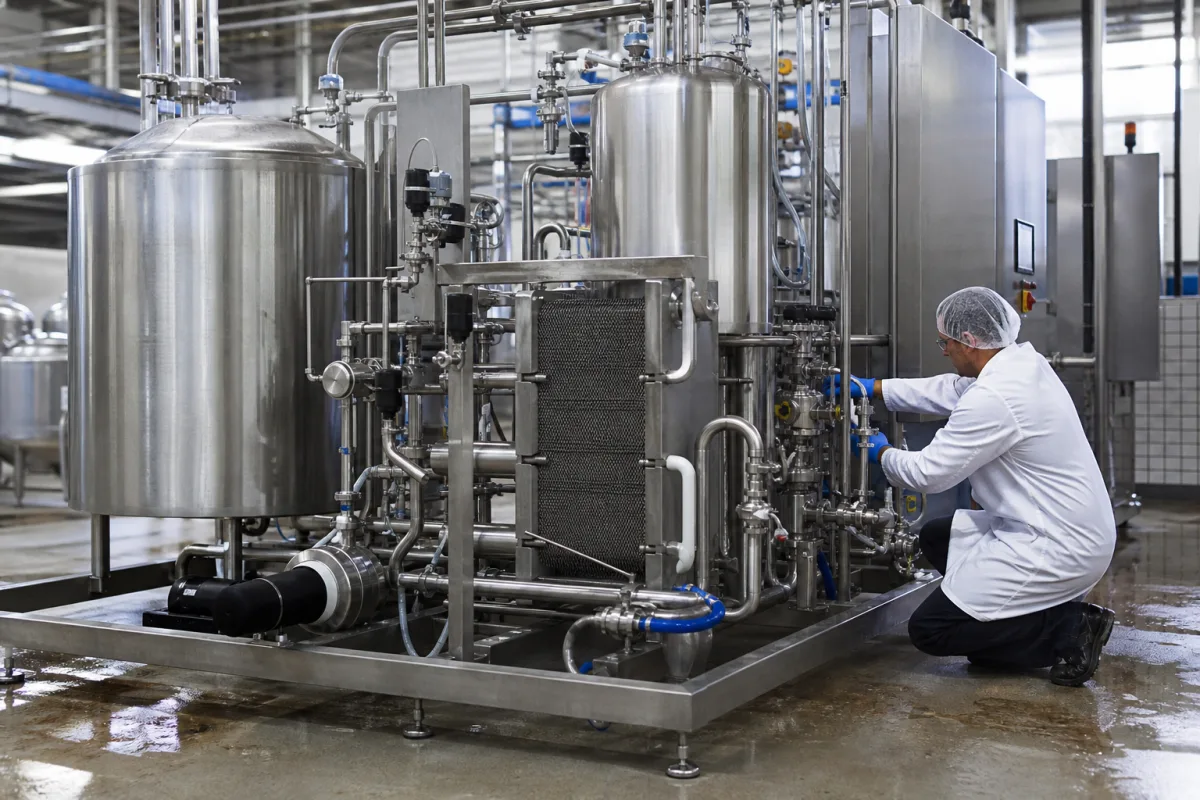
Cleaning-in-place (CIP) system for pharmaceutical plants: an automated cleaning skid whose cycle has to be validated under GMP
Clean-in-place skids for pharmaceutical plants · Sanitary design, validated operating ranges for automated recipes, dirty and clean hold times, residue limits, TOC and conductivity as stand-in measures, and swab and rinse recovery
This page covers clean-in-place skids for pharmaceutical and biopharmaceutical plants: tanks, a heat exchanger, a supply pump, valves, conductivity and temperature measurement and automated recipes that clean vessels and lines without dismantling them, where the cleaning cycle itself must be validated under GMP. Ask three things first: which operating ranges of flow, temperature, concentration and time the recipe holds and records, how residues will be sampled and measured against your limits, and how the skid and its circuits are designed to drain and avoid hard-to-clean parts.
Clean-in-place skids for pharmaceutical and biopharmaceutical plants whose cleaning cycles are validated under GMP, including tanks, heat exchangers, supply pumps, sanitary valves, conductivity and temperature measurement and automated recipes. CIP units for food, dairy, beverage, brewing and cosmetic plants are covered on the CIP system page, and combined CIP/SIP units for beverage lines on the Automated CIP/SIP system for beverage production page. Cleaning agents and manual cleaning are outside this page.
CNFX editorial research · Sources checked October 12, 2026 · 3 sources
Validated operating ranges, dirty and clean hold times, and sanitary design of the skid
EU GMP Annex 15 states that cleaning validation should consider the level of automation and that, where an automatic process is used, the specified normal operating range of the utilities and equipment should be validated; variable factors such as rinsing times should be assessed and the worst case used as the basis of the studies. It asks for dirty and clean hold times, set from the time between manufacture and cleaning and between cleaning and use, and for campaign length to be the basis of validation where campaigns are run. [2]
FDA's guide to inspections of cleaning validation tells inspectors to examine the design of large systems with semi-automatic or fully automatic CIP closely, since they represent significant concern; it states that sanitary piping without ball valves should be used, and that non-sanitary ball valves, which the guide says the bulk drug industry uses, make cleaning more difficult. It also points to the time between the end of processing and each cleaning step, because drying residues affect cleaning, and asks for evidence that routine cleaning and storage do not allow microbial growth. [1]
Editorial note: for a skid, this means the supplier should state the flow, temperature, concentration and contact-time range each recipe step holds, how deviations are alarmed and recorded, and which valves and dead legs on the skid and circuits are sanitary and drainable.
Give the supplier the equipment train and circuits to be cleaned, product residues and their solubility, the cleaning agents and water grades used, required flows and temperatures per circuit, the data to be recorded per cycle, and the sampling points your validation will use.
02
Residue limits, and when TOC and conductivity can stand in for a product-specific test
Annex 15 states that carryover limits should be based on a toxicological evaluation, documented in a risk assessment, with limits also for cleaning agents; a visual check is part of the acceptance criteria but not acceptable alone, and repeated cleaning and retesting until results pass is not acceptable. Where testing for specific residues is not feasible, representative parameters such as total organic carbon (TOC) and conductivity may be used, and for therapeutic macromolecules and peptides, which degrade at pH extremes and heat, a toxicological evaluation may not apply. [2]
FDA's guide records limits mentioned by industry, such as an analytical level of 10 ppm, a biological activity level of 1/1000 of the normal therapeutic dose and no visible residue, and states that FDA does not set acceptance specifications itself; between batches of the same product, a visibly clean criterion is enough and does not need validation. It notes that rinse samples cover a larger surface and reach systems that cannot be dismantled, while direct surface sampling reaches dried-on or insoluble residues, and that detergent composition withheld by suppliers can make residue testing difficult. [1]
03
Swab and rinse recovery by surface material
A cleaning validation study in the Iranian Journal of Pharmaceutical Research measured how much spiked residue (chlordiazepoxide) swab and rinse sampling recovered from 5 × 5 cm coupons of product-contact materials at 50, 100 and 200% of the target level, and used the worst case for each surface; it cites recovery above 80% as good, above 50% as reasonable and below 50% as questionable, and suggests dedicating equipment where recovery is below 50% or the area is hard to clean. [3]
Editorial calculation: at the 63.88% worst-case recovery for stainless steel swabs, a swab result of 10 µg corresponds to about 10 / 0.6388 ≈ 15.7 µg on the sampled area. The study's acceptance limit combines the maximum allowable carryover with the swabbed area, this recovery factor and the total product-contact area, with a 0.001 safety factor in the carryover formula. [3]
Explore company information and manufacturing capabilities, then discuss the scope of your project with a relevant supplier.
Share this page
Compiled and source-reviewed by the CNFX editorial team.
Each manufacturer above links to the page on that company's own website where the product is listed, with the date we checked it. How we source and review
· Page last updated 13 October 2026
Buyer questions
What must be validated on an automated pharmaceutical CIP system?
EU GMP Annex 15 asks for the specified normal operating range of the utilities and equipment to be validated where cleaning is automatic, with worst-case variable factors, dirty and clean hold times and campaign length. [2]
Can TOC or conductivity replace a product-specific residue test?
Annex 15 allows representative parameters such as total organic carbon and conductivity where testing for specific product residues is not feasible. [2]
What residue limits are used in cleaning validation?
FDA's guide records 10 ppm, 1/1000 of the normal therapeutic dose and no visible residue as limits mentioned by industry; Annex 15 asks for limits based on a toxicological evaluation. [1][2]
Sources and what still needs a direct check
Sources checked 2026-10-12. FDA's inspection guide and EU GMP Annex 15 set out cleaning validation expectations; the journal study reports measured sampling recoveries.