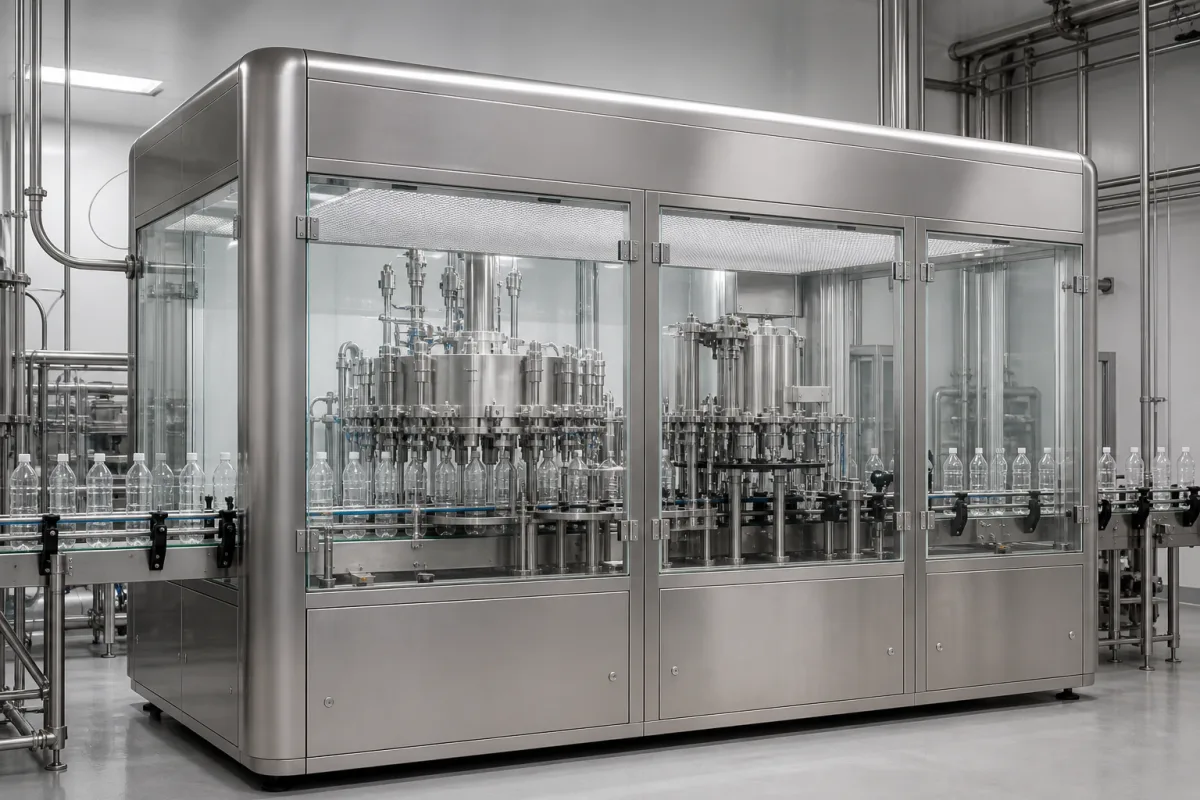
A filtered-air hood over a bottle filler and capper
The illustration shows the arrangement: a stainless frame with glass doors closed around a rotary filler and capper, conveyors passing through openings at each end, and a roof of filter units blowing filtered air down onto the open bottles. It is not an aseptic isolator; it is a ventilated enclosure that keeps room air off the bottles between filling and capping. US bottled-water rules set what the room has to do, and fan filter unit datasheets from item and Lindner give the numbers for building the hood.
Covers HEPA-ventilated hood enclosures over bottle fillers and cappers in food and beverage plants: the bottling-room requirements of 21 CFR 129, sizing the roof fan filter units by outflow velocity and area, H14 filter efficiency, pre-filters, seals and FFU control. Sterile chambers and tunnels of aseptic fillers with pressure cascades and peroxide decontamination are on Sterile Chamber and Tunnel (2811); complete aseptic cold-fill lines on 237; pharmaceutical isolators and RABS on 3493; cleanroom HVAC on Conditioning System (3346); the capping machine itself on the high-speed rotary capper page.
CNFX editorial research · Sources checked October 13, 2026 · 3 sources
What 21 CFR 129 asks of a bottling room, and where a hood fits
Part 129 sets current good manufacturing practice for processing and bottling of bottled drinking water in the US. It describes the room and the handling, not an air velocity or a filter class.
The rule is written for the whole bottling room. A hood narrows the zone that needs the cleanest air to the open bottles under the filler and capper, while the room around it still has to meet § 129.20.
Clause
Requirement
What it means for an enclosure around the filler and capper
§ 129.20(a)
Bottling room separated from other operations or storage by tight walls, ceilings and self-closing doors; conveyor openings no larger than needed to pass the containers
The hood's doors and its conveyor in- and out-feed openings are the items to check against this wording
§ 129.20(b)
Where processing is not in a sealed system under pressure, adequate protection to preclude contamination of the water and the system
A filtered-air hood is one form of such protection; the rule does not prescribe it
§ 129.20(c)
Adequate ventilation to minimise condensation in processing and bottling rooms
Airflow through the hood also has to keep its glass and frame dry
§ 129.35(b)
Air under pressure directed at product water or contact surfaces free of oil, dust, rust, excessive moisture and extraneous material
Applies to compressed air used inside the hood, not to the FFU supply air
§ 129.37
Closures stored in sanitary closures, examined and, as necessary, washed, rinsed and sanitized; filling, capping, closing and sealing done in a sanitary manner
Cap feed into the hood is part of the same sanitary chain
§ 129.80(f)
Filler, capper or sealer performance monitored; filled containers inspected visually or electronically for soundness, capping, coding and labelling
Glass doors keep the machine visible without opening the hood
21 CFR 129 applies to bottled drinking water sold in the US; other beverages and other jurisdictions have their own rules.
02
Counting the roof units: 1,019 m³/h at 0.45 m/s from each 1200 × 600 FFU
item Industrietechnik's 1200 × 600 fan filter unit, listed with a FlowBox installation kit, gives the figures needed to size a hood roof.
At 0.45 m/s, 1,019 m³/h corresponds to 1,019 ÷ 3600 ÷ 0.45 = 0.63 m² of outflow face per unit (Editorial calculation). For an example capper zone of 2.0 × 1.2 m (2.4 m², not taken from the illustration) the roof needs 2.4 ÷ 0.63 = 3.8, so four units, moving about 4,080 m³/h and drawing up to 2 kW at the 500 W rating (Editorial calculation).
item notes a tendency of this FFU to resonate between 0.5 and 0.6 m/s, potentiometer level 6 to 6.5 when new, so a hood designed for a higher velocity should be checked for noise at that setting.
item FFU 1200 × 600
Datasheet value
Size / height
540 × 1140 mm; 540 mm with HEPA filter
Volume flow / outflow velocity
1,019 m³/h at 0.45 m/s
Sound power
52 dB(A)
Fan
EC fan K3G310-RR05-H8, 200–277 V AC 50/60 Hz, 500 W, 2.2 A, 2,360 rpm
Control
0–10 V input; RS485 Modbus RTU; alarm contact
Weight
31 kg
The 2.0 × 1.2 m zone is an editorial example; take the open-bottle area from the actual filler and capper layout.
03
H14 at 99.995% integral, 99.975% local; pre-filters, seals and bus control
Both datasheets fit H14 filters to EN 1822 as standard; the difference between the two figures for H14 is what a scan test checks.
The H14 values as penetration: 0.005% integral lets through 1 particle in 20,000 at the most penetrating particle size, and the 0.025% local limit 1 in 4,000 at any single point of the filter face (Editorial calculation). Lindner supplies a scan test report from the filter maker and fits two nozzles on top of each unit for aerosol supply and raw-air measurement, so filter leakage can be measured in place.
With a new H14 at 95 Pa and an M5 pre-filter at 40 Pa, the fan works against about 135 Pa before any loading (Editorial calculation; the two figures are stated at slightly different flows). Where the hood air also has to be cooled, Lindner gives a maximum of 7 kW sensible cooling for a 12/12 unit in process areas and about 2 kW for workplaces.
Item
item Industrietechnik
Lindner
Main filter
H14 to EN 1822, glass fibre; 99.995% integral at MPPS, 99.975% local; 95 Pa at 1,019 m³/h; 70 °C / 100% RH
H14 to DIN EN 1822, hydrophobic micro-glass-fibre, narrow V pleats; scan test report from the maker; U15–U17 or PTFE filters on request
Pre-filter
M5 / ISO ePM10 70%, 40 Pa at 1,150 m³/h
ISO Coarse 60% (G4), ISO ePM1 50% (F7) or ISO ePM1 80% (F9)
Filter seal / change
Half-round PU gasket both sides
Dry seal or fluid seal; change from the room side or from the ceiling void
Clean class
—
Turbulent or laminar flow up to ISO 14644-1 class 3
Control
0–10 V, Modbus RTU
Data bus or 0–10 V; one control unit for 200 FFUs in up to 8 groups; external inputs such as emergency stop and night setback
Casing options
—
Aluminium; stainless steel, zinc-plated steel or RAL colours on request; plastic-foam lining for pharmaceutical, medical and food use
Lindner's plastic-foam lining is the option it names for food use; ask for the lining and casing material in contact with washdown chemicals.
04
What to specify for a filler-capper hood
Paste it into your enquiry below or into an email to a maker, then replace every bracket.
Give the open-bottle area under the filler and capper, the target outflow velocity, the conveyor opening sizes, door arrangement and interlocks, ambient temperature and humidity, washdown chemicals, and the rules the plant works to (21 CFR 129 or others). Ask for the number and type of FFUs, filter class with integral and local efficiency and a scan test report, pre-filter class, seal type and filter-change side, airflow and power per unit, noise, control interface, and frame and lining materials.
1 company lists this product among what they make. Company figures are quoted from each
company's own website; every card states where the relationship came from.
Qingdao HongshengHSYL Food Machinery Co., Ltd.
TBC
HSYL lists a Sterile Air System for food and beverage packaging lines: HEPA filtration, PLC-controlled positive pressure and SUS304 construction. Filter class to EN 1822, airflow and enclosure size are not stated; TBC. Location TBC.
Explore company information and manufacturing capabilities, then discuss the scope of your project with a relevant supplier.
Share this page
Compiled and source-reviewed by the CNFX editorial team.
Each manufacturer above links to the page on that company's own website where the product is listed, with the date we checked it. How we source and review
· Page last updated 13 October 2026
Buyer questions
Does 21 CFR 129 require a HEPA hood over the filler?
No. § 129.20 requires a bottling room separated by tight walls, ceilings and self-closing doors, conveyor openings no larger than needed, and adequate protection where processing is not a sealed system; it names no filter class or air velocity. [1]
How much air does one 1200 × 600 FFU deliver?
item's FFU 1200 × 600 delivers 1,019 m³/h at 0.45 m/s outflow velocity with an H14 filter, at 52 dB(A) sound power. [2]
What do H14 integral and local efficiency mean?
In item's filter data, H14 to EN 1822 is 99.995% integral and 99.975% local efficiency at the most penetrating particle size, a penetration of 0.005% and 0.025%. [2]
How is a roof of FFUs controlled together?
Lindner connects its EC fan units over a data bus or 0–10 V; one control and monitoring unit handles 200 units in up to 8 groups, with inputs for emergency stop and night setback. [3]
Sources and what still needs a direct check
Sources checked 2026-10-13. The US regulation for bottled-water plants and two fan filter unit datasheets from enclosure and cleanroom makers.