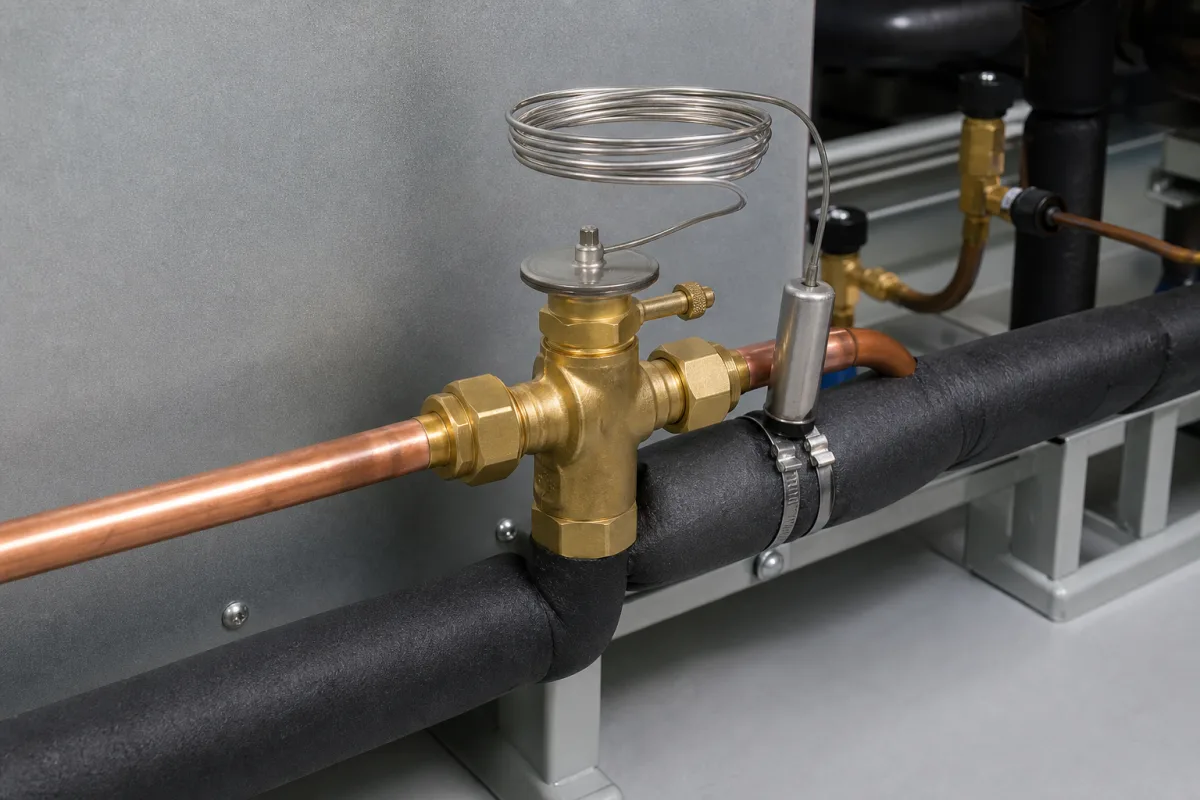
Thermostatic expansion valves (TXV) · superheat settings, internal or external equalisation, MOP, sizing with subcooling and distributor corrections
A thermostatic expansion valve meters liquid refrigerant into a dry-expansion evaporator, opening and closing as a charged bulb clamped to the evaporator outlet senses the suction-gas superheat, so that the evaporator is fed in proportion to its load. Ask three things first: which refrigerant, evaporating range and MOP the thermostatic element is charged for, whether the evaporator needs external equalisation, and what capacity the valve gives at your own evaporating, condensing and subcooling conditions.
Thermostatic expansion valves (internally and externally equalised, with or without MOP) for refrigeration, freezing and air-conditioning evaporators, including orifice assemblies. Electronic expansion valves, capillary tubes, float valves and complete chillers are outside this page except where compared.
CNFX editorial research · Sources checked October 11, 2026 · 4 sources
Danfoss's T2/TE2 data sheet (2021) explains that a thermostatic expansion valve keeps a constant superheat at the evaporator outlet and is suited to dry evaporators, where outlet superheat is proportional to load. Total superheat is static superheat (adjustable with the setting spindle; standard setting 4 K) plus opening superheat, which is 6 K from the start of opening to rated capacity; its worked example uses 5 K + 6 K = 11 K. [1]
The valve is supplied with internal (T2) or external (TE2) pressure equalisation, and the data sheet says external equalisation should always be used on systems with liquid distributors. MOP (maximum operating pressure) versions protect the compressor motor against excessive evaporating pressure, for example range NM (−40 to −5 °C) with MOP 0 °C and range NL (−40 to −15 °C) with MOP −10 °C. Limits include a test pressure of 38 bar, a maximum working pressure of 34 bar and a bulb temperature of 100 °C when installed. [1]
The bulb is fixed to the pipe with a strap for good temperature transfer; the data sheet lists a strap for tubes up to 28 mm. [1] Editorial note: ask the supplier for bulb mounting position and insulation instructions for your suction line size and orientation, as these are not given in the reviewed data sheet.
Give the supplier the refrigerant, evaporator capacity, evaporating and condensing temperatures, liquid subcooling, whether the evaporator has a liquid distributor and its pressure drop, required MOP, connection type and size (flare, solder), suction line size for the bulb, and the operating range from part load to full load.
02
Size the valve at your own conditions
Danfoss states its rated capacities at stated conditions: in its kW table, an evaporating temperature of 4.4 °C, condensing at 38 °C and liquid at 37 °C ahead of the valve. For other conditions it divides the required capacity by a subcooling factor and a distributor factor: in its example (R407C, 1.1 kW, −30 °C evaporating, 25 °C condensing, 2 K subcooling, 1 bar distributor drop), 1.1 / (0.98 × 0.96) = 1.17 kW, so it selects the orifice rated 1.21 kW at those conditions. [1]
Independent of any maker, the Air-Conditioning, Heating, and Refrigeration Institute publishes the rating standard for these valves: AHRI 750 (I-P) and AHRI 751 (SI), Performance Rating of Thermostatic Refrigerant Expansion Valves, both 2016 editions offered as free downloads. Its stated scope is thermostatic refrigerant expansion valves for the refrigerants listed in the standard at evaporator temperatures between +50 °F [10 °C] and −40 °F [−40 °C]. [3] Editorial note: that span matches the −40 to +10 °C of the Danfoss range N element above, so ask whether a supplier's capacity table is rated to AHRI 750/751 or to the maker's own conditions before comparing two valves. [3][1]
Its correction tables give a subcooling factor of 0.98 at 2 K, 1.00 at 4 K, 1.07 at 10 K and 1.12 at 15 K, and a distributor factor of 0.96 at 1 bar, 0.94 at 1.5 bar and 0.92 at 2 bar pressure drop. [1] An earlier Danfoss T2/TE2 leaflet rated the same orifice sizes at different conditions (evaporating +5 °C, condensing +32 °C, liquid +28 °C), listing 15.5 kW for R22 orifice 06 where the 2021 data sheet lists 19.7 kW at its conditions, which shows why ratings must be compared at the same basis. [2][1]
Editorial calculation: a 2.5 kW evaporator with 4 K subcooling and a distributor dropping 1.5 bar needs a valve giving at least 2.5 / (1.00 × 0.94) ≈ 2.66 kW from the maker's capacity table at your evaporating and condensing temperatures. Duty and conditions are assumed examples; use the maker's tables or selection software for your refrigerant. [1]
A TXV only holds superheat while it has stroke left. An Oak Ridge National Laboratory report for the US Department of Energy (ORNL/LTR-2018/485) summarises ASHRAE research project 1173 at Purdue University, which tested six residential air conditioners over a wide range of refrigerant charge with either a TXV or a fixed orifice. Systems with fixed orifices showed noticeable performance degradation once charge fell below 90% of the factory charge; systems with TXVs held up to about 80% and then suffered drastic penalties, because the TXVs were fully open and could no longer control the target superheat. The report recommends TXVs and compact (micro-channel) heat exchangers to limit charge with lower-GWP refrigerants. [4]
Editorial calculation: on a system with a 3.0 kg factory charge (assumed), the reported thresholds correspond to about 2.7 kg (90%) for a fixed orifice and 2.4 kg (80%) for a TXV, so a TXV tolerates roughly twice the charge loss (0.6 kg against 0.3 kg) before performance falls away. [4]
03
Compare what suppliers offer
Suppliers linked to this page list expansion valves; each card links to the page reviewed.
Listings include thermostatic expansion valves among pressure controls and refrigeration valves, expansion valves among refrigeration solenoid, ball and check valves, refrigeration and air-conditioning parts, and bus and truck air-conditioning parts. Ask each for refrigerant, element charge, capacity table and superheat setting.
04
Trace the valve components
This is a functional reference built from the sources cited; it is not one maker's specification.
Part
Role
Fix in the order
Thermostatic element (power head)
Diaphragm driven by bulb pressure; may include MOP. [1][2]
Refrigerant, range, MOP.
Capillary tube and bulb
Senses suction temperature; strapped to the pipe. [1]
Fill the specification fields with values for your system
An expansion valve quotation needs values for your system. The table explains each field, gives published values where a reviewed source states them, and says what to obtain from the supplier.
Field
What it means and published values
Ask the supplier for
Nominal Capacity (kW)
Rated at stated conditions; correct for subcooling and distributor drop. [1] Rating standard: AHRI 750/751. [3]
TXV systems held performance down to about 80% of factory charge, fixed orifices to about 90%, in six tested air conditioners (ORNL summary of ASHRAE RP-1173). [4]
Valve capacity margin at full opening.
06
Send the refrigerant, duty and evaporator data together
Paste it into your enquiry below or into an email to a maker, then replace every bracket.
Refrigerant: [type]
Duty: [kW at full and part load]
Conditions: [evaporating; condensing; subcooling]
Evaporator: [distributor yes/no; pressure drop]
Element: [range; MOP]
Connections: [flare/solder; sizes; equaliser]
Bulb: [suction line size; position]
Explore company information and manufacturing capabilities, then discuss the scope of your project with a relevant supplier.
Share this page
Compiled and source-reviewed by the CNFX editorial team.
Published product pages show what a company offers, not tested performance. Confirm the legal seller, factory and scope for your order. How we source and review
· Page last updated 13 October 2026
Buyer questions
What superheat does a thermostatic expansion valve run at?
Danfoss gives total superheat as static (standard 4 K, adjustable) plus 6 K opening superheat to reach rated capacity. [1]
When is an externally equalised valve needed?
Danfoss says external equalisation should always be used on systems with liquid distributors. [1]
How do I correct capacity for my conditions?
Divide the duty by subcooling and distributor factors, e.g. 1.1 / (0.98 × 0.96) = 1.17 kW, then select from the capacity table at your temperatures. [1]
Which standard rates thermostatic expansion valve capacity?
AHRI 750 (I-P) and 751 (SI), 2016, covering valves at evaporator temperatures from +10 °C down to −40 °C. [3]
Does a TXV make a system less sensitive to refrigerant charge?
An ORNL report summarising ASHRAE RP-1173 found fixed-orifice air conditioners degraded below 90% of factory charge, while TXV systems held until about 80%, when the valves were fully open and lost superheat control. [4]
Sources and what still needs a direct check
Sources checked 2026-10-11. The Danfoss sources are documents for its own T2/TE2 valves (a 2021 data sheet and an earlier product leaflet); they illustrate how valves are rated and selected, not general limits. The AHRI 750/751 scope page identifies the industry rating standard for thermostatic expansion valves. The Oak Ridge National Laboratory report summarises tests comparing TXV and fixed-orifice systems at reduced charge.