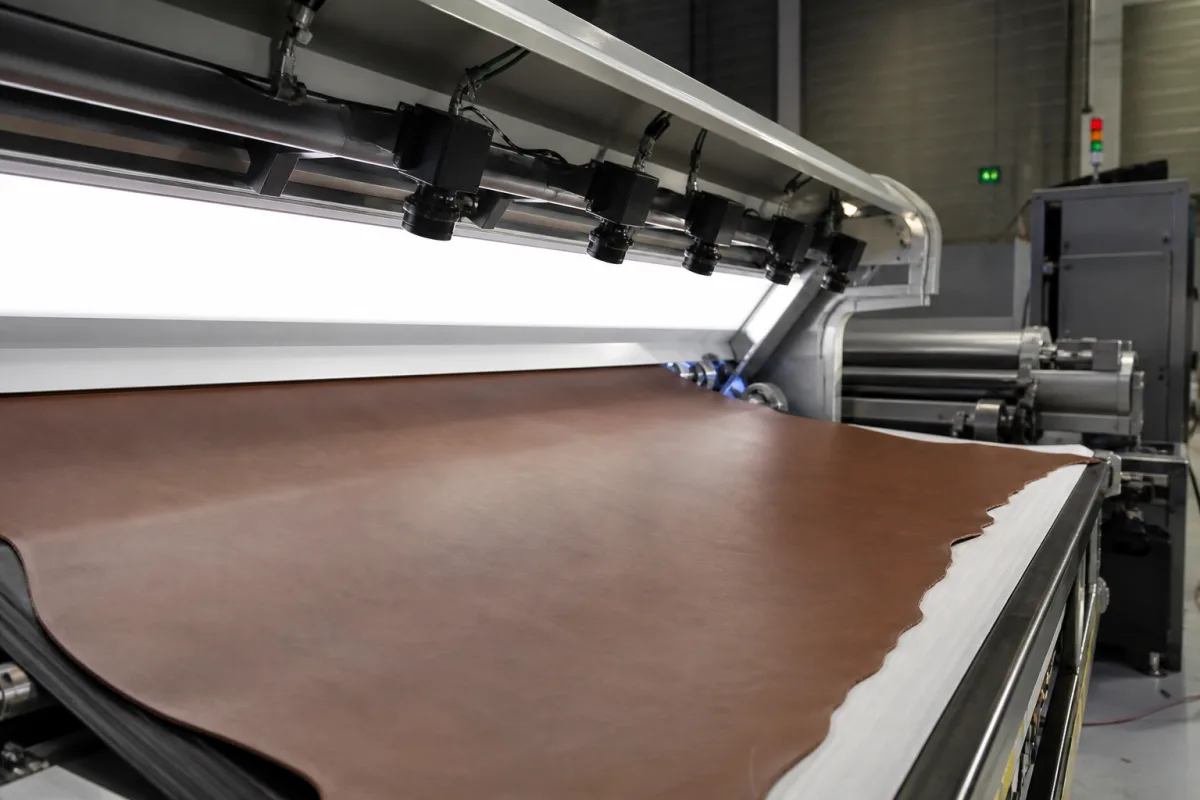
Leather hide defect mapping system: scanning whole hides for scars, bites and holes so the cutting layout avoids them
Whole-hide defect mapping before cutting · tension and angled light to show sealed scars and insect bites, texture windows sized to the smallest flaw, and a defect map the nesting software cuts around
A hide is not a web of uniform material: its outline is irregular, it is limp, and its defects — healed scars, insect bites, holes, wrinkles, veins, scratches — differ in contrast from barely visible to obvious. Leather inspection systems therefore do a different job from inspecting rigid parts on a line. They digitise the whole hide, mark where each defect lies and what kind it is, and hand that map to the cutting room, where a nesting program places the patterns for shoe uppers, upholstery or car seats around the flaws. The three patents reviewed here show the main choices a buyer has to ask about: how the hide is presented to the camera, what lighting reveals low-contrast defects, and how the image is broken into windows small enough to catch a bite a few millimetres across.
Inspection machines that scan complete leather hides or skins on a table or conveyor, detect and classify natural surface defects, and output a defect map for marking or automatic cutting. Camera resolution, exposure and camera data for production-line vision are covered on the Machine vision system for inspection page; inspection cells for cast and machined metal parts on the Vision system for cast and machined parts page; lens-loading vision modules on the Vision/sensor system for lens loading page; and GPU vision controllers on the AI vision controller page. Leather testing instruments for physical properties are outside this page.
CNFX editorial research · Sources checked October 12, 2026 · 3 sources
Stretching the hide over a roller and lighting it from two angles to show sealed scars and low-contrast bites
Some hide defects are closed when the leather lies flat. Patent US6157730 applies tension so that sealed scars open enough for the camera to see them: the hide is fed over a former, a relatively small-diameter roller, and scanned one line at a time as it passes. [1] The preferred embodiment images a line of about 1,000 mm, for which the patent says adjacently mounted CCD devices may be needed, lit by a 5 mm wide light strip, with the camera set at a distance that gives a pixel of 0.4 mm²; samples are processed in about 15 seconds each. [1]
The same patent raises light intensity when scanning speed rises and sets the optimum intensity for different leather colours by calibration runs on each type and colour. [1] Its software builds a contour map of the sample and classifies each defect against a stored quantitative definition based on defect depth and area. [1] Editorial calculation: a 0.4 mm² square pixel is about 0.63 mm on a side, so a 1,000 mm line holds roughly 1,580 pixels across.
Nike's patent US10955403B2 handles lighting differently: each image assembly carries two cameras, one working under direct light and one under indirect light from light bars at an angle to the camera axis, and it expects the indirect-light camera to detect eighty to ninety percent of the inconsistencies on the surface it scans. [2] It scans the upper and the lower surface of the hide with separate camera assemblies, and the conveyor stops while a clamp plate holds the section being scanned. [2]
Editorial note: ask whether the machine scans one face or both, and whether the hide is flat, clamped or tensioned when imaged; sealed scars and grain-side versus flesh-side defects depend on it.
02
Texture analysis in 8×8 to 512×512 pixel windows: too small gives false alarms, too large misses insect bites
Capex Invest's patent EP2787485A1 explains why simple thresholds struggle on hides: edge detection on grey-level jumps works for the outline of the hide, but low-contrast flaws such as scars or insect bites are not reliably detected that way, and in practice a threshold cannot always be taken from the grey-value histogram. [3] Its method divides the image into sub-images and evaluates the neighbourhood relationships of the pixels in each, through a co-occurrence (occurrence-probability) matrix and parameters such as contrast, entropy, homogeneity, energy and correlation, then compares each window with the others. [3]
The patent's apparatus places three rigidly mounted CCD cameras side by side so their fields together cover the full width of the support surface, with the hide moved lengthwise under them. [3] Windows flagged as defective can then be examined more closely in a further step. [3] US6157730 uses a related idea at another scale: it splits each image into equal square cells of 10⁴ pixels and treats each cell as roughly homogeneous with respect to the operating conditions. [1]
Editorial calculation, combining the two patents only as an illustration: at US6157730's 0.4 mm² pixel (about 0.63 mm wide), an 8×8 window spans about 5 mm and a 512×512 window about 320 mm, so the lower end of Capex's range is on the scale of the few-millimetre insect bite it names.
Preferred range; smaller windows mean more matrices to compute [3]
Above about 512×512 pixels
Hardly any false detections, but smaller defects are not reliably recognised; an insect bite of a few millimetres no longer shifts the window's statistics [3]
03
From defect map to cutting table: marking, digital storage and nesting around flaws
EP2787485A1 describes the job the map serves: pieces for furniture upholstery or car seats are cut from hides, and scars, insect bites, holes and wrinkles have to be marked so the cut can go around them. [3] It names the manual routes it aims to replace — marking flaws with brightener for a camera to pick up, or photographing the hide and clicking marks on screen — after which a nesting program places the patterns so the flaws fall outside them. [3] Detected location, size and type are saved for later use, such as the subsequent cutting. [3]
Nike's patent, written for shoe uppers, lists holes, scars, scratches, insect bites, wrinkles, blood vessels and dirt as inconsistencies, stores the locations from both faces digitally, and offers two outputs: a marking carriage that renders the digital marks onto the hide, or keeping the marks in memory for an automatic cutting operation with no physical mark on the leather. [2]
04
Data for a hide inspection system enquiry
Paste it into your enquiry below or into an email to a maker, then replace every bracket.
Hides: [species; stage — wet blue, crust or finished; maximum width and length; thickness]
Defects to find: [scars, insect bites, holes, wrinkles, veins, scratches; smallest size of each]
Presentation: [flat table, conveyor with clamping, or tensioned over a roller; one face or both]
Lighting: [direct, angled or both; colour range of leathers]
Throughput: [hides per hour or seconds per hide]
Output: [defect map file format for the nesting/cutting software; physical marking needed or not]
Explore company information and manufacturing capabilities, then discuss the scope of your project with a relevant supplier.
Share this page
Compiled and source-reviewed by the CNFX editorial team.
Each manufacturer above links to the page on that company's own website where the product is listed, with the date we checked it. How we source and review
· Page last updated 13 October 2026
Buyer questions
How can a camera see a scar that has healed shut?
Patent US6157730 tensions the hide over a small-diameter roller so sealed scars open enough to be imaged, scanning a 1,000 mm line with 0.4 mm² pixels. [1]
Why use two lighting angles?
Nike's US10955403B2 pairs a direct-light camera with an indirect-light camera and expects the indirect-light camera to detect eighty to ninety percent of the inconsistencies. [2]
What window size does texture-based defect detection use?
EP2787485A1 prefers about 8×8 to 512×512 pixels: smaller windows give a large number of misdetections, larger ones miss small defects such as insect bites a few millimetres across. [3]
What happens to the defect map?
It is stored with location, size and type and passed to nesting and cutting so patterns avoid the flaws; Nike's patent can also draw the marks onto the hide. [3][2]
Sources and what still needs a direct check
Sources checked 2026-10-12. Tensioned line scanning, pixel size and cycle time come from US6157730; direct and indirect lighting, two-face scanning and marking from Nike's US10955403B2; window sizes, texture analysis and the link to nesting from Capex Invest's EP2787485A1. Figures are those of the patents' described embodiments.