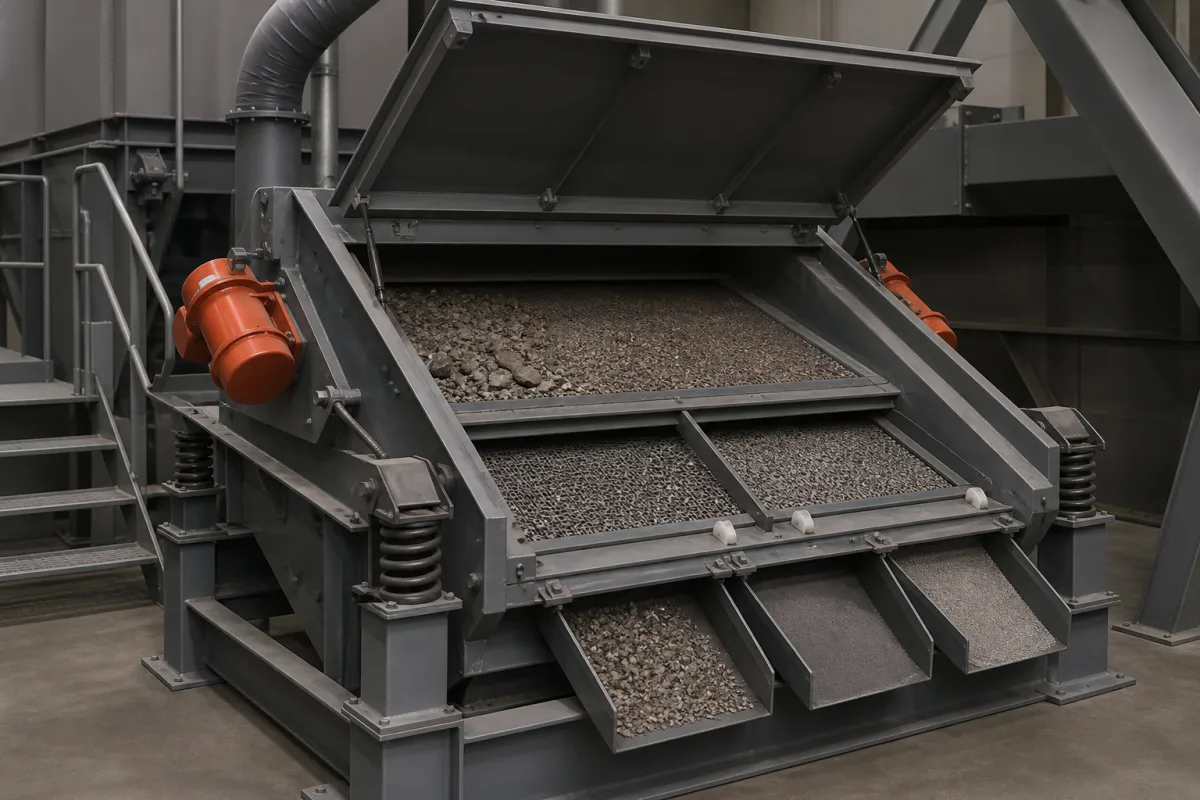
A vibrating screen separates by size only after the fines have worked down through the bed to the deck. That depends on the motion, the stroke and the speed, which together set the G-force; too little and the deck blinds, too much and the frame cracks. Choose the motion and angle for the material, then hold the stroke when the screen is loaded.
Inclined, horizontal, banana, dewatering, fine-material and grizzly vibrating screens for aggregates, minerals, recycling, grain and bulk solids. Mobile screening plants have their own page.
CNFX editorial research · Sources checked October 12, 2026 · 6 sources
MEKA, a screen manufacturer, explains that particles smaller than the aperture pass through as undersize and larger ones leave as oversize, but first the fines must slip down through the coarse material to reach the deck, called stratification. How material moves depends on its shape and on the screen's vibration frequency, amplitude and type of motion; "the most frequently used vibrating screens have 2, 3 or 4 decks". [1]
General Kinematics argues in Global Mining Review that it is the stroke, more than the G-force, that makes a screen effective, because stroke drives stratification. [2]
Give the supplier feed size distribution, the cut sizes for each deck, throughput, moisture, clay content and particle shape. Screen size and deck count come from these, not from capacity alone.
02
Keep stroke, speed and G-force in range
MEKA gives experience-based ranges of 3–4 G for inclined screens and 4–5 G for horizontal screens and feeders. Below range, screening efficiency and capacity fall and the deck can clog; above range, the structure is overstressed, with cracking and shorter bearing life. [1]
As an editorial calculation from basic physics: peak acceleration in G ≈ peak-to-peak stroke (mm) × rpm² ÷ 1,789,000. General Kinematics' example, 800 cycles per minute at an 11 mm stroke, gives about 3.93 G, matching its stated figure. [2]
General Kinematics also warns that a conventional brute-force machine loses stroke under load, for example from 11 mm to 9 mm, cutting G-force to about 3.22; it contrasts this with two-mass units driven by variable-frequency drives that hold stroke. Ask suppliers for stroke and G-force under your load, not only empty. [2]
03
Choose the motion, angle and screen type
MEKA describes inclined screens at 15° to 30° with strokes that "can generally be between 8 mm and 12 mm", and horizontal screens at 0° to 5° with elliptical motion and strokes of 14 to 20 mm, which resist clogging and give a higher stroke and G-force. Banana screens use decks at angles from 0° to 45° for high capacity and low bed depth. [1]
MEKA also describes dewatering screens with counter-rotating vibromotors and a deck inclined against the flow, fine-material screens that can screen feed of 0–5 mm down to 200 µm, and grizzly screens with parallel bars to scalp fines before a crusher. [1]
Ask the supplier which motion and stroke it recommends for your cut size and moisture, and whether stroke and speed can be adjusted on site.
04
Compare what suppliers offer
Suppliers linked to this page list linear, circular, banana, tumbler and rotary vibrating screens, two-stage waste screens and grain cleaning screens. [3][4][5]
Pingyuan lists vibrating, tumbler and rotary vibrating screens; Excellent lists vibrating and banana screens; Qunfeng lists a combi two-stage waste screen; VSEE lists vibrating cleaning screens for paddy rice. [3][4][5][6]
05
Trace the vibrating screen components
This is a functional reference built from the sources cited; it is not one maker's parts list.
Part
Role
Fix in the order
Screen box and decks
Carry the screen media; MEKA: "the most frequently used vibrating screens have 2, 3 or 4 decks". [1]
Deck count, width, length and angle.
Screen media
Sets the apertures for each cut.
Media type, aperture and open area per deck.
Exciter or vibration motors
Create the motion; eccentric weight position sets the pattern. [1]
Fill the specification fields with values for your material
A vibrating screen quotation needs material-specific values. The table explains each field, gives published values where a reviewed source states them, and says what to obtain from the supplier.
Explore company information and manufacturing capabilities, then discuss the scope of your project with a relevant supplier.
Share this page
Compiled and source-reviewed by the CNFX editorial team.
Published product pages show what a company offers, not tested performance. Confirm the legal seller, factory and scope for your order. How we source and review
· Page last updated 13 October 2026
Buyer questions
What G-force should a vibrating screen run at?
MEKA cites experience-based ranges of 3–4 G for inclined screens and 4–5 G for horizontal screens; below range capacity falls and decks clog, above it the structure is overstressed. [1]
How do stroke and speed relate to G-force?
By basic physics, G ≈ peak-to-peak stroke (mm) × rpm² ÷ 1,789,000; General Kinematics' 800 cpm at 11 mm example gives about 3.93 G. [2]
Inclined or horizontal screen?
MEKA describes inclined screens at 15–30° with 8–12 mm strokes and horizontal screens at 0–5° with elliptical motion and 14–20 mm strokes that resist clogging. [1]
Sources and what still needs a direct check
Sources checked 2026-10-12. MEKA is a crushing and screening equipment manufacturer; General Kinematics is a vibratory equipment manufacturer writing in Global Mining Review. Their ranges are experience values, not standards. The G-force relation is an editorial calculation from basic physics. Supplier pages describe their own offers.