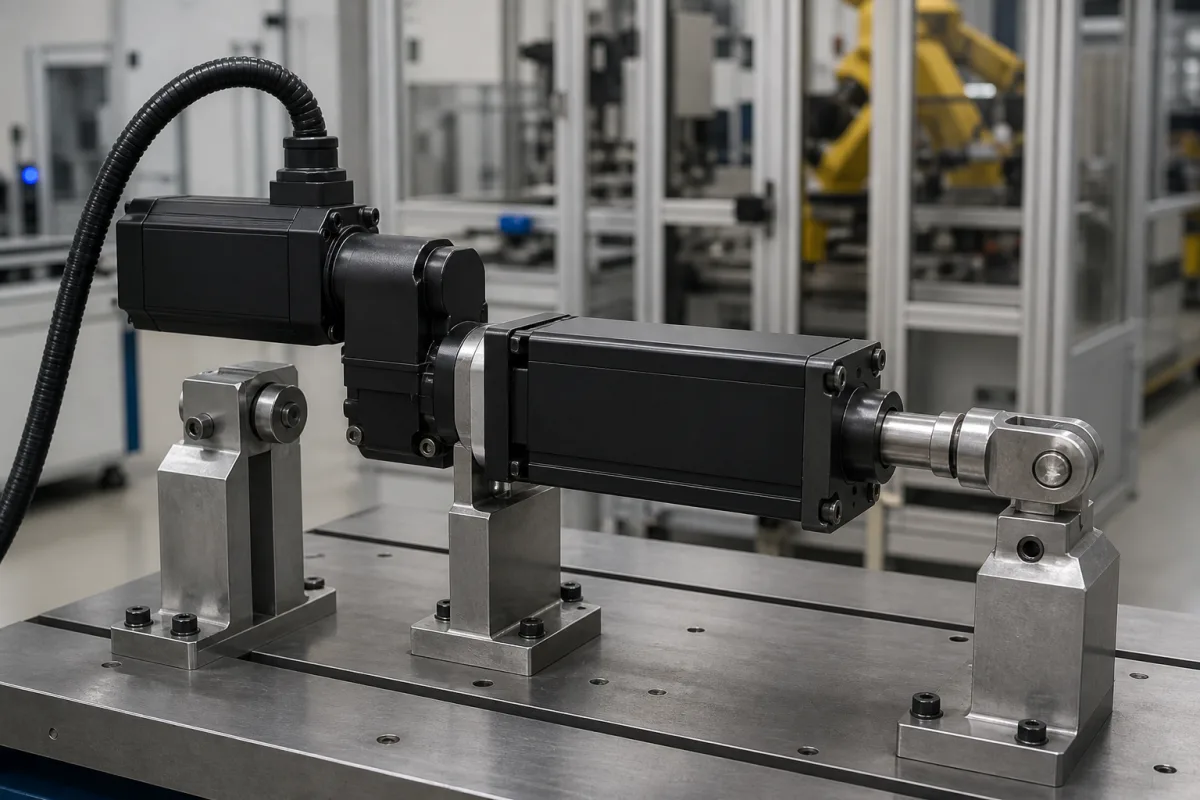
Adjustment actuator: a 12–48 V DC screw rod actuator that sets a machine position, holds it unpowered and reports where it is
The DC rod actuator that moves a machine setting and holds it · 12, 24, 36 or 48 V DC motor driving an acme or ball screw, self-locking or braked when stopped, with potentiometer, Hall or bus position feedback
Some machine settings change only between batches or when the product changes — the width of a guide, the angle of a flap, the height of a chute. A DC-powered screw actuator with position feedback can make that change on command and then sit still, holding the load, for hours. That use is different from a servo axis that runs all day. The questions are how the force and speed options trade against each other, what keeps the setting from drifting when power is off, how the controller knows the position, and how much of the time the motor may actually run.
DC electromechanical rod actuators (12, 24, 36 and 48 V DC) with acme or ball screws, used to adjust and hold machine settings, with their self-locking, brakes, overload clutches, limit switches and position feedback (potentiometer, Hall, analog or digital output, CAN bus). Servo- and stepper-driven industrial actuators for continuous automation axes are covered on the Linear actuators (electric, for automation) page; quarter-turn pneumatic valve actuators on the Pneumatic actuator page; machine compressed-air circuits on the Pneumatic system for production machines page; valve mounting interfaces on the Valve actuator mounting page; air-over-oil cylinders on the Hydro-pneumatic intensifier cylinder page.
CNFX editorial research · Sources checked October 12, 2026 · 3 sources
Same housing, different spindle pitch: from 160 mm/s at 500 N to 7 mm/s at 16 kN
An adjustment actuator family keeps one housing and offers a choice of gear ratios and spindle pitches, each giving a different force and speed. LINAK's LA36 datasheet shows the spread for its 24 V motor: [1]
Thomson's Electrak HD, a ball-screw unit, runs the same trade-off from 1.7 kN at 71/58 mm/s (no load/max. load) through 2.6, 4.5, 6.8 and 10 kN to 16 kN at 7/5 mm/s, with a static load of 18 kN at fully retracted stroke and 12, 24 or 48 V DC inputs. [2] At 24 V its current draw is 1.5 A at no load and 9–10 A at maximum load depending on the load rating. [2]
Editorial calculation: for the Electrak HD 6.8 kN version at 24 V, 6,800 N × 0.014 m/s = 95 W of mechanical output against 24 V × 10 A = 240 W of electrical input, about 40% overall at full load. [2] LINAK notes that fully loaded LA36 actuators need a soft start to keep the clutch from slipping at start-up, and that full-load strokes are limited for some codes. [1]
State the force needed in push and in pull, the travel, the time allowed for an adjustment, and the supply voltage available on the machine; ask for the speed and current at your load, not only the maximum figures.
02
Holding the setting with power off: self-lock rating, load-lock nut, brake and slip clutch
An adjustment that drifts under load is no adjustment. The three makers state holding in different ways. LINAK's LA36 has an integrated brake and high self-lock ability, with a minimum self-lock force above the rated load (for the 6,800 N code, 8,800 N push and pull), and mechanical overload protection through a slip clutch set to 1.2–1.5 times maximum load. [1]
Editorial note: TiMOTION's condition matters when a third-party controller drives the motor — if its output floats rather than shorting the motor leads when stopped, the stated self-locking force may not apply. [3] Ask any supplier under what electrical condition its self-lock figure holds.
Thomson also lists manual override, anti-rotation and end-of-stroke dynamic braking on all Electrak HD units, with braking through the whole stroke only on the low-level switching and SAE J1939 options. [2] LINAK offers a hand crank for manual operation and a non-rotating piston rod eye. [1]
Maker and model
How the load is held
Published figure
LINAK LA36
Acme spindle, integrated brake, self-lock
Self-lock min. 13,000 N for the 10,000 N code; 3,400 N for the 2,600 N code [1]
Self-locking force reached only when the motor terminals are short-circuited (built into TiMOTION control boxes)
Self-locking force up to 8,000 N for the K, R and Y codes [3]
03
Telling the controller where the rod is: potentiometer span, Hall A/B pulses, analog or digital output, CAN
A setting is only repeatable if the actuator reports its position. LINAK offers for the LA36 a potentiometer whose full scale is reached at 333 mm stroke with an 8 mm pitch, 500 mm with 12 mm and 833 mm with 20 mm; a Hall sensor with A/B signal; analog feedback; built-in end stop switches; and adjustable magnetic sensors for end-stop signals. [1]
Editorial calculation: LINAK's three potentiometer spans correspond to the same number of spindle turns — 333 ÷ 8 ≈ 41.6, 500 ÷ 12 ≈ 41.7 and 833 ÷ 20 ≈ 41.7 — so on a short stroke only part of the potentiometer's range is used, and resolution per millimetre falls. [1] TiMOTION's TA41 gives Hall sensors and a reed sensor as its output signals. [3]
Thomson warns not to use PWM voltage for speed control of Electrak HD, to avoid damaging the onboard electronics. [2] Editorial note: check this against the controller planned for the machine before choosing an actuator with onboard electronics.
Thomson Electrak HD control option
Adds
EXX
Electrak monitoring package: current, voltage and temperature monitoring, load trip point, internal end-of-stroke switches [2]
Low-level signal motor switching; with analog position output [2]
LPS
Programmable limit switches and signal-follower [2]
COO / CNO
CANopen or SAE J1939 bus control with open-loop speed control [2]
SY2
Synchronisation option for running actuators together [2]
04
How long it may run: 25%, 20%, 15% and 5% duty, and the temperatures they are quoted at
Adjustment actuators are not rated for continuous running. Thomson gives a full-load duty cycle of 25% at 25 °C for the Electrak HD, falling to 15% for the 10 kN and 16 kN versions. LINAK gives 20% at maximum load for LA36 strokes up to 600 mm, 15% for 601–999 mm, and 5% for the 10,000 N version, at 25 °C ambient. [2][1]
Editorial note: the TA41 row shows why the same-looking rod actuator is not interchangeable across uses — TiMOTION positions it for medical equipment, without an IP rating, while the LA36 and Electrak HD are built for outdoor and wash-down machinery. [3][1][2] For a machine adjustment, state the ambient, the wash-down regime and how many adjustments per hour are expected, and check them against the duty figure at your load.
Give the number of adjustments per hour and their length, ambient temperature range, wash-down or outdoor exposure, and end-play tolerance on the set position.
05
Details for an adjustment actuator enquiry
Paste it into your enquiry below or into an email to a maker, then replace every bracket.
Load: [push and pull force; static holding force]
Motion: [stroke; time per adjustment; adjustments per hour]
Power: [12 / 24 / 36 / 48 V DC; controller type; PWM or not]
Holding: [self-lock; brake; manual override]
Feedback: [potentiometer; Hall A/B; analog or digital output; CANopen or J1939]
Limits: [end-stop switches; overload clutch]
Environment: [temperature; IP rating; wash-down; salt spray]
Mounting: [rear and front fixtures; orientation]
Explore company information and manufacturing capabilities, then discuss the scope of your project with a relevant supplier.
Share this page
Compiled and source-reviewed by the CNFX editorial team.
Each manufacturer above links to the page on that company's own website where the product is listed, with the date we checked it. How we source and review
· Page last updated 13 October 2026
Buyer questions
How much force can a DC adjustment actuator give?
LINAK's LA36 ranges from 500 to 10,000 N depending on gear and pitch; Thomson's Electrak HD from 1.7 to 16 kN dynamic, with 18 kN static at full retraction. [1][2]
What duty cycle do DC rod actuators allow?
Thomson gives 25% at full load for Electrak HD (15% for 10 and 16 kN); LINAK gives 20% for LA36 up to 600 mm stroke, 15% for longer strokes and 5% for the 10,000 N version. [2][1]
How does an adjustment actuator hold its position without power?
LINAK uses an acme spindle with integrated brake and self-lock; Thomson uses a load-lock ball nut and holding brake; TiMOTION's TA41 reaches its self-locking force only with the motor terminals short-circuited. [1][2][3]
What position feedback is available?
LINAK offers potentiometer, Hall A/B and analog feedback; Thomson offers analog or digital position output and CANopen or SAE J1939 control. [1][2]
Sources and what still needs a direct check
Sources checked 2026-10-12. Force, speed, self-lock, clutch, feedback and duty data come from LINAK's LA36 product data sheet (distributor-hosted copy) and Thomson's Electrak HD technical specifications (distributor-hosted catalogue pages); the medical-type comparison and short-circuit self-locking condition from TiMOTION's TA41 datasheet.