Industry-Verified Manufacturing Data (2026)

Feedback Sensor (e.g., Encoder)

Based on aggregated insights from multiple verified factory profiles within the CNFX directory, the standard Feedback Sensor (e.g., Encoder) used in the Machinery and Equipment Manufacturing sector typically supports operational capacities ranging from standard industrial configurations to heavy-duty production requirements.

Technical Definition & Core Assembly

A canonical Feedback Sensor (e.g., Encoder) is characterized by the integration of Sensing Element and Signal Transducer. In industrial production environments, manufacturers listed on CNFX commonly emphasize Aluminum Alloy (Housing) construction to support stable, high-cycle operation across diverse manufacturing scenarios.

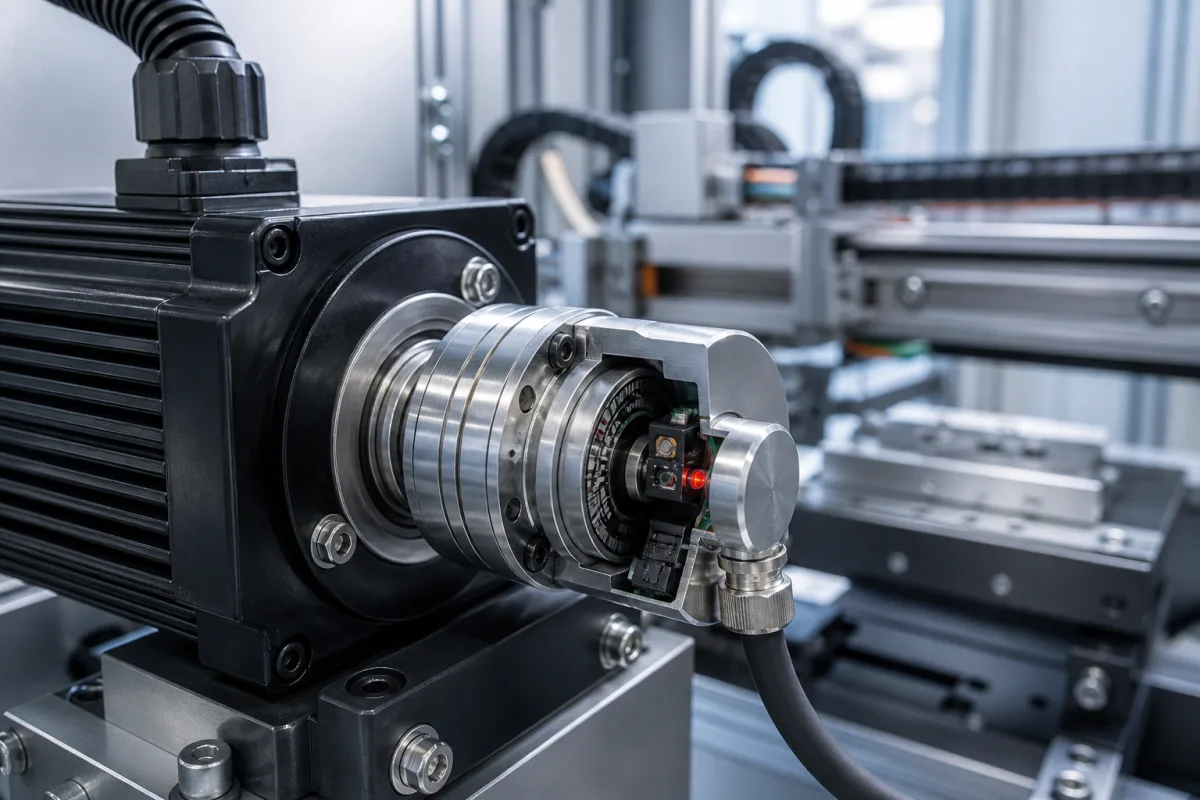
A device that measures and reports the position, speed, or other state of an actuator component to enable closed-loop control.
Product Specifications

Technical details and manufacturing context for Feedback Sensor (e.g., Encoder)

Definition
A feedback sensor, such as an encoder, is a critical component within an Adjustment Actuator system. It provides real-time, precise measurement data (e.g., rotational position, linear displacement, speed) of the actuator's moving part. This data is fed back to the controller, which compares it to the desired setpoint and adjusts the actuator's drive signal accordingly, enabling accurate, stable, and responsive closed-loop control essential for automation and precision tasks.
Working Principle
The sensor (e.g., an optical, magnetic, or inductive encoder) generates a signal (analog or digital) proportional to the physical parameter being measured (position/speed). This signal is transmitted to a control unit. For a rotary encoder, this typically involves a disc with patterns interrupting a light beam or altering a magnetic field, producing pulse trains. The controller counts these pulses to determine precise position and derives speed from the pulse frequency.
Common Materials
Aluminum Alloy (Housing), Stainless Steel (Shaft), Glass/Plastic (Code Disc), Silicon (Photodetectors/ICs)
Technical Parameters
  • Pulses Per Revolution; defines the resolution of a rotary encoder. (ppr) Customizable
Components / BOM
  • Sensing Element
    Generates the primary signal based on physical movement (e.g., optical pattern on disc, magnetic poles).
    Material: Glass/Plastic (for optical disc), Magnetic Alloy (for magnetic ring)
  • Signal Transducer
    Converts the physical signal from the sensing element into an electrical signal (e.g., photodetector, Hall-effect sensor).
    Material: Silicon (Photodiode/IC)
  • Signal Conditioning Circuit
    Amplifies, filters, and shapes the raw electrical signal into a clean, standardized output (e.g., TTL, HTL, sine/cosine).
    Material: Silicon (Integrated Circuits), Copper (PCB traces)
  • Mechanical Housing & Interface
    Provides structural support, alignment, and mounting interface (e.g., shaft, flange, connector).
    Material: Aluminum Alloy, Stainless Steel
Engineering Reasoning
0-10000 RPM with ±0.1° angular resolution
125°C operating temperature, 100g shock acceleration, 5000V ESD discharge
Design Rationale: Hall effect sensor demagnetization at Curie temperature (125°C for NdFeB magnets), piezoelectric crystal fracture at 100g mechanical shock, semiconductor junction breakdown at 5000V electrostatic discharge
Risk Mitigation (FMEA)
Trigger Electromagnetic interference from 50-100MHz switching power supplies
Mode: Signal-to-noise ratio degradation below 20dB causing position error >0.5°
Strategy: Shielded twisted-pair cabling with ferrite chokes and differential signal conditioning
Trigger Contaminant ingress (ISO 4406 Class 18/16/13 particulate >4μm)
Mode: Optical encoder disc contamination causing 30% light transmission loss
Strategy: IP67-rated housing with labyrinth seals and positive pressure nitrogen purge at 1.2 bar

Industry Taxonomies & Aliases

Commonly used trade names and technical identifiers for Feedback Sensor (e.g., Encoder).

Applied To / Applications

This component is essential for the following industrial systems and equipment:

Industrial Ecosystem & Supply Chain DNA

Complementary Systems
Downstream Applications
Specialized Tooling

Application Fit & Sizing Matrix

Operational Limits
pressure: 0 to 2 bar (non-submersible)
other spec: IP67 rating, 1000–5000 PPR (pulses per revolution)
temperature: -40°C to +85°C
Media Compatibility
✓ clean air environments ✓ industrial lubricants ✓ non-corrosive gases
Unsuitable: high-pressure washdown or submerged conditions without proper sealing
Sizing Data Required
  • required resolution (PPR or bits)
  • shaft size and mounting type
  • output signal type (e.g., incremental, absolute, analog)

Reliability & Engineering Risk Analysis

Failure Mode & Root Cause
Signal Degradation
Cause: Contamination ingress (dust, oil, moisture) interfering with optical or magnetic sensing elements, or electrical noise from nearby equipment.
Mechanical Wear or Breakage
Cause: Excessive vibration, misalignment, or shaft loading leading to bearing failure, code disc cracking, or coupling damage.
Maintenance Indicators
  • Intermittent or erratic position/speed readings (e.g., jumps, dropouts) in the control system.
  • Unusual audible noise (grinding, clicking) from the encoder housing during rotation.
Engineering Tips
  • Ensure proper sealing and environmental protection (IP rating match) and route signal cables separately from power cables to minimize electrical interference.
  • Verify and maintain precise shaft alignment, use flexible couplings to absorb minor misalignment, and adhere to specified axial/radial load limits.

Compliance & Manufacturing Standards

Reference Standards
ISO 13849-1: Safety of machinery - Safety-related parts of control systems IEC 60034-1: Rotating electrical machines - Rating and performance EN 50178: Electronic equipment for use in power installations
Manufacturing Precision
  • Shaft runout: ≤0.01mm
  • Mounting flange flatness: ≤0.02mm
Quality Inspection
  • Environmental testing (IP rating validation)
  • Signal accuracy verification against reference standard

Factories Producing Feedback Sensor (e.g., Encoder)

Verified manufacturers with capability to produce this product in China

✓ 97% Supplier Capability Match Found

S Sourcing Manager from Canada Feb 05, 2026
★★★★★
"As a professional in the Machinery and Equipment Manufacturing sector, I confirm this Feedback Sensor (e.g., Encoder) meets all ISO standards."
Technical Specifications Verified
P Procurement Specialist from United States Feb 02, 2026
★★★★☆
"Standard OEM quality for Machinery and Equipment Manufacturing applications. The Feedback Sensor (e.g., Encoder) arrived with full certification. (Delivery took slightly longer than expected, but technical support was excellent.)"
Technical Specifications Verified
T Technical Director from United Arab Emirates Jan 30, 2026
★★★★★
"Great transparency on the Feedback Sensor (e.g., Encoder) components. Essential for our Machinery and Equipment Manufacturing supply chain."
Technical Specifications Verified
Verification Protocol

“Feedback is collected from verified sourcing managers during RFQ (Request for Quote) and factory evaluation processes on CNFX. These reports represent historical performance data and technical audit summaries from our B2B manufacturing network.”

17 sourcing managers are analyzing this specification now. Last inquiry for Feedback Sensor (e.g., Encoder) from India (1h ago).

Supply Chain Compatible Machinery & Devices

Hydraulic Press

Industrial machine using hydraulic pressure to compress, form, or assemble materials

Explore Specs →
Heavy-Duty CNC Plasma Cutting Machine

Industrial machine for precision metal cutting using plasma arc technology

Explore Specs →
Automated Assembly Line System

Integrated production system for sequential component assembly operations

Explore Specs →
Automated Powder Coating System

Integrated industrial system for applying dry powder coatings to metal substrates.

Explore Specs →

Frequently Asked Questions

What is the primary function of this feedback sensor in machinery manufacturing?

This feedback sensor provides real-time measurement of position, speed, or other actuator states to enable precise closed-loop control systems in industrial machinery, ensuring accurate operation and process control.

Why is aluminum alloy used for the housing and stainless steel for the shaft?

Aluminum alloy provides lightweight yet durable housing with good heat dissipation, while stainless steel offers corrosion resistance and mechanical strength for the rotating shaft, ensuring longevity in industrial environments.

How does the sensing element work in this feedback sensor?

The sensing element uses a glass or plastic code disc with optical patterns read by silicon photodetectors, converting mechanical position into electrical signals that are conditioned by integrated circuits for accurate digital output.

Can I contact factories directly on CNFX?

CNFX is an open directory, not a transaction platform. Each factory profile provides direct contact information and production details to help you initiate direct inquiries with Chinese suppliers.

Get Quote for Feedback Sensor (e.g., Encoder)

Request technical pricing, lead times, or customized specifications for Feedback Sensor (e.g., Encoder) directly from verified manufacturing units.

Your business information is encrypted and only shared with verified Feedback Sensor (e.g., Encoder) suppliers.

Thank you! Your message has been sent. We'll respond within 1–3 business days.

Need to Manufacture Feedback Sensor (e.g., Encoder)?

Connect with verified factories specializing in this product category

Add Your Factory Contact Us
Previous Product
Feedback Sensor
Next Product
Feedback Sensor (e.g., LVDT)