Industry-Verified Manufacturing Data (2026)

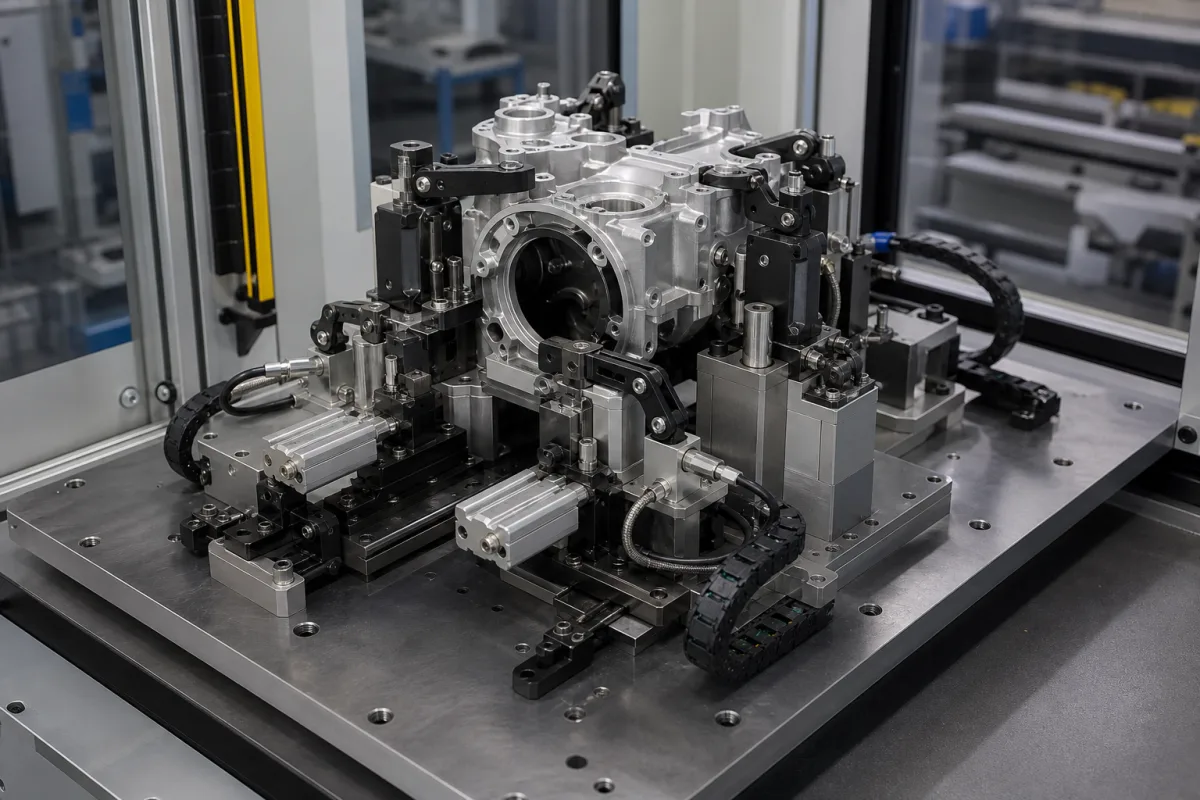
Automated Fixture System

Based on aggregated insights from multiple verified factory profiles within the CNFX directory, the standard Automated Fixture System used in the Machinery and Equipment Manufacturing sector typically supports operational capacities ranging from standard industrial configurations to heavy-duty production requirements.

Technical Definition & Core Assembly

A canonical Automated Fixture System is characterized by the integration of Fixture Base Plate and Linear Actuator Module. In industrial production environments, manufacturers listed on CNFX commonly emphasize Aluminum alloy (for frames and lightweight structures) construction to support stable, high-cycle operation across diverse manufacturing scenarios.

A precision positioning and securing system within a Quality Testing Station that automatically handles, aligns, and holds test specimens or products during inspection processes.
Product Specifications

Technical details and manufacturing context for Automated Fixture System

Definition
The Automated Fixture System is a critical component of the Quality Testing Station responsible for the automated handling, precise positioning, and secure clamping of test specimens or manufactured products. It ensures consistent and repeatable placement for accurate measurement, inspection, and testing by other station components, such as sensors, cameras, or probes. This system typically integrates with the station's control software to receive instructions and adapt to different product geometries or testing protocols.
Working Principle
The system operates by receiving commands from the Quality Testing Station's central controller. Actuators (e.g., pneumatic cylinders, electric motors, or servo drives) move fixture elements (clamps, locators, supports) to predefined positions based on the product's specifications. Sensors provide feedback on position and clamping force. The system securely holds the product in the exact orientation required for the subsequent testing sequence, then releases it upon completion.
Common Materials
Aluminum alloy (for frames and lightweight structures), Stainless steel (for wear-resistant clamps and guides), Engineering plastics (for non-marring contact surfaces)
Technical Parameters
  • Positioning repeatability of the fixture system, critical for test accuracy. (mm) Customizable
Components / BOM
  • Fixture Base Plate
    Provides a stable, machined reference surface for mounting all other fixture components and aligning with the testing station.
    Material: Cast iron or precision-ground steel
  • Linear Actuator Module
    Provides controlled linear motion to position fixture arms, clamps, or locators along one or more axes.
    Material: Aluminum housing, steel guide rails, ball screw
  • Programmable Clamping Unit
    A motorized or pneumatic clamp that applies and releases a controlled force to secure the test specimen.
    Material: Stainless steel jaws, aluminum body
  • Position Feedback Sensor
    Measures the actual position of moving fixture elements and provides data to the control system for closed-loop operation.
    Material: Stainless steel housing, glass scale or magnetic strip
  • Control Interface Module
    Receives commands from the main station controller and drives the actuators, while monitoring sensor feedback.
    Material: PCB, plastic enclosure, connector terminals
Engineering Reasoning
0.5-2.0 kN clamping force, 0.01-0.05 mm positioning accuracy, 0-60°C ambient temperature
Clamping force exceeds 2.5 kN causing permanent deformation, positioning error exceeds 0.1 mm, ambient temperature exceeds 80°C
Design Rationale: Yield strength of aluminum alloy 6061-T6 (276 MPa) exceeded at 2.5 kN clamping force, thermal expansion coefficient mismatch (23.6 μm/m·K for aluminum vs 10.8 μm/m·K for steel) causing positioning drift
Risk Mitigation (FMEA)
Trigger Pneumatic pressure regulator drift exceeding 0.7 bar from setpoint
Mode: Inconsistent clamping force causing specimen slippage during vibration testing
Strategy: Install digital pressure sensors with 0.1 bar accuracy and closed-loop feedback control
Trigger Stepper motor microstepping resolution degradation below 1.8° per full step
Mode: Positioning accuracy loss exceeding 0.05 mm tolerance
Strategy: Implement optical encoder feedback with 0.001 mm resolution and PID position correction

Industry Taxonomies & Aliases

Commonly used trade names and technical identifiers for Automated Fixture System.

Applied To / Applications

This component is essential for the following industrial systems and equipment:

Industrial Ecosystem & Supply Chain DNA

Complementary Systems
Downstream Applications
Specialized Tooling

Application Fit & Sizing Matrix

Operational Limits
pressure: 0 to 10 bar
temperature: 0°C to 50°C
load capacity: 0 to 100 kg
repeatability: ±0.005 mm
positioning accuracy: ±0.01 mm
Media Compatibility
✓ metallic test specimens ✓ plastic components ✓ electronic assemblies
Unsuitable: highly corrosive chemical environments
Sizing Data Required
  • maximum specimen dimensions (LxWxH)
  • specimen weight range
  • required positioning accuracy

Reliability & Engineering Risk Analysis

Failure Mode & Root Cause
Positional drift
Cause: Wear in linear guides or ball screws due to inadequate lubrication, contamination ingress, or misalignment from improper installation
Clamping force degradation
Cause: Pneumatic cylinder seal wear or hydraulic fluid contamination leading to pressure loss, or mechanical wear in clamping mechanisms from repeated cycling
Maintenance Indicators
  • Unusual grinding or scraping noises during movement cycles
  • Visible misalignment or inconsistent part positioning during operation
Engineering Tips
  • Implement predictive maintenance using vibration analysis on drive components and pressure monitoring on clamping systems
  • Establish regular calibration schedules for positioning sensors and force measurement systems, with environmental controls to minimize thermal expansion effects

Compliance & Manufacturing Standards

Reference Standards
ISO 9001:2015 - Quality Management Systems ANSI B5.54 - Machine Tool Components and Fixtures DIN 6325 - Clamping Devices for Machine Tools
Manufacturing Precision
  • Positional Accuracy: +/-0.01mm
  • Surface Flatness: 0.05mm/m
Quality Inspection
  • Coordinate Measuring Machine (CMM) Verification
  • Load Capacity and Repeatability Testing

Factories Producing Automated Fixture System

Verified manufacturers with capability to produce this product in China

✓ 94% Supplier Capability Match Found

T Technical Director from United Arab Emirates Feb 23, 2026
★★★★★
"Reliable performance in harsh Machinery and Equipment Manufacturing environments. No issues with the Automated Fixture System so far."
Technical Specifications Verified
P Project Engineer from Australia Feb 20, 2026
★★★★☆
"Testing the Automated Fixture System now; the technical reliability results are within 1% of the laboratory datasheet. (Delivery took slightly longer than expected, but technical support was excellent.)"
Technical Specifications Verified
S Sourcing Manager from Singapore Feb 17, 2026
★★★★★
"Impressive build quality. Especially the technical reliability is very stable during long-term operation."
Technical Specifications Verified
Verification Protocol

“Feedback is collected from verified sourcing managers during RFQ (Request for Quote) and factory evaluation processes on CNFX. These reports represent historical performance data and technical audit summaries from our B2B manufacturing network.”

14 sourcing managers are analyzing this specification now. Last inquiry for Automated Fixture System from Vietnam (1h ago).

Supply Chain Compatible Machinery & Devices

Hydraulic Press

Industrial machine using hydraulic pressure to compress, form, or assemble materials

Explore Specs →
Heavy-Duty CNC Plasma Cutting Machine

Industrial machine for precision metal cutting using plasma arc technology

Explore Specs →
Automated Assembly Line System

Integrated production system for sequential component assembly operations

Explore Specs →
Automated Powder Coating System

Integrated industrial system for applying dry powder coatings to metal substrates.

Explore Specs →

Frequently Asked Questions

What materials are used in the Automated Fixture System to ensure durability and precision?

The system uses aluminum alloy for lightweight structural frames, stainless steel for wear-resistant clamps and guides, and engineering plastics for non-marring contact surfaces to protect specimens during testing.

How does the Automated Fixture System improve quality testing station efficiency?

It automates specimen handling, alignment, and securing with programmable clamping and position feedback sensors, reducing manual intervention, minimizing errors, and accelerating inspection processes.

What are the key components included in the Automated Fixture System BOM?

The Bill of Materials includes a Fixture Base Plate, Linear Actuator Module, Programmable Clamping Unit, Position Feedback Sensor, and Control Interface Module for integrated operation.

Can I contact factories directly on CNFX?

CNFX is an open directory, not a transaction platform. Each factory profile provides direct contact information and production details to help you initiate direct inquiries with Chinese suppliers.

Get Quote for Automated Fixture System

Request technical pricing, lead times, or customized specifications for Automated Fixture System directly from verified manufacturing units.

Your business information is encrypted and only shared with verified Automated Fixture System suppliers.

Thank you! Your message has been sent. We'll respond within 1–3 business days.

Need to Manufacture Automated Fixture System?

Connect with verified factories specializing in this product category

Add Your Factory Contact Us
Previous Product
Automated Conveyor Module
Next Product
Automated Mold Preparation Station