Backwash valves and control valves for media filters and softeners · service and backwash flow, pressure drop and Cv, backwash rate per bed area, cycle programming, operating pressure and temperature, materials and drinking-water certification
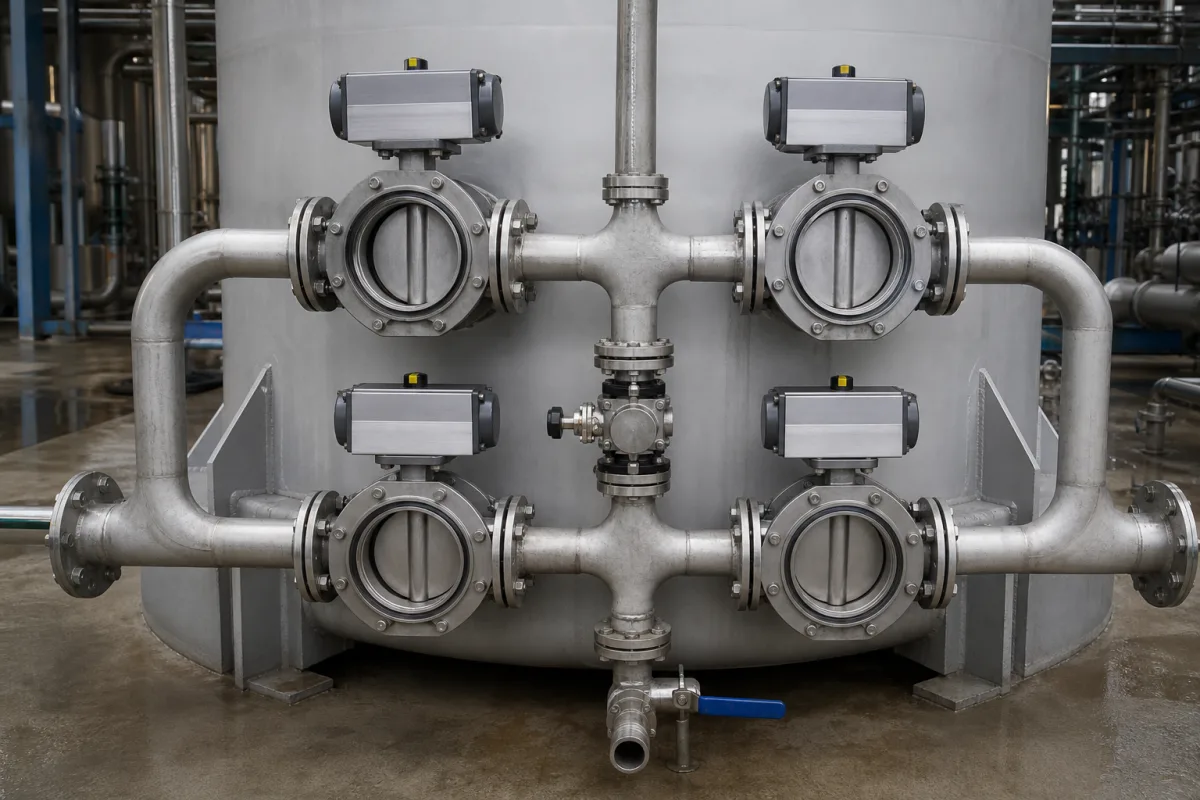
A backwash valve assembly switches a media filter or softener between normal service and cleaning: it reverses flow upward through the bed to flush out trapped dirt, then rinses before returning to service. It may be a single multi-cycle control valve on top of the tank or a set of automated valves piped around a larger vessel. Ask three things first: the service and backwash flows the filter needs, which set the valve size; how cycles are started and timed; and the pressure, temperature and water-quality certifications required.
Backwash and control valves for water filters and softeners — top- or side-mount multi-cycle control valves, multiport valves and automated valve nests for larger filters — with timers, meters and controllers. Filter vessels and media, self-cleaning screen filters, general-purpose butterfly or ball valves bought alone, and complete water treatment systems are outside this page except where compared.
CNFX editorial research · Sources checked October 12, 2026 · 4 sources
Clack's WS3 Water Specialist control valve, a 3-inch valve for commercial and industrial filters and softeners, lists service flow of 250 gpm (56.8 m³/h) at a 15 psi (1 bar) pressure drop and backwash flow of 220 gpm (50.0 m³/h) at a 25 psi (1.7 bar) drop, with Cv values of 64.6 for service and 44.0 for backwash. Its sizing note calculates filter tank size at 10 gpm of backwash per square foot of bed area (407 L/min per m²). [1] Pentair's 1.5-inch 2850s control valve lists 70 gpm continuous at 15 psi drop, 90 gpm peak at 25 psi drop, Cv 18 and maximum backwash of 70 gpm, handling softeners up to 36-inch tanks and filters up to 30-inch tanks. [2]
Editorial calculation: at 10 gpm per square foot, the WS3's 220 gpm backwash supports about 22 ft² of bed — a round tank of roughly 63 in (1.6 m) diameter; a larger bed would need more backwash flow than the valve passes, so valve and tank must be sized together. [1]
Give the supplier the filter or softener type and media, tank diameter and number of tanks, service flow and allowable pressure drop, backwash and rinse flow, regeneration or backwash initiation (time, meter, differential pressure, remote), number of cycles and durations, operating pressure and temperature, inlet/outlet size and connection, body and seal materials, drinking-water certification needed, controller interface (e.g. Modbus), power supply, and quantity.
02
Set cycles, initiation, limits and materials
The WS3 offers up to nine programmable cycles in any order, with backwash, slow rinse and fast rinse each settable from 1 to 95 minutes; regeneration can be initiated by meter (delayed or immediate), time clock or remote signal, systems can be single, alternating, progressive-flow or series, and it can communicate with building automation over Modbus RS485. It operates at 20–125 psi (1.4–8.6 bar) and 4–43 °C, has a lead-free brass body, is certified to NSF/ANSI 44, NSF/ANSI/CAN 61 and 372, and lists compatibility with sodium and potassium chloride, potassium permanganate, sodium bisulphite, chlorine and chloramines. [1] The 2850s uses a hydraulically balanced piston, seal and spacer design, has a lead-free brass body, offers five adjustable cycles including upflow backwash and rinses, and supports multi-tank systems. [2]
Editorial note: for large filters built with separate automated valves around the vessel, ask the supplier for the valve sequence, actuator type, position feedback and how the controller prevents two paths being open at once.
03
Check the valve's backwash flow against public-water filter rules
The 2022 Recommended Standards for Water Works (the Ten States Standards, Great Lakes – Upper Mississippi River Board of State and Provincial Public Health and Environmental Managers) set rules for rapid rate pressure filters, whose normal use it gives as iron and manganese removal. At least two units are required; the filtration rate "shall not exceed four gallons per minute per square foot" unless testing approved by the reviewing authority shows otherwise; and the underdrain must distribute backwash water at a rate not less than 15 gallons per minute per square foot (37 m/hr.). Each filter must be filtered and backwashed individually, with backwash flow indicators and controls readable while operating the control valves. [4]
These rates give a check on valve size. Clack's WS3 passes 220 gpm of backwash at a 25 psi drop and its sizing note works at 10 gpm of backwash per square foot [1]. Under the Ten States minimum of 15 gpm/ft² for a pressure filter [4], the same valve covers a smaller tank. Ask the supplier which backwash rate its tank sizing assumes and which design rules the project must meet; Virginia's softener rule on this page uses the same 6 to 8 gpm/ft² backwash band [3].
The requirement for individual backwash of each filter and readable backwash flow indicators [4] matters when a valve nest or more than one valve serves a bank of filters. Pentair's 2850s lists 70 gpm of backwash for a 1.5-inch valve [2]; for multi-tank systems ask how each tank is backwashed separately and where the flow indicator sits.
Editorial calculation: 220 gpm of backwash covers about 14.7 ft² of filter at 15 gpm/ft² (a tank of about 52 in diameter), 11.0 ft² at 20 gpm/ft² (about 45 in) and 22.0 ft² at 10 gpm/ft² (about 63.5 in). [1][4]
Item (Ten States Standards 2022)
Value
Pressure filter rate
Not more than 4 gpm/ft² (unless approved testing shows otherwise)
Backwash rate (pressure filter underdrain)
Not less than 15 gpm/ft² (37 m/hr.)
Backwash rate (gravity filters, 4.3.1.13)
Minimum 15 gpm/ft²; 20 gpm/ft² (50 m/hr.) or 50% bed expansion recommended; 10 gpm/ft² (24 m/hr.) may be acceptable for full depth anthracite or GAC
Softening (cation exchange)
Not more than 7 gpm/ft² (17 m/hr.); backwash 6 to 8 gpm/ft²
Number of units
At least two
Wash water collectors
At least 18 inches above the media surface
Values are from the 2022 Recommended Standards for Water Works (text extracted from the PDF hosted by the Pennsylvania DEP); state rules decide which provisions apply to a given system.
04
Compare what suppliers offer
The companies in the manufacturer list below show this product on their own websites. Confirm the legal seller, factory and scope for your order.
When requesting quotations, ask each supplier for flow at stated pressure drops, Cv for service and backwash, cycle programming, certifications and spare-part availability.
05
Check softener valves against public-waterworks design limits
For softeners on public waterworks, Virginia's Waterworks Regulations (12VAC5-590-900) set design limits that bear directly on the control valve. Units may be pressure or gravity type, upflow or downflow, with automatic or manual regeneration. The hydraulic loading rate should not exceed seven gpm/ft² and the backwash rate should be six to eight gpm/ft²; the resin bed must be at least three feet deep, and hardness-removal design capacity must not exceed 20,000 grains/ft³ when regenerated with 0.3 pounds of salt per kilograin removed. [3] Water applied to the resin must not exceed 0.3 mg/L of iron and manganese or reach a turbidity of five NTU. [3]
The regulation also requires backwash, rinse and air-relief discharge pipes to be installed so that backsiphonage cannot occur, meters on each softener unit and on total water delivered, and a bypass for blending, which should carry an automatic proportioning or regulating device and a shutoff valve. [3] Editorial calculation: at the six to eight gpm/ft² backwash rate, a valve passing 220 gpm of backwash (the Clack WS3 figure above) covers a softener bed of about 220 ÷ 8 = 27.5 ft² to 220 ÷ 6 ≈ 36.7 ft². [3][1] Editorial note: ask the supplier to state the service flow per square foot of bed and the backwash flow control setting for your tank, and to confirm the drain-line air gap or backflow arrangement.
06
Trace the valve assembly
This is a functional reference built from the sources cited; it is not one maker's design.
Fill the specification fields with values for your project
A backwash valve quotation needs values for your project. The table explains each field, gives published values where a reviewed source states them, and says what to obtain from the supplier.
Explore company information and manufacturing capabilities, then discuss the scope of your project with a relevant supplier.
Share this page
Compiled and source-reviewed by the CNFX editorial team.
Published product pages show what a company offers, not tested performance. Confirm the legal seller, factory and scope for your order. How we source and review
· Page last updated 13 October 2026
Buyer questions
How much backwash flow does a media filter need?
Clack sizes filter tanks at 10 gpm of backwash per square foot of bed area (407 L/min per m²). [1]
What flow does a 3-inch control valve pass?
Clack's WS3 lists 250 gpm service at 15 psi drop and 220 gpm backwash at 25 psi drop. [1]
How long are backwash and rinse cycles?
The WS3 allows backwash, slow rinse and fast rinse each from 1 to 95 minutes. [1]
What backwash rate do softener rules require?
Virginia's Waterworks Regulations (12VAC5-590-900) say the softener backwash rate should be six to eight gpm/ft², with hydraulic loading not above seven gpm/ft². [3]
What backwash rate do public water pressure filters need?
The 2022 Ten States Standards require the underdrain of a rapid rate pressure filter to distribute backwash water at not less than 15 gpm per square foot (37 m/hr), with filtration not above 4 gpm per square foot and at least two units. [4]
Sources and what still needs a direct check
Sources checked 2026-10-12. Both are maker specification sheets (Clack and Pentair) hosted by distributors.