Industry-Verified Manufacturing Data (2026)

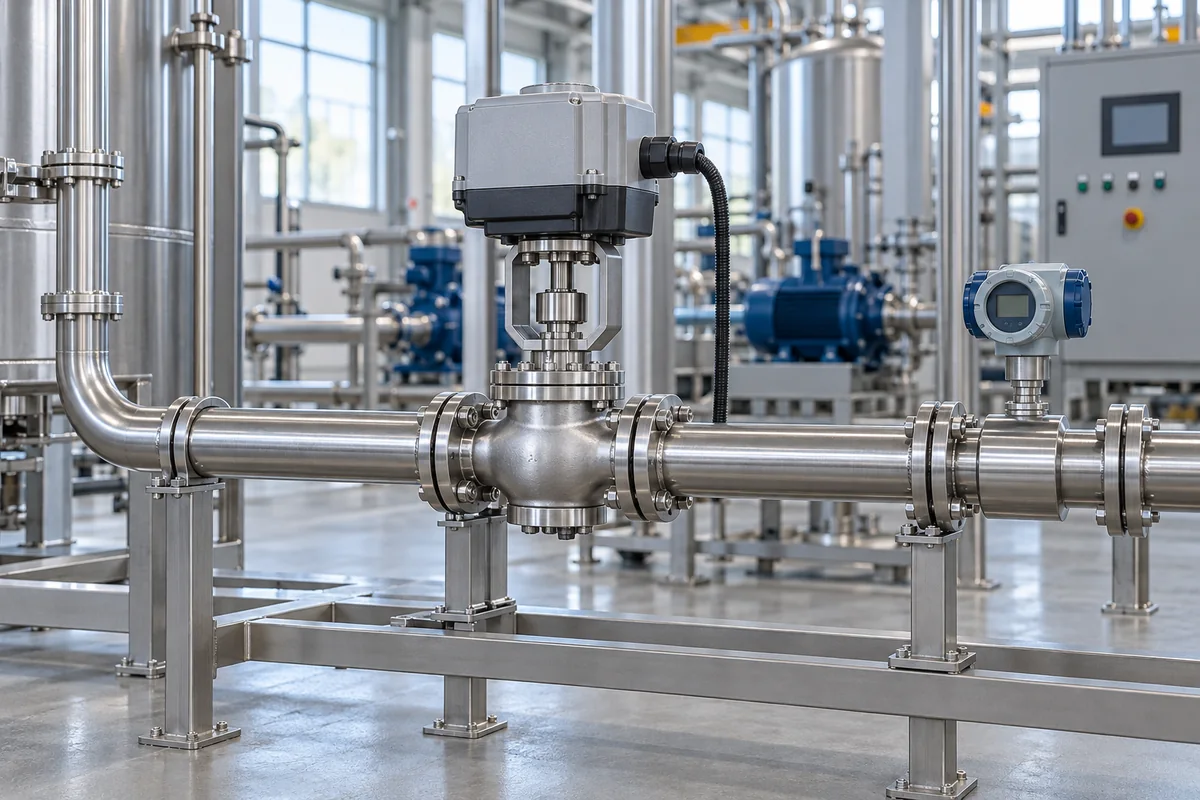
Control Valve / Actuator

Based on aggregated insights from multiple verified factory profiles within the CNFX directory, the standard Control Valve / Actuator used in the Machinery and Equipment Manufacturing sector typically supports operational capacities ranging from standard industrial configurations to heavy-duty production requirements.

Technical Definition & Core Assembly

A canonical Control Valve / Actuator is characterized by the integration of Valve Body and Valve Trim (Plug/Seat). In industrial production environments, manufacturers listed on CNFX commonly emphasize Stainless Steel (Body/Trim) construction to support stable, high-cycle operation across diverse manufacturing scenarios.

A component that regulates fluid flow by adjusting valve position in response to control signals.
Product Specifications

Technical details and manufacturing context for Control Valve / Actuator

Definition
Within a Flow Controller system, the Control Valve/Actuator is the final control element that physically modulates the flow rate, pressure, or level of a process fluid. It receives signals from the controller and converts them into mechanical movement to open, close, or throttle the valve, thereby executing the desired control action on the process.
Working Principle
The actuator (pneumatic, electric, or hydraulic) receives a control signal (e.g., 4-20 mA, 3-15 psi, digital). This signal positions the actuator stem, which is mechanically linked to the valve plug or disc. The movement of this internal valve component changes the flow area through the valve body, precisely regulating the flow of the process medium.
Common Materials
Stainless Steel (Body/Trim), PTFE/Elastomer (Seals/Packing), Aluminum/Steel (Actuator Housing)
Technical Parameters
  • Valve size (Nominal Diameter) (mm) Customizable
Components / BOM
  • Valve Body
    Contains the process fluid and provides flow path.
    Material: Stainless Steel, Cast Iron, Alloy
  • Valve Trim (Plug/Seat)
    Modulates flow by changing the orifice area.
    Material: Stainless Steel, Hardened Alloy, Ceramic
  • Actuator
    Converts control signal into stem force/movement.
    Material: Aluminum, Steel, Composite
  • Positioner
    Ensures valve stem position matches the control signal.
    Material: Aluminum, Plastic, Electronic Components
  • Packing/Seals
    Prevents leakage along the valve stem.
    Material: PTFE, Graphite, Elastomer
Engineering Reasoning
0.5-100 bar differential pressure, -40°C to 200°C fluid temperature, 4-20 mA control signal
Cavitation occurs at vapor pressure ≤ 0.5 bar absolute, actuator torque exceeds 150 Nm at 100 bar, stem displacement exceeds ±25 mm from setpoint
Design Rationale: Cavitation-induced pitting from Bernoulli's principle (P_vapor ≤ P_local), actuator stall torque from magnetic saturation at 1.8 Tesla flux density, stem overtravel from PID windup with integral time constant > 60 seconds
Risk Mitigation (FMEA)
Trigger Solenoid coil insulation breakdown at 150°C Curie temperature
Mode: Actuator position drift exceeding ±2% of full scale
Strategy: Class H insulation with 180°C thermal rating and PTC thermistor protection at 130°C
Trigger Diaphragm fatigue cracking at 10⁷ cycles with 0.5 mm amplitude
Mode: Air leakage exceeding 0.1 L/min at 6 bar supply pressure
Strategy: EPDM diaphragm with 15 MPa tensile strength and 2.0 safety factor at 100 bar

Industry Taxonomies & Aliases

Commonly used trade names and technical identifiers for Control Valve / Actuator.

Applied To / Applications

This component is essential for the following industrial systems and equipment:

Industrial Ecosystem & Supply Chain DNA

Complementary Systems
Downstream Applications
Specialized Tooling

Application Fit & Sizing Matrix

Operational Limits
pressure: 0 to 100 bar (g)
flow rate: 0.1 to 1000 m³/h
temperature: -40°C to 200°C
slurry concentration: Up to 30% solids by weight
Media Compatibility
✓ Water/Steam ✓ Natural Gas ✓ Chemical Process Fluids
Unsuitable: Hydrofluoric Acid (HF) due to material compatibility issues
Sizing Data Required
  • Required Flow Rate (Cv/Kv)
  • Pressure Drop (ΔP)
  • Fluid Properties (density, viscosity)

Reliability & Engineering Risk Analysis

Failure Mode & Root Cause
Stiction and hysteresis
Cause: Accumulation of process media deposits, corrosion, or wear on valve stem, packing, or actuator linkage, leading to increased friction and poor response.
Internal leakage (seat leakage)
Cause: Erosion or cavitation damage to valve trim or seat, thermal cycling causing distortion, or foreign material entrapment preventing proper closure.
Maintenance Indicators
  • Erratic or sluggish valve response with hunting or stick-slip behavior during operation
  • Audible hissing or whistling from valve body when in closed position indicating internal leakage
Engineering Tips
  • Implement regular stroking exercises and partial stroke testing to prevent stiction and verify functionality without full process interruption
  • Install upstream strainers/filters and ensure proper sizing/selection of valve trim materials to match process conditions, minimizing erosion and cavitation damage

Compliance & Manufacturing Standards

Reference Standards
ISO 15848-1:2015 (Leakage classification and testing) ANSI/FCI 70-2-2013 (Control valve seat leakage) DIN EN 15714-3:2009 (Industrial valves - Actuators)
Manufacturing Precision
  • Bore diameter: +/-0.02mm
  • Actuator shaft runout: 0.05mm maximum
Quality Inspection
  • Hydrostatic pressure test (per API 598)
  • Actuator torque/stroke verification

Factories Producing Control Valve / Actuator

Verified manufacturers with capability to produce this product in China

✓ 94% Supplier Capability Match Found

T Technical Director from United Arab Emirates Feb 23, 2026
★★★★★
"Reliable performance in harsh Machinery and Equipment Manufacturing environments. No issues with the Control Valve / Actuator so far."
Technical Specifications Verified
P Project Engineer from Australia Feb 20, 2026
★★★★☆
"Testing the Control Valve / Actuator now; the technical reliability results are within 1% of the laboratory datasheet. (Delivery took slightly longer than expected, but technical support was excellent.)"
Technical Specifications Verified
S Sourcing Manager from Singapore Feb 17, 2026
★★★★★
"Impressive build quality. Especially the technical reliability is very stable during long-term operation."
Technical Specifications Verified
Verification Protocol

“Feedback is collected from verified sourcing managers during RFQ (Request for Quote) and factory evaluation processes on CNFX. These reports represent historical performance data and technical audit summaries from our B2B manufacturing network.”

15 sourcing managers are analyzing this specification now. Last inquiry for Control Valve / Actuator from Vietnam (1h ago).

Supply Chain Compatible Machinery & Devices

Hydraulic Press

Industrial machine using hydraulic pressure to compress, form, or assemble materials

Explore Specs →
Heavy-Duty CNC Plasma Cutting Machine

Industrial machine for precision metal cutting using plasma arc technology

Explore Specs →
Automated Assembly Line System

Integrated production system for sequential component assembly operations

Explore Specs →
Automated Powder Coating System

Integrated industrial system for applying dry powder coatings to metal substrates.

Explore Specs →

Frequently Asked Questions

What materials are used in this control valve/actuator construction?

The valve features a stainless steel body and trim, PTFE or elastomer seals/packing for leak-proof operation, and aluminum or steel actuator housing for durability in industrial environments.

How does this control valve regulate fluid flow in machinery applications?

The valve adjusts its position automatically in response to control signals, precisely regulating fluid flow through the valve trim (plug/seat) assembly, with the actuator and positioner ensuring accurate movement and control.

What components are included in the control valve/actuator BOM?

The bill of materials includes valve body, valve trim (plug/seat), actuator, positioner, and packing/seals - all designed for reliable performance in machinery and equipment manufacturing applications.

Can I contact factories directly on CNFX?

CNFX is an open directory, not a transaction platform. Each factory profile provides direct contact information and production details to help you initiate direct inquiries with Chinese suppliers.

Get Quote for Control Valve / Actuator

Request technical pricing, lead times, or customized specifications for Control Valve / Actuator directly from verified manufacturing units.

Your business information is encrypted and only shared with verified Control Valve / Actuator suppliers.

Thank you! Your message has been sent. We'll respond within 1–3 business days.

Need to Manufacture Control Valve / Actuator?

Connect with verified factories specializing in this product category

Add Your Factory Contact Us
Previous Product
Control Valve
Next Product
Control Valve / Multiport Valve