Industry-Verified Manufacturing Data (2026)

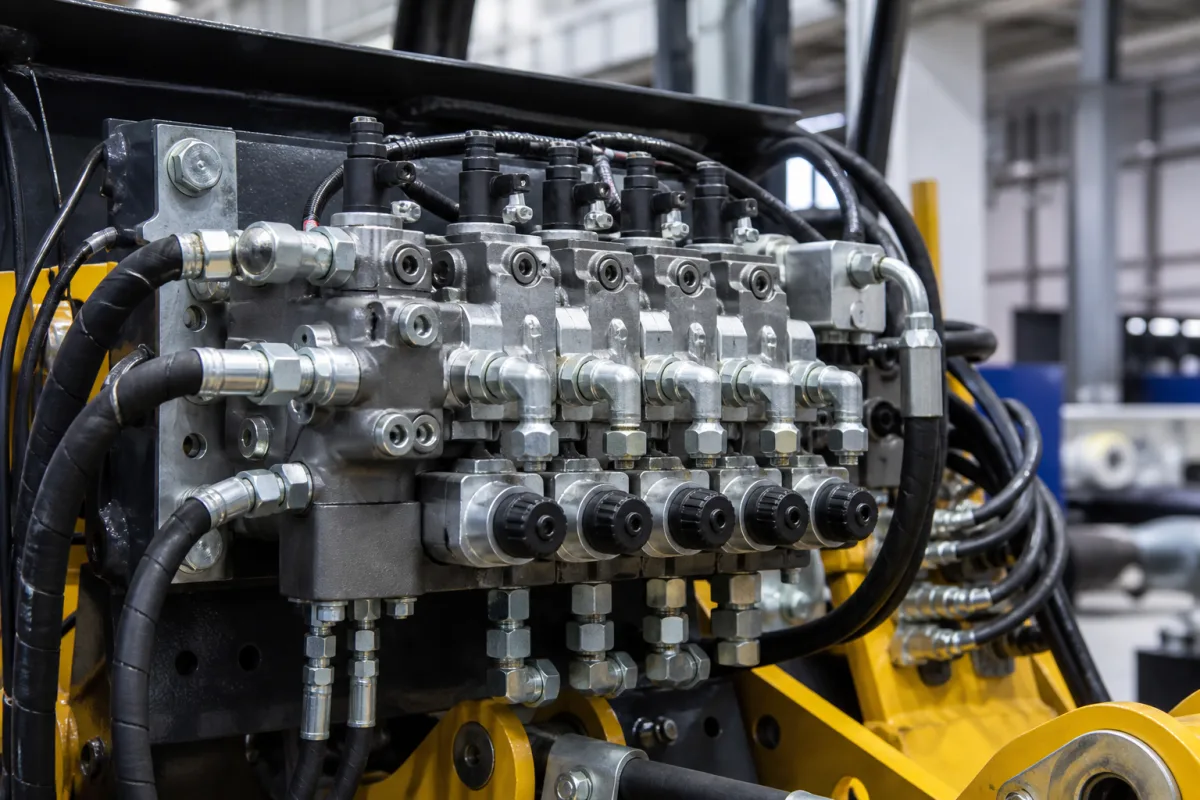
Control Valve Bank

Based on aggregated insights from multiple verified factory profiles within the CNFX directory, the standard Control Valve Bank used in the Machinery and Equipment Manufacturing sector typically supports operational capacities ranging from standard industrial configurations to heavy-duty production requirements.

Technical Definition & Core Assembly

A canonical Control Valve Bank is characterized by the integration of Manifold Block and Directional Control Valve. In industrial production environments, manufacturers listed on CNFX commonly emphasize Carbon Steel construction to support stable, high-cycle operation across diverse manufacturing scenarios.

A modular assembly of hydraulic control valves that regulates fluid flow and pressure within a hydraulic system.
Product Specifications

Technical details and manufacturing context for Control Valve Bank

Definition
A control valve bank is a critical component of the Hydraulic Stoppering System, consisting of multiple directional, pressure, and flow control valves mounted on a common manifold. It serves as the central control unit for managing the hydraulic fluid's path, pressure, and flow rate to actuate the system's stoppers, ensuring precise and synchronized stopping force application in industrial machinery.
Working Principle
The valve bank receives hydraulic fluid from a pump and distributes it through its individual valves. Each valve can be electrically or manually actuated to open, close, or modulate flow, directing fluid to specific actuators (like cylinders in a stopper). This allows for controlled extension, retraction, and pressure holding of the stopper mechanisms.
Common Materials
Carbon Steel, Stainless Steel, Brass
Technical Parameters
  • Manifold port size and spacing (e.g., CETOP, ISO standard) (mm) Standard Spec
Components / BOM
  • Manifold Block
    Provides the structural base and internal fluid passages connecting all valves and ports.
    Material: Carbon Steel
  • Directional Control Valve
    Directs hydraulic fluid flow to specific outlets to control actuator movement (e.g., extend/retract stopper).
    Material: Steel, Brass
  • Pressure Relief Valve
    Protects the system by limiting maximum pressure, preventing damage from overpressure.
    Material: Steel
  • Mounting Hardware
    Bolts and seals used to secure valves to the manifold and ensure leak-free connections.
    Material: Steel, Rubber
Engineering Reasoning
0.5-350 bar
420 bar (burst pressure) or 0.1 bar (cavitation threshold)
Design Rationale: Cavitation occurs when fluid pressure drops below vapor pressure (0.1 bar at 20°C), causing vapor bubble formation and implosion damage. Material fatigue failure occurs at 420 bar due to yield strength exceedance of valve body steel (ASTM A216 WCB, yield strength 250 MPa).
Risk Mitigation (FMEA)
Trigger Contamination ingress exceeding ISO 4406 Class 18/16/13
Mode: Spool valve sticking causing flow regulation failure
Strategy: Install dual 3-micron absolute filtration with differential pressure monitoring
Trigger Water content exceeding 1000 ppm in hydraulic fluid
Mode: Corrosion-induced leakage at valve sealing interfaces
Strategy: Implement vacuum dehydration system maintaining fluid below 500 ppm water content

Industry Taxonomies & Aliases

Commonly used trade names and technical identifiers for Control Valve Bank.

Applied To / Applications

This component is essential for the following industrial systems and equipment:

Industrial Ecosystem & Supply Chain DNA

Complementary Systems
Downstream Applications
Specialized Tooling

Application Fit & Sizing Matrix

Operational Limits
pressure: Up to 350 bar
flow rate: Up to 300 L/min per valve
temperature: -20°C to 120°C
slurry concentration: Not recommended for slurries >5% solids by volume
Media Compatibility
✓ Hydraulic oil (ISO VG 32-68) ✓ Water-glycol fluids ✓ Phosphate ester fluids
Unsuitable: Corrosive chemicals or seawater environments
Sizing Data Required
  • Maximum system pressure (bar)
  • Required flow rate (L/min)
  • Number of independent control functions needed

Reliability & Engineering Risk Analysis

Failure Mode & Root Cause
Sticking or binding
Cause: Accumulation of process media deposits, corrosion products, or foreign particles in the valve trim or packing area, often due to improper filtration, incompatible materials, or infrequent cycling.
Internal leakage (seat leakage)
Cause: Wear or damage to the valve seat and plug/disc from cavitation, erosion (from high-velocity or abrasive fluids), or mechanical over-torquing during operation or maintenance, leading to failure to achieve tight shut-off.
Maintenance Indicators
  • Erratic or unstable process control (e.g., hunting, oscillations in flow/pressure) indicating sticking, hysteresis, or excessive friction in the valve assembly.
  • Audible hissing or whistling from the valve body during shut-off, signaling internal leakage past the seat, or abnormal grinding/vibration noises suggesting cavitation or mechanical wear.
Engineering Tips
  • Implement a routine valve exercising program for infrequently cycled valves to prevent sticking and keep seals lubricated, using partial strokes or full cycles as per manufacturer guidelines.
  • Install and maintain upstream filtration (e.g., strainers) and ensure proper sizing/selection of valves to operate within 20-80% of travel, avoiding extreme throttling near closed positions to reduce cavitation and erosion risks.

Compliance & Manufacturing Standards

Reference Standards
ISO 17292:2015 (Metal ball valves for petroleum, petrochemical and allied industries) ANSI/ISA 75.01.01 (Flow equations for sizing control valves) DIN EN 12516-1 (Industrial valves - Shell design strength)
Manufacturing Precision
  • Valve seat leakage: Class IV per ANSI/FCI 70-2
  • Actuator stroke repeatability: +/-0.5% of full scale
Quality Inspection
  • Hydrostatic shell test (1.5x rated pressure)
  • Functional stroke test with positioner calibration

Factories Producing Control Valve Bank

Verified manufacturers with capability to produce this product in China

✓ 98% Supplier Capability Match Found

S Sourcing Manager from Singapore Feb 13, 2026
★★★★★
"The technical documentation for this Control Valve Bank is very thorough, especially regarding technical reliability."
Technical Specifications Verified
P Procurement Specialist from Germany Feb 10, 2026
★★★★☆
"Reliable performance in harsh Machinery and Equipment Manufacturing environments. No issues with the Control Valve Bank so far. (Delivery took slightly longer than expected, but technical support was excellent.)"
Technical Specifications Verified
T Technical Director from Brazil Feb 07, 2026
★★★★★
"Testing the Control Valve Bank now; the technical reliability results are within 1% of the laboratory datasheet."
Technical Specifications Verified
Verification Protocol

“Feedback is collected from verified sourcing managers during RFQ (Request for Quote) and factory evaluation processes on CNFX. These reports represent historical performance data and technical audit summaries from our B2B manufacturing network.”

9 sourcing managers are analyzing this specification now. Last inquiry for Control Valve Bank from Vietnam (29m ago).

Supply Chain Compatible Machinery & Devices

Heavy-Duty CNC Plasma Cutting Machine

Industrial machine for precision metal cutting using plasma arc technology

Explore Specs →
Automated Assembly Line System

Integrated production system for sequential component assembly operations

Explore Specs →
Automated Powder Coating System

Integrated industrial system for applying dry powder coatings to metal substrates.

Explore Specs →
Centrifugal Pump Impeller

Rotating component that transfers energy to fluid in centrifugal pumps.

Explore Specs →

Frequently Asked Questions

What are the main applications of a control valve bank in machinery manufacturing?

Control valve banks are essential in hydraulic systems for industrial machinery, used to regulate fluid flow and pressure in applications like presses, injection molding machines, material handling equipment, and automated production lines to ensure precise control and safety.

How does the modular design benefit maintenance and customization?

The modular assembly allows for easy replacement or addition of individual valves (like directional or pressure relief valves) without overhauling the entire system, reducing downtime and enabling customization for specific pressure, flow, or control requirements in different machinery setups.

What factors should be considered when selecting materials like carbon steel, stainless steel, or brass?

Material choice depends on the operating environment: carbon steel for cost-effectiveness in non-corrosive settings, stainless steel for corrosion resistance in harsh or wet conditions, and brass for compatibility with certain fluids or where non-sparking properties are needed, ensuring durability and system integrity.

Can I contact factories directly on CNFX?

CNFX is an open directory, not a transaction platform. Each factory profile provides direct contact information and production details to help you initiate direct inquiries with Chinese suppliers.

Get Quote for Control Valve Bank

Request technical pricing, lead times, or customized specifications for Control Valve Bank directly from verified manufacturing units.

Your business information is encrypted and only shared with verified Control Valve Bank suppliers.

Thank you! Your message has been sent. We'll respond within 1–3 business days.

Need to Manufacture Control Valve Bank?

Connect with verified factories specializing in this product category

Add Your Factory Contact Us
Previous Product
Control Valve Assembly
Next Product
Control Valve Block