Industry-Verified Manufacturing Data (2026)

Linear Guide

Based on aggregated insights from multiple verified factory profiles within the CNFX directory, the standard Linear Guide used in the Machinery and Equipment Manufacturing sector typically supports operational capacities ranging from standard industrial configurations to heavy-duty production requirements.

Technical Definition & Core Assembly

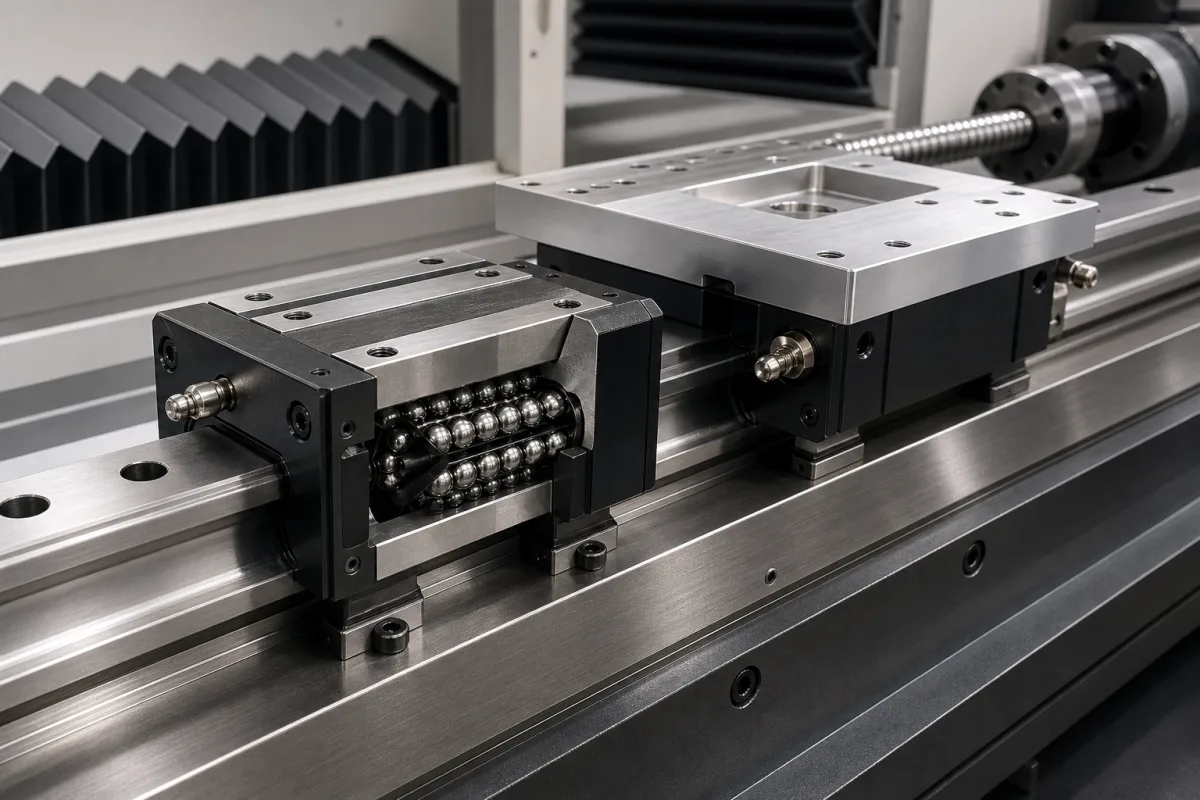
A canonical Linear Guide is characterized by the integration of Rail and Carriage Block. In industrial production environments, manufacturers listed on CNFX commonly emphasize Carbon steel construction to support stable, high-cycle operation across diverse manufacturing scenarios.

A precision mechanical component that provides smooth, low-friction linear motion along a fixed path.
Product Specifications

Technical details and manufacturing context for Linear Guide

Definition
In the Back Gauge System, the Linear Guide is a critical component that enables precise positioning and movement of the gauge along a straight axis. It ensures accurate, repeatable linear motion with minimal friction and play, allowing the back gauge to maintain consistent positioning for material alignment during cutting or processing operations.
Working Principle
The Linear Guide operates on the principle of rolling contact between precision-ground rails and bearing elements (typically balls or rollers). The bearing elements circulate within a carriage block, reducing friction and enabling smooth linear motion along the rail. This design provides high rigidity, load capacity, and positional accuracy for the moving components of the Back Gauge System.
Common Materials
Carbon steel, Stainless steel
Technical Parameters
  • Rail width and height dimensions that determine load capacity and rigidity (mm) Customizable
Components / BOM
  • Rail
    Fixed track that provides the guiding surface for linear motion
    Material: hardened steel
  • Carriage Block
    Moving component that houses bearing elements and attaches to the gauge
    Material: steel alloy
  • Bearing Balls/Rollers
    Rolling elements that reduce friction between rail and carriage
    Material: chrome steel
  • End Caps
    Seals the ends of the carriage to retain lubricant and prevent contamination
    Material: plastic or rubber
Engineering Reasoning
0.1-100 m/s linear velocity, -20°C to 80°C ambient temperature, 0.5-50 kN load capacity
Contact stress exceeds 1.2 GPa at ball/raceway interface, lubricant film thickness drops below 0.1 μm, preload loss exceeds 30% of initial value
Design Rationale: Hertzian contact stress-induced plastic deformation at ball/raceway interface, boundary lubrication failure due to lubricant starvation, fretting corrosion at mounting interfaces under cyclic loading
Risk Mitigation (FMEA)
Trigger Contaminant ingress (ISO 4406 particle count >18/15/12) exceeding 5 μm particle size
Mode: Abrasive wear of ball tracks causing increased rolling resistance >15%
Strategy: Integral sealing with IP65-rated labyrinth seals and positive-pressure purge system
Trigger Thermal expansion mismatch (Δα > 12×10⁻⁶ K⁻¹) between guide rail and mounting surface
Mode: Binding and stick-slip motion with friction coefficient >0.15
Strategy: Thermal compensation design using Invar 36 alloy inserts and controlled expansion mounting bolts

Industry Taxonomies & Aliases

Commonly used trade names and technical identifiers for Linear Guide.

Applied To / Applications

This component is essential for the following industrial systems and equipment:

Industrial Ecosystem & Supply Chain DNA

Complementary Systems
Downstream Applications
Specialized Tooling

Application Fit & Sizing Matrix

Operational Limits
speed: Up to 5 m/s (with proper lubrication)
accuracy: ±0.005 to ±0.05 mm/m (depending on precision grade)
pressure: N/A (mechanical load rating instead)
temperature: -20°C to +80°C (standard), up to +150°C with special seals/lubrication
load capacity: Dynamic: 5-50 kN, Static: 10-100 kN (varies by size/type)
Media Compatibility
✓ Clean industrial environments ✓ Machine tool applications ✓ Automated assembly systems
Unsuitable: High-particulate environments without protective covers (e.g., foundries, woodworking with heavy sawdust)
Sizing Data Required
  • Maximum load (static and dynamic)
  • Required travel length and accuracy
  • Mounting configuration and space constraints

Reliability & Engineering Risk Analysis

Failure Mode & Root Cause
Wear and scoring of guide rails
Cause: Contamination ingress (dust, chips, debris) leading to abrasive wear, inadequate lubrication, or misalignment causing uneven load distribution
Ball or roller bearing failure
Cause: Fatigue from cyclic loading beyond design limits, improper preload adjustment, or corrosion due to moisture ingress or chemical exposure
Maintenance Indicators
  • Abnormal grinding, scraping, or clicking noises during operation
  • Visible scoring marks, pitting, or discoloration on guide rails or rolling elements
Engineering Tips
  • Implement strict contamination control with seals, wipers, and regular cleaning schedules, and ensure proper lubrication with manufacturer-recommended grease/oil at specified intervals
  • Perform precision alignment during installation and periodic checks using laser alignment tools, and maintain correct preload according to operational load conditions to prevent uneven wear

Compliance & Manufacturing Standards

Reference Standards
ISO 3408-1:2006 (Ball screws - Part 1: Vocabulary and designation) ANSI/B11.19-2019 (Performance Requirements for Safeguarding) DIN 645-1:2009 (Linear motion rolling bearings - Part 1: Single row recirculating ball bearings and guideway assemblies)
Manufacturing Precision
  • Parallelism of rail mounting surfaces: ≤0.02mm/1000mm
  • Running accuracy of carriage: ≤0.005mm (repeat positioning)
Quality Inspection
  • Hardness testing (Rockwell C scale for bearing surfaces)
  • Dimensional accuracy verification using CMM (Coordinate Measuring Machine)

Factories Producing Linear Guide

Verified manufacturers with capability to produce this product in China

✓ 98% Supplier Capability Match Found

P Procurement Specialist from Singapore Feb 08, 2026
★★★★★
"As a professional in the Machinery and Equipment Manufacturing sector, I confirm this Linear Guide meets all ISO standards."
Technical Specifications Verified
T Technical Director from Germany Feb 05, 2026
★★★★★
"Standard OEM quality for Machinery and Equipment Manufacturing applications. The Linear Guide arrived with full certification."
Technical Specifications Verified
P Project Engineer from Brazil Feb 02, 2026
★★★★★
"Great transparency on the Linear Guide components. Essential for our Machinery and Equipment Manufacturing supply chain."
Technical Specifications Verified
Verification Protocol

“Feedback is collected from verified sourcing managers during RFQ (Request for Quote) and factory evaluation processes on CNFX. These reports represent historical performance data and technical audit summaries from our B2B manufacturing network.”

15 sourcing managers are analyzing this specification now. Last inquiry for Linear Guide from USA (1h ago).

Supply Chain Compatible Machinery & Devices

Hydraulic Press

Industrial machine using hydraulic pressure to compress, form, or assemble materials

Explore Specs →
Heavy-Duty CNC Plasma Cutting Machine

Industrial machine for precision metal cutting using plasma arc technology

Explore Specs →
Automated Assembly Line System

Integrated production system for sequential component assembly operations

Explore Specs →
Automated Powder Coating System

Integrated industrial system for applying dry powder coatings to metal substrates.

Explore Specs →

Frequently Asked Questions

What are the main applications for linear guides in machinery manufacturing?

Linear guides are essential in CNC machines, automation equipment, 3D printers, packaging machinery, and robotic systems where precise linear motion is required for positioning, cutting, or assembly operations.

What is the difference between carbon steel and stainless steel linear guides?

Carbon steel linear guides offer high strength and durability at a lower cost, ideal for general industrial applications. Stainless steel guides provide superior corrosion resistance, making them suitable for food processing, medical equipment, or environments with moisture or chemicals.

How do I maintain a linear guide system for optimal performance?

Regular cleaning to remove debris, proper lubrication of bearing balls/rollers, inspection of carriage block and rail alignment, and checking end caps for secure mounting will ensure smooth operation and extend the lifespan of your linear guide system.

Can I contact factories directly on CNFX?

CNFX is an open directory, not a transaction platform. Each factory profile provides direct contact information and production details to help you initiate direct inquiries with Chinese suppliers.

Get Quote for Linear Guide

Request technical pricing, lead times, or customized specifications for Linear Guide directly from verified manufacturing units.

Your business information is encrypted and only shared with verified Linear Guide suppliers.

Thank you! Your message has been sent. We'll respond within 1–3 business days.

Need to Manufacture Linear Guide?

Connect with verified factories specializing in this product category

Add Your Factory Contact Us
Previous Product
Linear Encoders
Next Product
Linear Guide / Bearing