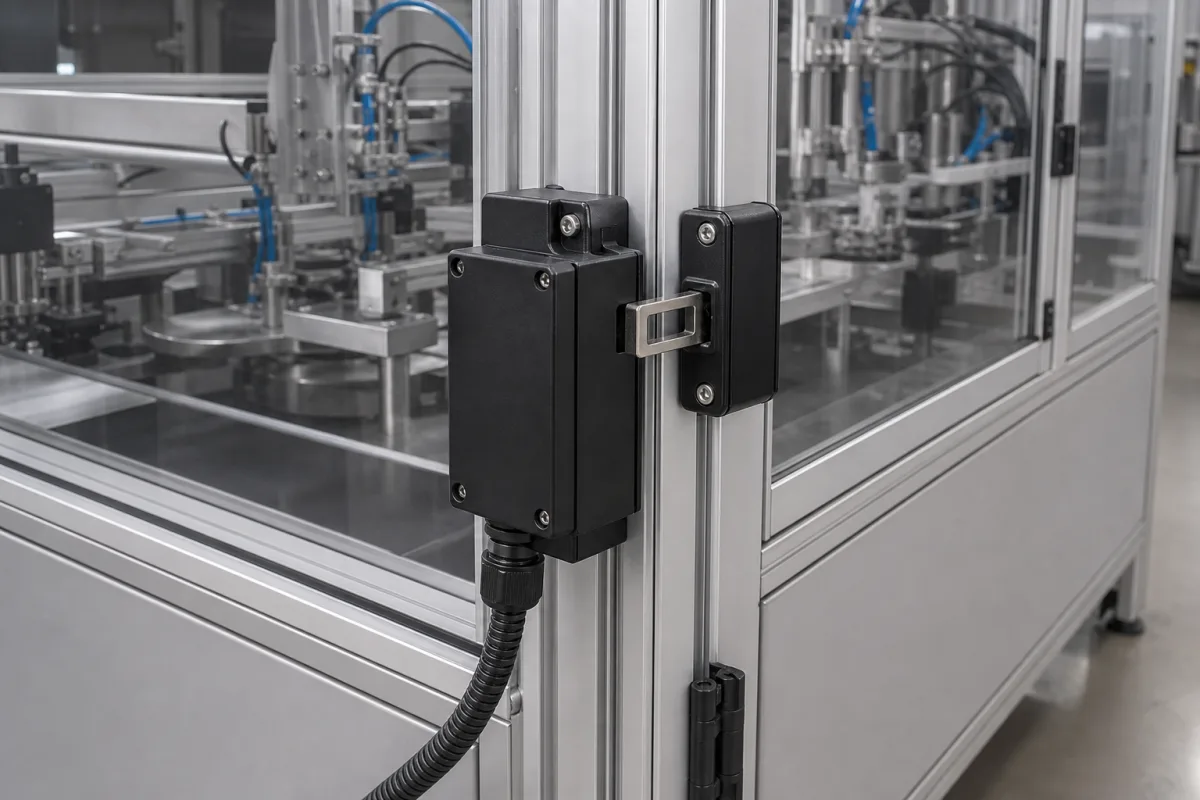
Machine guarding · ISO 14119 interlock types and coding levels, defeat prevention, guard locking force, positive opening, B10d and MTTFd
A safety interlock switch detects whether a movable machine guard is closed and, through the safety control system, prevents hazardous machine functions while it is open; a guard-locking version also holds the guard shut until the hazard has stopped. Ask three things first: which ISO 14119 interlock type and coding level the switch has and how it will be protected against defeat, whether the guard needs locking as well as interlocking, and what contact design and reliability data the switch provides for the required performance level.
Guard interlocking devices for machinery: tongue (key) actuated switches, coded non-contact (RFID, magnetic) sensors, guard-locking switches and trapped-key interlocks. Safety relays, light curtains, safety mats and general limit switches are outside this page.
CNFX editorial research · Sources checked October 11, 2026 · 4 sources
Pick the interlock type and coding level, and prevent defeat
ReeR's summary of ISO 14119:2013 groups interlocking devices into type 1 (uncoded cam or hinge switches), type 2 (coded mechanical actuators such as a shaped tongue), type 3 (uncoded inductive, magnetic, capacitive, ultrasonic or optical), type 4 (coded magnetic, RFID or optical) and type 5 (trapped-key). It defines low, medium and high level coded actuators as having 1 to 9, 10 to 1,000 and more than 1,000 code variations. [1]
ReeR explains that ISO 14119 defines defeat as making an interlock inoperative or bypassing it, and lists measures against it: mounting out of reach, shielded or hidden; coded devices so actuators cannot be substituted; welding, gluing or riveting so the device cannot be moved; status monitoring or cyclic testing; and a second device on a different principle with a plausibility check. It notes that the standard's table 3 sets the additional measures by device type, and that guards must not be easy to bypass under Directive 2006/42/EC. [1]
ReeR also notes that NC contacts of two or more interlocks wired in series are taken as 60% diagnostic coverage, allowing PL d but not PL e, because faults can be masked, and that the access time to the hazard must be compared with the system's stopping performance using approach speeds from ISO 13855. [1] Editorial note: tell the supplier how many guards share a safety input and the stopping time of the machine before choosing between series-wired switches and individually monitored or electronic devices.
Give the supplier the guard type (hinged, sliding, lift-off), entry direction and door alignment, required performance level, whether guard locking is needed and why (stopping time, run-down), coding level wanted, how many guards share a safety input, supply and contact ratings, cable entry or connector, environment (washdown, temperature, vibration) and certificates required.
02
Check guard locking, positive opening and reliability data
ReeR states that ISO 14119 treats interlocking and guard locking as two separate safety functions whose required performance levels may differ, and that where guard locking relies on fault exclusion its specified holding force (FZH) must withstand the static forces expected on the locking bolt. [1] Rockwell lists its TLS-Z GD2 guard-locking switch as a type 4 device with high (unique) RFID coding per ISO 14119, PL e Cat 4, locking force up to 2,000 N, power-to-release or power-to-lock versions, and PFHD 1.70E-09. [4]
For tongue switches, IDEM's KOBRA KM lists positive-break contacts to EN 60947-5-1, 8 mm travel for positive opening, B10d of 2.5 × 10⁶ operations at 100 mA, MTTFd of 356 years at 8 cycles per hour around the clock, maximum approach and withdrawal speed of 600 mm/s, IP67, −25 to +80 °C, and an optional 40 N actuator holding version. [2] IDEM's IDIS-1 achieves positive actuation at 5 mm withdrawal and warns never to use the switch as a mechanical stop, using guides and stops to protect switch and actuator. [3]
Editorial calculation: 8 cycles per hour for 24 h × 365 days is 70,080 operations a year; with B10d = 2.5 × 10⁶, MTTFd = B10d / (0.1 × 70,080) ≈ 357 years, matching IDEM's 356 years, and the switch reaches its B10d count in about 2.5 × 10⁶ / 70,080 ≈ 36 years. At 60 cycles per hour the same switch reaches it in under 5 years. [2] Use your actual guard opening rate.
03
Interlock switches sold within wider safety device ranges
Listings include safety interlock switches alongside light curtains, safety mats, safety edges and safety relays; ask each for ISO 14119 type and coding level, positive-opening data, B10d or PFHD, and certificates.
04
Actuator, head, contacts, locking solenoid and fixings
The actuator row fixes the ISO 14119 type and coding level, and ReeR notes that the standard's table 3 sets the additional anti-defeat measures by device type. [1]
Protect against shock; fixed against removal. [3][1]
One-way screws or rivets.
05
Contact ratings, life, force and enclosure data for an interlock order
Read the life rows against your guard opening rate: the KM reaches its B10d count in about 36 years at 8 cycles per hour but in under 5 years at 60. [2]
Explore company information and manufacturing capabilities, then discuss the scope of your project with a relevant supplier.
Share this page
Compiled and source-reviewed by the CNFX editorial team.
Each manufacturer above links to the page on that company's own website where the product is listed, with the date we checked it. How we source and review
· Page last updated 13 October 2026
Buyer questions
What are ISO 14119 coding levels?
Per ReeR's summary, low, medium and high level coded actuators have 1–9, 10–1,000 and more than 1,000 code variations. [1]
Can two or more interlock switches be wired in series?
ReeR notes series-wired NC contacts are taken as 60% diagnostic coverage, allowing PL d but not PL e, because faults can be masked. [1]
How long does a tongue interlock switch last?
IDEM's KOBRA KM lists B10d of 2.5 million operations; at 8 cycles per hour continuously that is about 36 years (editorial calculation). [2]
Sources and what still needs a direct check
Sources checked 2026-10-11. ReeR, IDEM and Rockwell Automation are safety device makers; ReeR's page summarises ISO 14119, whose own text governs.