Editorial Technical Reference

Servo Actuator / Linear Motor

This page explains how Servo Actuator / Linear Motor is classified within Machinery and Equipment Manufacturing. Technical values and manufacturer relationships are research references; confirm the current specification and supplier evidence for each order.

Technical Definition & Core Assembly

A precision electromechanical component that converts electrical signals into controlled linear motion.
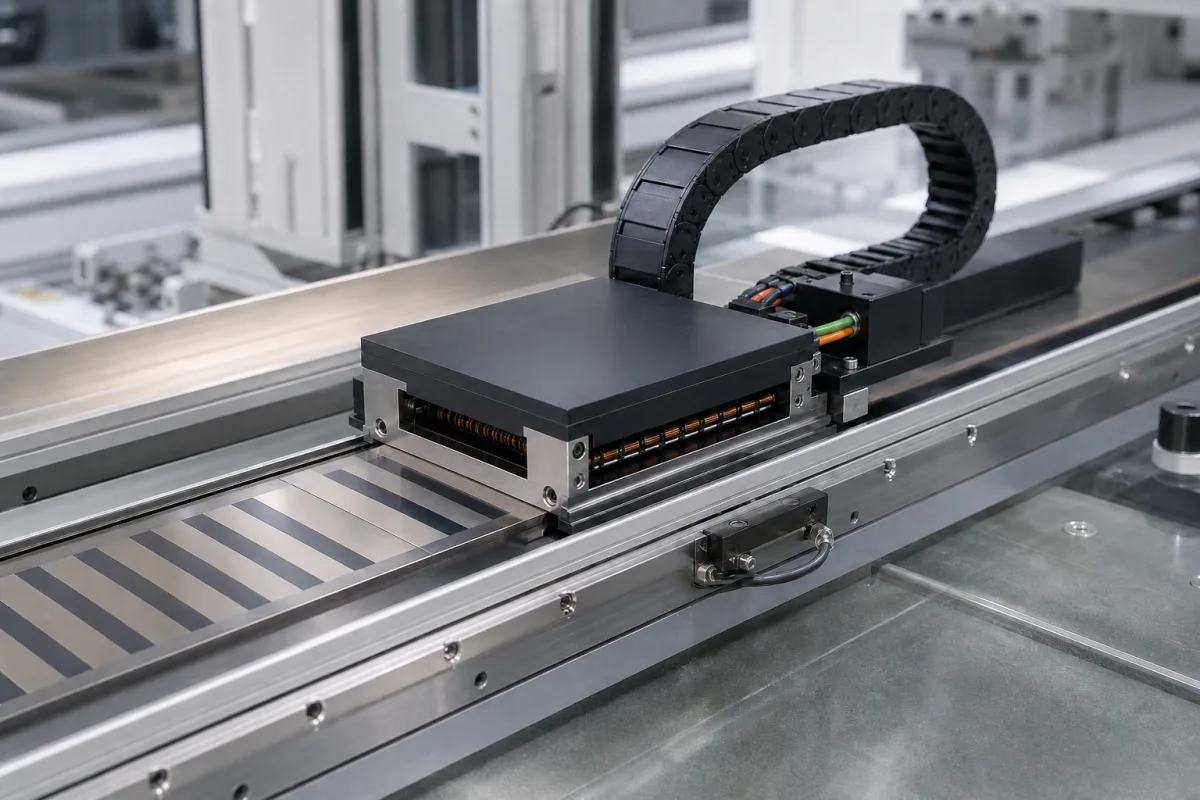
Representative product image. Confirm appearance and specifications with the manufacturer.

Product Specifications

Technical details and manufacturing context for Servo Actuator / Linear Motor

Definition
This servo actuator, also known as a linear motor, is a core component of the Precision Gap Adjustment System. It provides accurate, high-speed linear positioning to maintain or adjust precise gaps between components in manufacturing processes. The device directly converts electrical energy into linear mechanical motion using electromagnetic force, eliminating the need for mechanical conversion mechanisms such as belts or screws. This direct drive approach enables precise position, velocity, and force control, making it suitable for applications requiring rapid and repeatable adjustments. The actuator is constructed with neodymium magnets, copper windings, steel laminations, and an aluminum housing, ensuring robust performance and thermal management. Key parameters include a stroke length of 50–500 mm (custom strokes available on request), peak force of 100–5000 N at rated current, continuous force of 50–2500 N (thermal limit at 25°C ambient), position repeatability of ±0.01 mm with linear encoder feedback, maximum speed of 1–5 m/s (depends on load and motor size), supply voltage of 24–48 V DC (48 V for higher power models), maximum current of 5–20 A (peak current at stall), operating temperature of -20–60°C (below -20°C may affect lubrication), protection class IP54–IP65 per IEC 60529 (IP65 for dust and water jets), maximum payload of 10–100 kg (horizontal mounting, dynamic load), weight of 2–15 kg (varies with stroke and force), and feedback resolution of 0.001–0.005 mm (linear encoder resolution). These values are reference ranges and must be confirmed for the specific model and application. Always verify model-specific values and standards with the legal manufacturer or supplier.
Working Principle
The servo actuator operates on the principle of electromagnetic force. When an electric current flows through the copper windings, it creates a magnetic field that interacts with the neodymium magnets, producing a linear force directly along the axis of motion. This force is proportional to the current, allowing precise control of position, velocity, and force via the control signal. The absence of mechanical transmission components reduces backlash and increases responsiveness, enabling high-speed and high-accuracy positioning. The linear encoder provides real-time feedback to the control system, ensuring closed-loop control and repeatable positioning.
Common Materials
Neodymium magnets, Copper windings, Steel laminations, Aluminum housing
Technical Parameters
ParameterTypical rangeNotes & selection driver
Stroke Length50–500 mmCustom strokes available on request
Peak Force100–5000 NForce at rated current
Continuous Force50–2500 NThermal limit at 25°C ambient
Position Repeatability±0.01 mmWith linear encoder feedback
Maximum Speed1–5 m/sDepends on load and motor size
Supply Voltage24–48 V DC48 V for higher power models
Maximum Current5–20 APeak current at stall
Operating Temperature-20–60 °CBelow -20°C may affect lubrication
Protection ClassIP54–IP65IP65 for dust and water jetsIEC 60529
Maximum Payload10–100 kgHorizontal mounting, dynamic load
Weight2–15 kgVaries with stroke and force
Feedback Resolution0.001–0.005 mmLinear encoder resolution

Ranges are indicative industry figures for RFQ preparation, not a supplier commitment. Confirm every value and standard with the legal manufacturer before ordering.

Components / BOM
  • Stator
    Generates electromagnetic field for motion
    Material: Steel laminations with copper windings
  • Mover
    Contains permanent magnets that interact with stator field
    Material: Neodymium magnets in aluminum carrier
  • Position feedback sensor
    Provides real-time position data for closed-loop control
    Material: Glass scale or magnetic encoder
  • Linear guides
    Provides smooth, low-friction linear motion
    Material: Hardened steel with ball bearings

Applied To / Applications

This component is essential for the following industrial systems and equipment:

Industrial Ecosystem & Supply Chain Structure

Complementary Systems
Downstream Applications
Specialized Tooling

Application Fit & Sizing Matrix

Operational Limits
pressure: Atmospheric to 2 bar (typical), IP65/IP67 sealed variants available
other spec: Max velocity: 2-5 m/s, Max acceleration: 50-200 m/s², Positioning accuracy: ±0.01-0.1 mm, Repeatability: ±0.005-0.02 mm
temperature: -20°C to +80°C (operating), -40°C to +100°C (storage)
Media Compatibility
✓ Clean dry air environments ✓ Industrial automation cells with controlled atmospheres ✓ Precision assembly lines with minimal particulate contamination
Unsuitable: Submerged or high-pressure washdown environments without proper IP69K sealing
Sizing Data Required
  • Required force/thrust (N)
  • Maximum travel length (mm)
  • Duty cycle and velocity profile (continuous/intermittent operation with speed/acceleration requirements)

Reliability & Engineering Risk Analysis

Failure Mode & Root Cause
Encoder feedback failure
Cause: Contamination ingress (dust, moisture, oil) into optical/ magnetic encoder components, or electrical noise interference in signal lines.
Bearing/guide system wear or seizure
Cause: Inadequate lubrication, particulate contamination in the linear motion assembly, or misalignment causing uneven load distribution.
Maintenance Indicators
  • Audible grinding, screeching, or irregular humming from the actuator during operation.
  • Visual observation of erratic, jerky, or inconsistent linear motion (e.g., stuttering, position drift, or failure to hold position).
Engineering Tips
  • Implement a strict contamination control protocol: use appropriate seals and bellows, maintain clean work environment, and ensure compressed air (if used for cooling/purge) is filtered and dry.
  • Establish a predictive maintenance routine using vibration analysis and thermal imaging to detect early bearing wear and misalignment, and perform regular alignment checks per manufacturer specifications.

Indicative industry ranges for design and RFQ preparation. Confirm the exact figures and applicable standard with the manufacturer before specifying.

Compliance & Manufacturing Standards

Applicable Standards
ISO 9409-1:2004 (Mechanical interface for modular servo actuators) ANSI/B11.19-2019 (Performance criteria for safeguarding and safety functions of servo systems) DIN EN 61800-5-1:2007 (Adjustable speed electrical power drive systems - Safety requirements)

Quoted from the published standard.

Manufacturing Precision
  • Positioning repeatability: +/-0.01mm
  • Straightness of travel: 0.05mm per 1000mm
Quality Inspection
  • Dynamic performance test (frequency response, settling time)
  • Thermal imaging test for heat dissipation verification

Manufacturers of Servo Actuator / Linear Motor

Manufacturer profiles associated with Servo Actuator / Linear Motor.

Sourcing Servo Actuator / Linear Motor from China?
Tell us your specification and target quantity — we will match it against manufacturer records and come back with the factories that fit.
Request manufacturers We manufacture this

Manufacturer listings support early research and capability understanding. They are not certification, ranking, or transaction guarantees.

Technical documentation
Request current drawings, revision history, and a signed specification sheet.
Manufacturing capability
Verify equipment lists, process limits, capacity, and representative production evidence.
Inspection readiness
Confirm test methods, calibrated equipment, sampling plans, and traceable reports.
Supplier transparency
Check the legal entity, factory address, ownership, certifications, and direct contacts.

CNFX does not score or rank suppliers. Buyers must verify all claims and documents with the legal manufacturer before ordering.

Supply Chain Compatible Machinery & Devices

Automated Powder Coating System

Integrated industrial system for applying dry powder coatings to metal substrates.

Explore Specs →
Centrifugal Pump Impeller

The centrifugal pump impeller is a critical rotating component that converts mechanical energy from the motor into kinetic energy in fluid systems.

Explore Specs →
High-Precision CNC Laser Cutting Machine

Computer-controlled industrial machine using focused laser beams to cut sheet metal with micron-level accuracy.

Explore Specs →
Industrial-Grade Hydraulic Cylinder Piston Rod

This industrial-grade piston rod is a precision-ground cylindrical component designed for use in hydraulic cylinders.

Explore Specs →

Frequently Asked Questions

What is the difference between a servo actuator and a linear motor?

In this context, the terms are used interchangeably. The device is a linear motor that acts as a servo actuator, providing precise control of linear motion. It uses electromagnetic force directly, without mechanical conversion, to achieve high accuracy and speed.

What are the typical applications for this servo actuator?

It is designed for use in the Precision Gap Adjustment System, where it maintains or adjusts precise gaps between components in manufacturing processes. It is suitable for applications requiring high-speed, accurate linear positioning, such as assembly, inspection, or material handling.

How do I select the right model for my application?

Selection depends on required stroke, force, speed, payload, and environmental conditions. Review the parameter ranges provided (e.g., stroke 50-500 mm, peak force 100-5000 N) and consult the manufacturer to confirm the exact model meets your needs. Always verify specifications with the legal manufacturer or supplier.

What maintenance is required for this actuator?

Maintenance typically involves checking for wear on moving parts, ensuring proper lubrication (especially at low temperatures), and verifying the integrity of electrical connections and the linear encoder. Follow the manufacturer's guidelines for maintenance intervals and procedures.

Data Basis

Editorial classification, named public sources where available, and source-reviewed manufacturer records.

Preliminary Technical Classification
This page supports structured research, RFQ preparation, and supplier evaluation. It does not replace buyer-led supplier qualification, standards review, or technical approval.
Buyer enquiry

Request manufacturing insight for Servo Actuator / Linear Motor

Ask for use case, specification boundaries, supplier type, and RFQ preparation information for this product.

Where it goes
Straight to the CNFX editorial desk, and to the manufacturer if this product is linked to a claimed profile. Nothing is broadcast to a supplier list.
Your details stay here
We do not sell or rent enquiry data, and we do not add you to a mailing list. Used only to answer this request.
No commission, no middleman
CNFX is a directory. We take no cut of any order and never negotiate on a supplier's behalf.
What we don't claim
A listing is not an endorsement. Qualify every supplier and verify every figure yourself before ordering.

Your business information is used only to process this request.

Thank you! Your message has been sent. We'll respond within 1–3 business days.
Sorry, we couldn't send your message. Please try again, or email us at contact@cnfx.com.

Need to Manufacture Servo Actuator / Linear Motor?

Compare manufacturer profiles with relevant product and process capability.

Previous Product
Z-axis Ram/Spindle
Last Product
Get QuotesChat