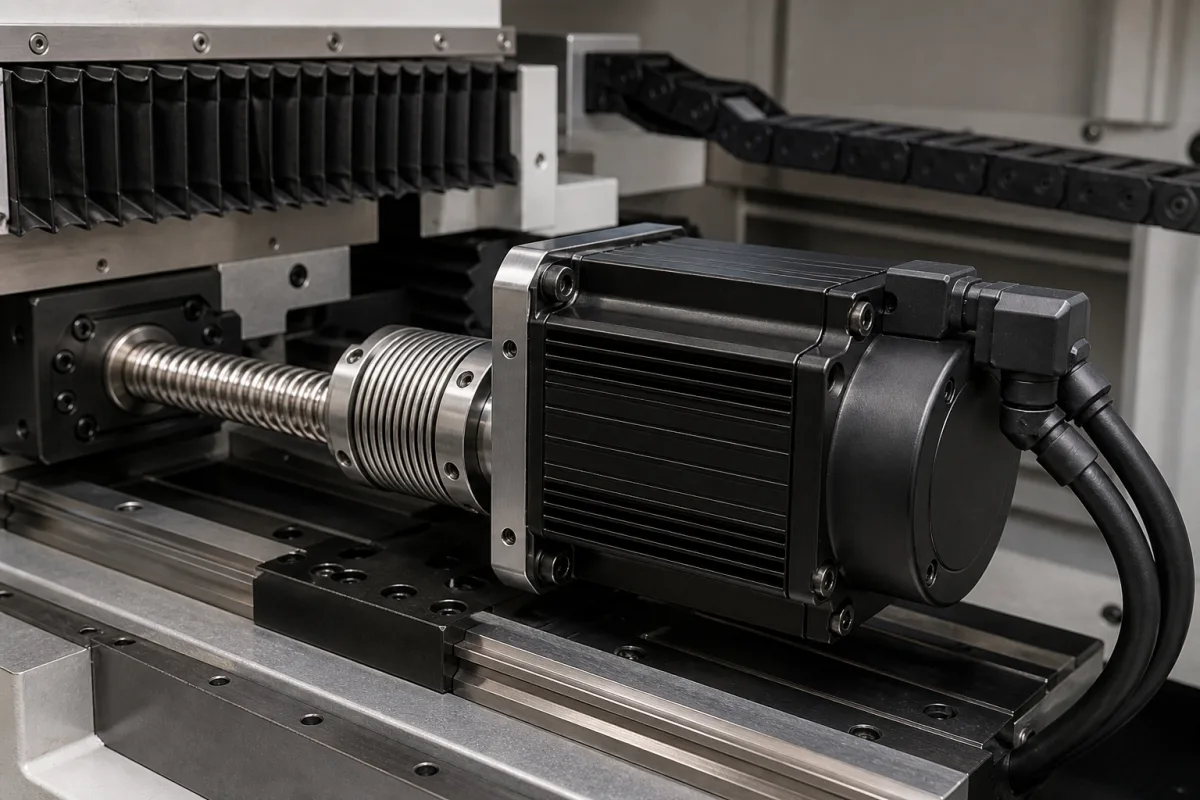
Motion control · Sized by the move, not the horsepower
A servo motor is chosen by the move it must make: how much inertia it accelerates, how fast, and how often. Design News names sizing from the power of the motor it replaces, or from torque alone, as mistakes. Build the motion profile, then check peak torque and RMS torque against the motor's speed-torque curve.
AC and DC brushless servo motors for machine axes and automation, with their encoders and brakes. The servo drive is chosen as a matched pair with the motor; stepper motors and drives have their own pages.
CNFX editorial research · Sources checked October 12, 2026 · 6 sources
Design News lists the core sizing factors as inertia ratio, speed, maximum torque at speed and RMS torque at speed, and names two mistakes: sizing from the horsepower of the motor already installed, and sizing from torque alone. [1]
The inertia ratio compares load inertia, reflected to the motor shaft, with the motor's own inertia. The same article says “Inertia ratios around 5:1 are typical for many applications”, that performance and ease of tuning improve as the ratio falls toward 2:1 or 1:1, and that 10:1, 100:1 or more is not unusual where high performance is not needed. There is no single required ratio; a very low ratio can just mean an oversized motor. [1]
Give the supplier the mechanism (ball screw, belt, gearbox, rotary table), the moving mass or inertia, the gear ratio and efficiency, friction and any external force, so the reflected inertia and torque can be calculated.
02
Check peak and RMS torque against the speed-torque curve
A motor's speed-torque curve has a continuous region, limited by heating, and an intermittent region for short bursts such as acceleration. Rated torque is the maximum continuous torque up to rated speed; above rated speed available torque falls. Design News advises that the maximum torque at application speed should fall in the intermittent region and the RMS torque in the continuous region, and notes that drives alarm and disable the motor if the intermittent time limit is exceeded. [1]
RMS torque is the time-weighted average over a full machine cycle: the constant torque that would heat the motor equally. As a calculation example only, a cycle of 6 N·m for 0.2 s (accelerate), 1 N·m for 0.6 s (constant speed), −4 N·m for 0.2 s (decelerate) and 0 N·m for 0.5 s (dwell) gives √[(6²×0.2 + 1²×0.6 + 4²×0.2) ÷ 1.5] = √(11 ÷ 1.5) ≈ 2.7 N·m RMS, with a 6 N·m peak. Both points must be checked at the speeds where they occur.
Catalogue ratings can be cross-checked with P = T × ω. Ctrl-Motor lists a 750 W, 80 mm servo motor at 2.4 N·m and 3,000 rpm: 2.4 × (3,000 × 2π ÷ 60) ≈ 754 W, which is consistent. Ask for the full speed-torque curve, not only the rated point. [2]
Ask the supplier for peak torque and how long it can be held, the speed-torque curve at your supply voltage, and the sizing calculation with your motion profile. A motor whose maximum torque sits in the continuous region may be oversized. [1]
03
Choose frame, voltage, encoder, brake and environment
Chinese makers linked to this page publish servo motors in standard frame sizes from about 40 mm to 130 mm, roughly 100 W to a few kW, at 220 V or 380 V AC, and some offer low-voltage DC and integrated designs. [3][4][5]
Ctrl-Motor lists versions with holding brakes and IP65 protection, and special high- and low-temperature and vacuum-rated servo motors. Specify ambient temperature, washdown or dust exposure, vacuum, and whether a brake is needed to hold a vertical axis when power is off. [2]
Encoders for servo motors are offered as absolute and incremental optical or magnetic types. State whether the axis must know its position immediately after power-up without homing, the resolution needed, and the drive's feedback protocol. [6]
04
Stator, magnet rotor, encoder, holding brake, bearings, housing and cables
Two rows tie back to sizing: rotor inertia sets the inertia ratio, and ZGC lists low- and medium-inertia versions; the encoder type decides whether the axis knows its position at power-up without homing. [4][6]
Part
Role
Fix in the order
Stator and windings
Produce the rotating field; winding and insulation set voltage and thermal rating.
Rated voltage, insulation class and thermal protection.
Rotor with permanent magnets
Produces torque with low rotor inertia; low- and medium-inertia versions are offered. [4]
Rotor inertia and magnet type.
Encoder
Measures position and speed for closed-loop control; absolute or incremental. [6]
Carry radial and axial loads from belts, pinions and couplings.
Permissible radial and axial load and shaft key or smooth shaft.
Housing, flange and seals
Mount the motor and protect it; IP65 versions are listed. [2]
Flange size, IP rating and oil seal.
Connectors and cables
Carry power and feedback to the drive.
Connector type, cable length and drag-chain rating.
05
Rated power, torque and speed, rotor inertia, voltage, current, IP rating and ambient range for a motor order
Rated torque and speed are one point on the speed-torque curve; ask for the curve itself, and check rated power against P = T × ω as in the Ctrl-Motor example above. [1][2]
Field
What it means and published values
Ask the supplier for
Rated power (kW)
Follows from rated torque and speed (P = T × ω). [2]
Rated power at your supply voltage.
Rated torque (N·m)
Continuous torque up to rated speed, limited by heating. [1]
Rated and peak torque and peak duration.
Rated speed (r/min)
Highest speed at which rated torque is available. [1]
These companies make servo motors in standard frame sizes, special-environment servo motors, integrated servo designs, or servo-motor encoders.
Ctrl-Motor
Location not checked for this product
Lists 80 W–1,800 W AC servo motors, including 750 W 80 mm at 2.4 N·m and 3,000 rpm, brake and IP65 versions, and high/low-temperature and vacuum-rated motors.
Explore company information and manufacturing capabilities, then discuss the scope of your project with a relevant supplier.
Share this page
Compiled and source-reviewed by the CNFX editorial team.
Each manufacturer above links to the page on that company's own website where the product is listed, with the date we checked it. How we source and review
· Page last updated 13 October 2026
Buyer questions
What inertia ratio should a servo motor have?
There is no single required value. Design News says “Inertia ratios around 5:1 are typical for many applications”, notes performance improves as it falls toward 2:1 or 1:1, and says 10:1 or more is acceptable where high performance is not needed. [1]
Why size by RMS torque?
RMS torque is the constant torque that would heat the motor the same as the real cycle. It must lie in the continuous region of the speed-torque curve, while the peak torque may use the intermittent region. [1]
Do I need a brake?
On vertical axes or where the load can back-drive the motor when power is off, specify a holding brake; suppliers such as Ctrl-Motor list brake versions. [2]
Sources and what still needs a direct check
Sources checked 2026-10-12. Design News is an engineering trade publication used for sizing principles; supplier pages describe their own products. Calculations are editorial examples.