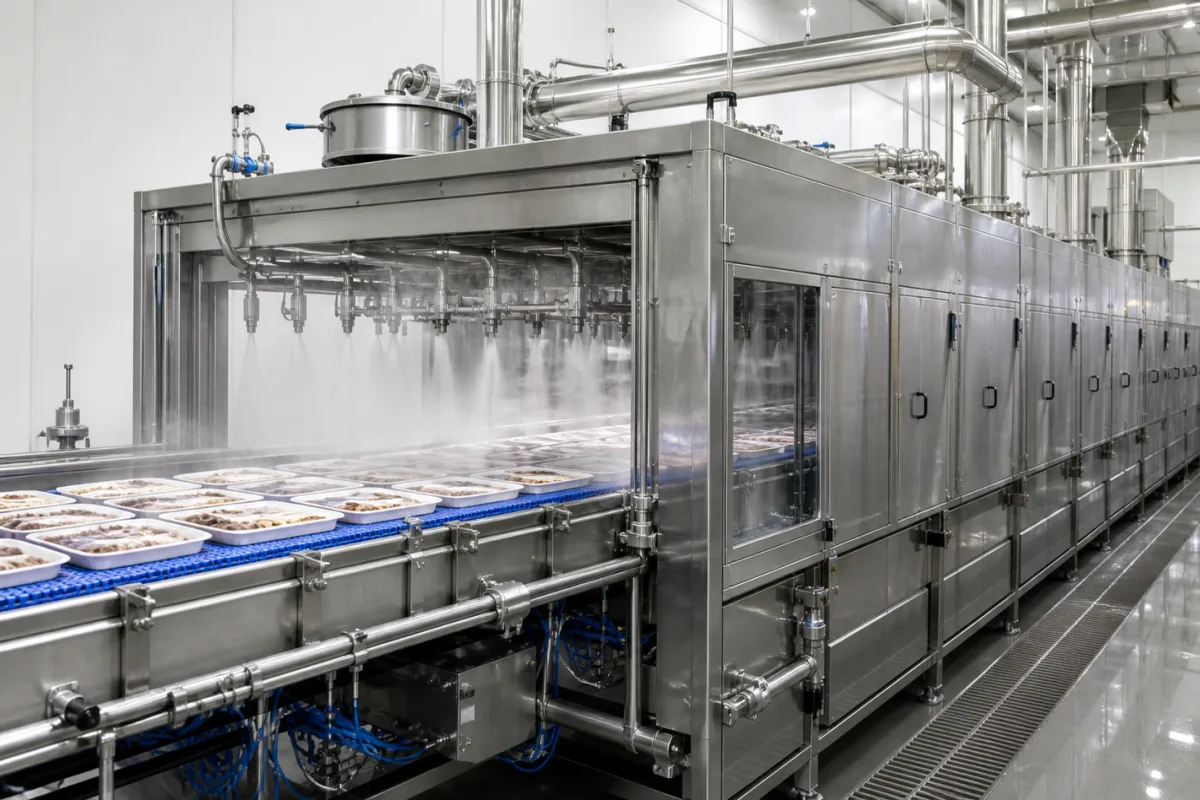
Hot-water spray heating zone for in-pack pasteurizing of sealed food trays and pouches (spray headers, nozzles and recirculation)
In-pack pasteurizing · the hot-water spray section: spray density, nozzle layout, header pressure, recirculation and heat recovery
The spray heating zone is the section of an in-pack pasteurizing tunnel where pumped hot water is sprayed from overhead headers onto sealed trays, pouches or bags on the belt, drains to a reservoir, is reheated and sprayed again. It is bought, rebuilt or retrofitted as a module: headers, nozzles, pump, reservoir and heater. Three things decide whether it heats every pack alike: how much water lands on each square metre of belt (spray density), how the nozzles are spaced and overlapped to the side walls, and how the water temperature is held and recovered between zones.
The hot-water spray heating section and its water circuit — spray headers and nozzles, recirculation pump, reservoir, steam or heat-exchanger heating and regenerative links to the cooling zones — rather than the whole tunnel. Complete conveyor tunnels and the chilled-food time-temperature targets are covered on the Automated food sterilization tunnel for sealed trays and pouches of chilled foods page; tunnel pasteurizers for filled bottles and cans are covered on the Tunnel sterilizer (tunnel pasteurizer) for filled bottles and cans page. Water-immersion baths, microwave tunnels, retorts and medical sterilization chambers are outside this page.
CNFX editorial research · Sources checked October 12, 2026 · 4 sources
Spray-water temperature and dwell: delivering the core lethality target from the spray side
The spray zone does not set the lethality target — the product's hazard analysis does — but its water temperature and the time a pack spends under it decide whether the slowest-heating point reaches it. FDA expresses pasteurization targets as a cumulative lethality with a z-value: for fishery soups and sauces, F90°C = 10 minutes with z = 7 °C below 90 °C and z = 10 °C above. [1]
Editorial calculation from FDA's z-value: every 7 °C that the slowest point runs below 90 °C multiplies the required time by ten, so a pack core that only reaches 83 °C needs 10 × 10^((90 − 83) ÷ 7) = 100 minutes to accumulate the same lethality. A spray-water temperature that leaves the core a few degrees short therefore costs far more belt length than it saves in steam. [1]
Longqiang's continuous spray tunnel splits the water into four circuits — circulating warm water for preheating, circulating hot water for pasteurization, circulating warm water for pre-cooling and spray cooling water — with automatic control of pasteurization temperature, a maximum pasteurization temperature of 100 °C and 0.4 MPa steam. Its PLS series lists pouches and trays among the packs it handles. [4]
Dwell under the hot sprays is section length divided by belt speed. Editorial calculation: Longqiang's PLS-1000 lists a 9000 mm pasteurization section and a stepless belt speed of 110–553 mm/min, so a pack spends 9000 ÷ 553 = 16.3 minutes in it at top speed and 9000 ÷ 110 = 81.8 minutes at the slowest. [4]
The tunnel-pasteurizer patent US 4,727,800 defines preheat zones as those with spray water below about 140 °F (60 °C) and heating zones as those above it, and ties cooling zones to heating zones so that the warmed cooling water preheats incoming product. [2]
Give the supplier the core lethality the product needs and its z-value, the pack's slowest-heating point from your heat-penetration data, the entry core temperature, and the belt speed range; ask for the spray-water set point and dwell the zone will use to meet it.
02
Map the cold spot across the spray deck: side walls, nozzle overlap and lanes
FDA asks for a temperature distribution study within the heating system to identify any cold spots, and a heat penetration study on the slowest-heating product under the worst-case heating conditions. In a spray zone, uneven water coverage is one place a cold spot comes from. [1]
The patent US 4,727,800 describes why. Some earlier tunnels ran as little as 3.4 gal/min/ft² with spray heads in a straight line down the tunnel, and measurements of their spray pattern showed a wide variance in the water reaching different containers across the tunnel width — giving non-uniform heating. The patent staggers the nozzles transversely and adds nozzles at the side walls, paired on 3-inch transverse centres, so that packages next to the walls are covered. [2]
Nozzle geometry sets how far each spray reaches. Spraying Systems' technical reference gives the example of a 65° nozzle 15 inches (39 cm) from the target covering 19.2 inches (48.8 cm), but warns that the tabulated angle does not hold over long spray distances, that liquids more viscous than water spray narrower, and that its tables are for water at 21 °C — so ask for spray-coverage data when coverage is critical. [3]
Editorial note: run the distribution study with the belt fully loaded, probes in packs at both side walls and in each lane, and at the highest belt speed you plan to use; repeat it after any nozzle change or header cleaning. FDA also lists container seal integrity and protection from contaminated cooling water as critical controls for products pasteurized in the finished container. [1]
03
Spray density, nozzle type, spacing and header pressure
Spray density — water flow per unit of belt area — is the figure that ties nozzles, pump and heat transfer together. The patent US 4,727,800 sets it at above about 7 gal/min/ft² of tunnel surface and reports, from its heat-transfer measurements, that about 9 gal/min/ft² is the optimum: further increases do not significantly raise heat transfer. [2]
The same patent's nozzle is a hollow-cone type with a 3/8-inch orifice, fed at about 5 to 6 psig, on staggered centres 9 to 12 inches apart along the tunnel and 6 inches across it, and chosen as the type least likely to clog; the overlapping hollow cones give a uniform density at the top of the containers. The patent was written for beer in cans and bottles, so its spray layout transfers to a tray deck but its beer temperatures do not. [2]
Spraying Systems gives the pressure-flow relation for a hydraulic nozzle as Q1/Q2 = (P1/P2)^n, with n = 0.46 for standard and square full-cone nozzles, 0.44 for wide-angle full cones and 0.50 for hollow-cone, flat and solid-stream nozzles; flow of a liquid denser than water falls with 1/√SG. [3]
Editorial calculation: 7 gal/min/ft² is 7 × 3.785 L ÷ 0.0929 m² = 285 L/min per m² of belt, and 9 gal/min/ft² is 367 L/min per m². On Longqiang's PLS-1000 pasteurization section of 9000 × 1500 mm (13.5 m²), 285 L/min/m² would mean 3,850 L/min, about 231 m³/h, through the headers. With n = 0.50 for a hollow cone, doubling header pressure raises flow by √2, about 41%. [2][4][3]
04
Headers, nozzles, pump, reservoir, heater and regenerative links in the spray circuit
Part
What it does in the spray zone
Fix in the order
Spray headers and nozzles
Deliver the spray density; staggered hollow cones with extra nozzles at the side walls. [2]
Nozzle type, orifice, spacing, angle.
Recirculation pump
Returns collected water to the headers; flow follows the nozzle exponent. [2][3]
Flow at header pressure.
Reservoir under the deck
Collects water draining off the packs for reuse; Longqiang lists a hot-water recycle capacity of 21 m³ on PLS-1000. [2][4]
Volume and level control.
Heater
Steam heating of the circulating water; 0.4 MPa steam on Longqiang's tunnel. [4]
Steam pressure or heat-exchanger duty.
Regenerative ties
Pair cooling and heating zones so warmed cooling water preheats product (zones 3–6, 2–7, 1–8 in the patent). [2]
Explore company information and manufacturing capabilities, then discuss the scope of your project with a relevant supplier.
Share this page
Compiled and source-reviewed by the CNFX editorial team.
Each manufacturer above links to the page on that company's own website where the product is listed, with the date we checked it. How we source and review
· Page last updated 13 October 2026
Buyer questions
How much water should a spray zone put on the belt?
The patent US 4,727,800 specifies above about 7 gal/min/ft² (about 285 L/min per m²) and reports heat transfer levelling off near 9 gal/min/ft². [2]
How does nozzle flow change with header pressure?
Spraying Systems gives Q1/Q2 = (P1/P2)^n, with n = 0.46 for standard full-cone nozzles and 0.50 for hollow-cone nozzles. [3]
How is the cold spot in a spray zone found?
FDA describes a temperature distribution study in the heating system and a heat penetration study on the slowest-heating product under worst-case conditions. [1]
Sources and what still needs a direct check
Sources checked 2026-10-12. FDA's guidance supplies the lethality and validation rules; the US patent and Spraying Systems' technical reference supply spray density, nozzle and pressure data; Longqiang's PLS series gives one maker's spray-tunnel figures.