Industry-Verified Manufacturing Data (2026)

Torque Sensor (if equipped)

Based on aggregated insights from multiple verified factory profiles within the CNFX directory, the standard Torque Sensor (if equipped) used in the Machinery and Equipment Manufacturing sector typically supports operational capacities ranging from standard industrial configurations to heavy-duty production requirements.

Technical Definition & Core Assembly

A canonical Torque Sensor (if equipped) is characterized by the integration of Sensing Element and Shaft/Coupling. In industrial production environments, manufacturers listed on CNFX commonly emphasize Stainless Steel construction to support stable, high-cycle operation across diverse manufacturing scenarios.

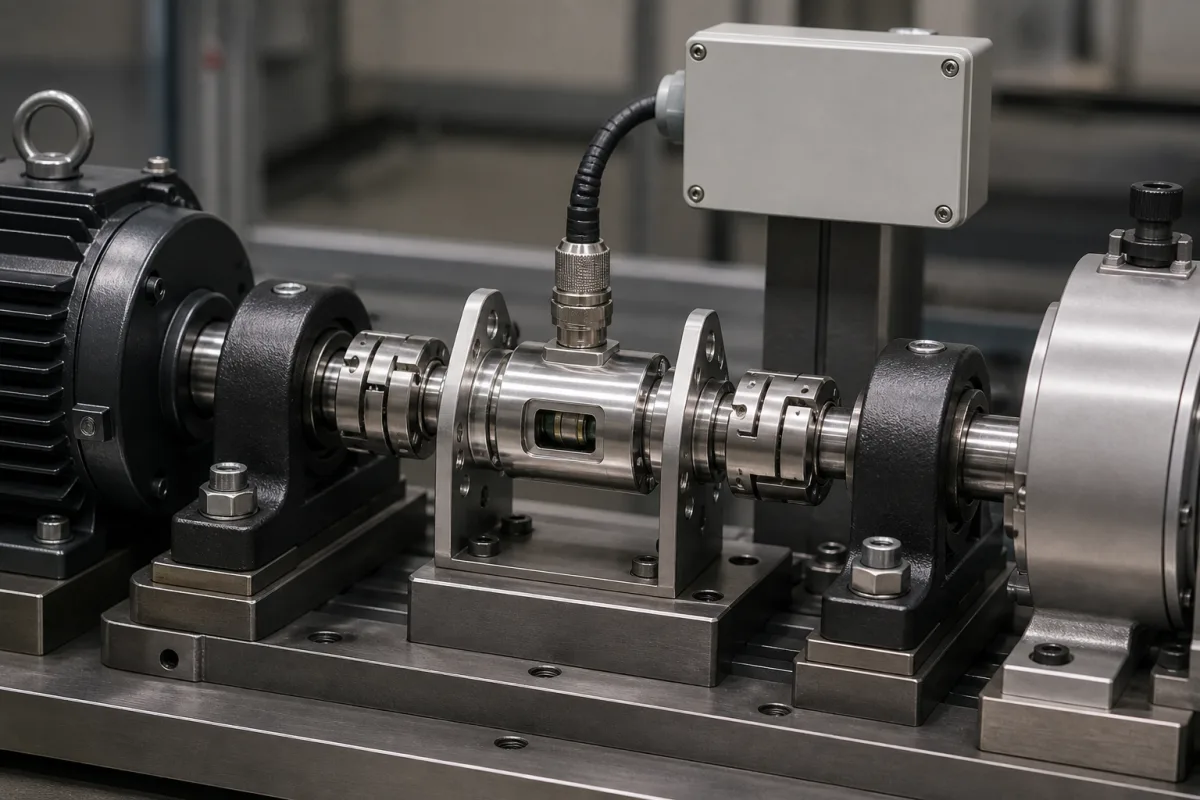
A device that measures the rotational force (torque) applied to a shaft or component within a torque adjustment mechanism.
Product Specifications

Technical details and manufacturing context for Torque Sensor (if equipped)

Definition
A torque sensor is a precision measurement component integrated into torque adjustment mechanisms to monitor and quantify the rotational force being applied. It provides real-time feedback to control systems, enabling precise torque regulation, overload protection, and performance optimization in mechanical assemblies.
Working Principle
Typically operates by measuring the strain, torsion, or magnetic effects on a shaft. Common methods include strain gauges that detect minute deformations, magnetoelastic principles where torque changes magnetic permeability, or optical encoders measuring angular deflection. The sensor converts this physical change into an electrical signal proportional to the applied torque.
Common Materials
Stainless Steel, Aluminum Alloy, Strain Gauge Foil, Epoxy Resin
Technical Parameters
  • Maximum measurable torque range (N·m) Customizable
Components / BOM
  • Sensing Element
    Detects mechanical strain or torsion and converts it to measurable change
    Material: Strain Gauge Foil/Quartz Crystal
  • Shaft/Coupling
    Transmits torque from the driven component to the sensing element
    Material: Stainless Steel/Alloy Steel
  • Signal Conditioning Circuit
    Amplifies and processes the raw signal from the sensing element
    Material: PCB with Electronic Components
  • Housing
    Protects internal components from environmental factors and provides mounting interface
    Material: Aluminum Alloy/Stainless Steel
Engineering Reasoning
0.1-1000 N·m
1200 N·m (120% of maximum rated torque)
Design Rationale: Piezoresistive strain gauge deformation exceeding 0.2% strain limit, causing permanent Wheatstone bridge circuit imbalance and hysteresis error exceeding 0.5% FS
Risk Mitigation (FMEA)
Trigger Electromagnetic interference from adjacent 480V AC motor drives inducing 50V peak-to-peak noise
Mode: Signal conditioning circuit saturation causing 12-bit ADC clipping at 4095 counts
Strategy: Shielded twisted pair cabling with ferrite chokes and differential signal amplification with 80dB CMRR
Trigger Cyclic torsional loading at 15 Hz exceeding 800 N·m for 10^7 cycles
Mode: Strain gauge adhesive layer delamination causing resistance drift of 0.15 Ω/hour
Strategy: Epoxy bonding with 25 MPa shear strength and temperature cycling validation from -40°C to 125°C

Industry Taxonomies & Aliases

Commonly used trade names and technical identifiers for Torque Sensor (if equipped).

Applied To / Applications

This component is essential for the following industrial systems and equipment:

Industrial Ecosystem & Supply Chain DNA

Complementary Systems
Downstream Applications
Specialized Tooling

Application Fit & Sizing Matrix

Operational Limits
pressure: 0 to 100 bar
other spec: Torque range: 0.1 Nm to 10,000 Nm, Accuracy: ±0.1% to ±0.5% FS, Speed: 0 to 10,000 RPM
temperature: -40°C to +125°C
Media Compatibility
✓ Hydraulic fluids ✓ Lubricating oils ✓ Clean dry air
Unsuitable: Corrosive chemical environments (e.g., strong acids, chlorinated solvents)
Sizing Data Required
  • Maximum torque requirement (Nm)
  • Shaft diameter and connection type
  • Required accuracy and response time

Reliability & Engineering Risk Analysis

Failure Mode & Root Cause
Signal drift or loss
Cause: Strain gauge degradation due to thermal cycling, moisture ingress, or mechanical overloading beyond rated capacity, leading to calibration shift or complete failure.
Mechanical fatigue or fracture
Cause: Cyclic torsional stress, misalignment, or improper mounting causing crack propagation in the sensing element or shaft, often exacerbated by vibration or shock loads.
Maintenance Indicators
  • Erratic or fluctuating torque readings inconsistent with process conditions
  • Audible creaking, grinding, or clicking noises during rotation, indicating mechanical wear or looseness
Engineering Tips
  • Implement regular calibration checks using traceable standards, especially after thermal or load shocks, and maintain environmental seals to prevent contamination.
  • Ensure proper shaft alignment, use recommended mounting hardware and torque values, and install vibration dampeners if exposed to resonant frequencies.

Compliance & Manufacturing Standards

Reference Standards
ISO 9001:2015 (Quality Management Systems) ASTM E251-92 (Standard Test Methods for Performance Characteristics of Metallic Bonded Resistance Strain Gages) CE Marking (EU Machinery Directive 2006/42/EC)
Manufacturing Precision
  • Full-Scale Output: +/-0.5%
  • Nonlinearity: +/-0.1% of full scale
Quality Inspection
  • Calibration Verification against NIST-traceable standards
  • Environmental Testing (Temperature, Humidity, Vibration)

Factories Producing Torque Sensor (if equipped)

Verified manufacturers with capability to produce this product in China

✓ 97% Supplier Capability Match Found

S Sourcing Manager from Canada Jan 12, 2026
★★★★★
"The Torque Sensor (if equipped) we sourced perfectly fits our Machinery and Equipment Manufacturing production line requirements."
Technical Specifications Verified
P Procurement Specialist from United States Jan 09, 2026
★★★★☆
"Found 28+ suppliers for Torque Sensor (if equipped) on CNFX, but this spec remains the most cost-effective. (Delivery took slightly longer than expected, but technical support was excellent.)"
Technical Specifications Verified
T Technical Director from United Arab Emirates Jan 06, 2026
★★★★★
"The technical documentation for this Torque Sensor (if equipped) is very thorough, especially regarding technical reliability."
Technical Specifications Verified
Verification Protocol

“Feedback is collected from verified sourcing managers during RFQ (Request for Quote) and factory evaluation processes on CNFX. These reports represent historical performance data and technical audit summaries from our B2B manufacturing network.”

11 sourcing managers are analyzing this specification now. Last inquiry for Torque Sensor (if equipped) from Mexico (37m ago).

Supply Chain Compatible Machinery & Devices

Hydraulic Press

Industrial machine using hydraulic pressure to compress, form, or assemble materials

Explore Specs →
Heavy-Duty CNC Plasma Cutting Machine

Industrial machine for precision metal cutting using plasma arc technology

Explore Specs →
Automated Assembly Line System

Integrated production system for sequential component assembly operations

Explore Specs →
Automated Powder Coating System

Integrated industrial system for applying dry powder coatings to metal substrates.

Explore Specs →

Frequently Asked Questions

What materials are used in this torque sensor's construction?

This torque sensor features a durable construction using stainless steel and aluminum alloy for the housing and shaft components, with strain gauge foil bonded using epoxy resin for precise torque measurement.

How does this torque sensor work in torque adjustment mechanisms?

The sensor measures rotational force applied to shafts using strain gauge technology that detects minute deformations, converting mechanical torque into electrical signals via the signal conditioning circuit for monitoring and control applications.

What are the main components included in this torque sensor?

Key components include the sensing element (strain gauge), shaft/coupling for torque transmission, signal conditioning circuit for signal processing, and protective housing made from corrosion-resistant materials.

Can I contact factories directly on CNFX?

CNFX is an open directory, not a transaction platform. Each factory profile provides direct contact information and production details to help you initiate direct inquiries with Chinese suppliers.

Get Quote for Torque Sensor (if equipped)

Request technical pricing, lead times, or customized specifications for Torque Sensor (if equipped) directly from verified manufacturing units.

Your business information is encrypted and only shared with verified Torque Sensor (if equipped) suppliers.

Thank you! Your message has been sent. We'll respond within 1–3 business days.

Need to Manufacture Torque Sensor (if equipped)?

Connect with verified factories specializing in this product category

Add Your Factory Contact Us
Previous Product
Torque Sensor
Next Product
Torque Transducer