Industry-Verified Manufacturing Data (2026)

Vacuum Valves

Based on aggregated insights from multiple verified factory profiles within the CNFX directory, the standard Vacuum Valves used in the Machinery and Equipment Manufacturing sector typically supports operational capacities ranging from standard industrial configurations to heavy-duty production requirements.

Technical Definition & Core Assembly

A canonical Vacuum Valves is characterized by the integration of Valve Body and Sealing Element. In industrial production environments, manufacturers listed on CNFX commonly emphasize Aluminum alloy construction to support stable, high-cycle operation across diverse manufacturing scenarios.

Control components that regulate vacuum flow and pressure within vacuum gripper systems
Product Specifications

Technical details and manufacturing context for Vacuum Valves

Definition
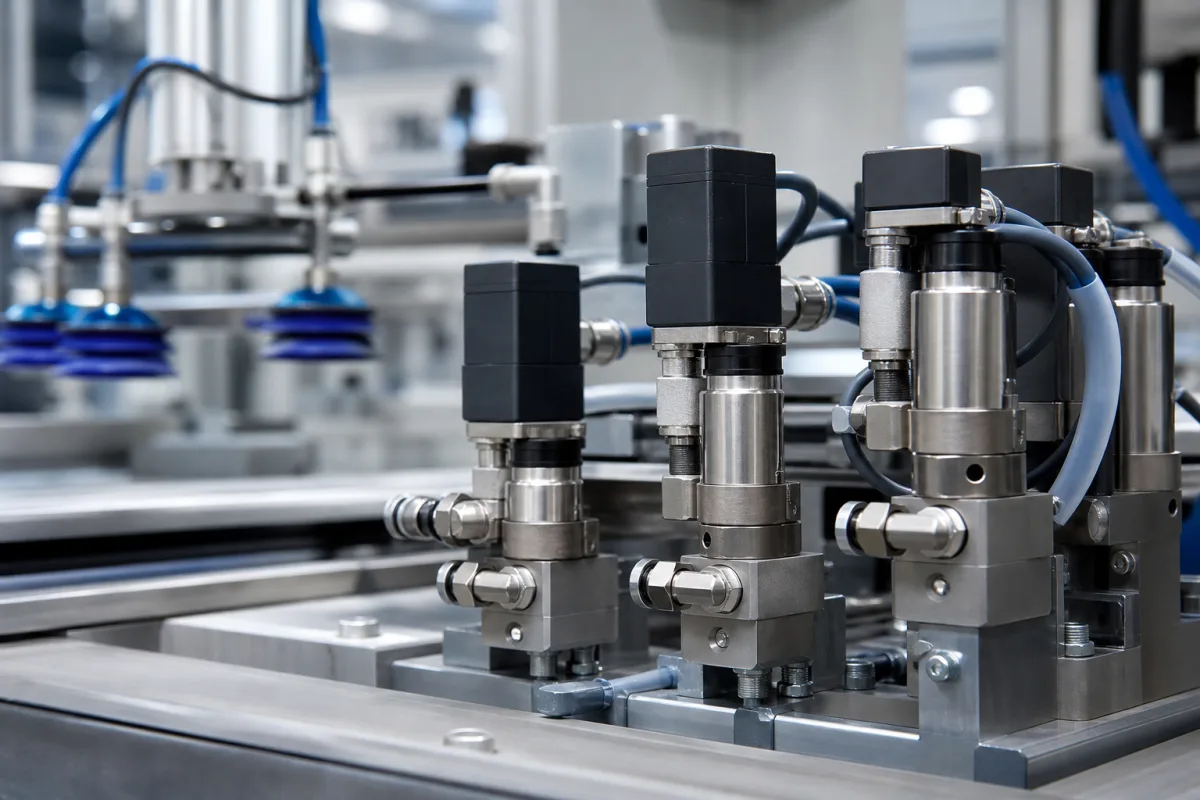
Vacuum valves are critical components in vacuum gripper systems that control the flow of air or gas to create, maintain, or release vacuum pressure. They enable precise operation of vacuum grippers by managing suction and release cycles, ensuring reliable material handling and positioning in automated manufacturing processes.
Working Principle
Vacuum valves operate by opening or closing passages to control airflow. When activated, they either connect the vacuum gripper to a vacuum source to create suction or vent the system to atmospheric pressure to release objects. They typically use electromagnetic, pneumatic, or mechanical actuation to switch between vacuum and vent states.
Common Materials
Aluminum alloy, Stainless steel, Engineering plastics
Technical Parameters
  • Port connection size (e.g., 1/8", 1/4", 3/8", 1/2") (mm) Standard Spec
Components / BOM
  • Valve Body
    Main housing containing flow passages and mounting interfaces
    Material: Aluminum alloy or stainless steel
  • Sealing Element
    Prevents air leakage between vacuum and atmospheric sides
    Material: NBR, FKM, or EPDM rubber
  • Actuator
    Mechanism that opens and closes the valve (solenoid, pneumatic, or manual)
    Material: Steel, brass, or engineering plastics
  • Port Connections
    Threaded or quick-connect interfaces for vacuum lines
    Material: Brass or stainless steel
Engineering Reasoning
1e-6 to 1013 mbar (10^-6 to 1013 hPa)
Leak rate exceeding 1e-9 mbar·L/s at 1 mbar differential pressure
Design Rationale: Elastomer seal compression set exceeding 15% permanent deformation at 70°C, causing molecular flow leakage through micro-gaps exceeding 10^-7 m
Risk Mitigation (FMEA)
Trigger Particulate contamination exceeding ISO 4406 Class 14/12/9 in vacuum line
Mode: Seat erosion creating 5 μm wear grooves, increasing leak rate to 1e-7 mbar·L/s
Strategy: Install 0.3 μm absolute rated sintered metal filter with differential pressure monitoring at 50 mbar threshold
Trigger Solenoid coil temperature exceeding 130°C due to 24V DC continuous energization
Mode: Insulation Class H breakdown at 180°C, causing inter-turn short circuit with 2.3 Ω resistance drop
Strategy: Implement PWM duty cycle control limiting ON-time to 85% with thermal cutoff at 115°C surface temperature

Industry Taxonomies & Aliases

Commonly used trade names and technical identifiers for Vacuum Valves.

Applied To / Applications

This component is essential for the following industrial systems and equipment:

Industrial Ecosystem & Supply Chain DNA

Complementary Systems
Downstream Applications
Specialized Tooling

Application Fit & Sizing Matrix

Operational Limits
pressure: 0.1 mbar to 1 bar absolute
flow rate: Up to 1000 l/min (air)
temperature: -20°C to 80°C
slurry concentration: Not applicable (dry media only)
Media Compatibility
✓ Clean dry air ✓ Inert gases (N2, Ar) ✓ Non-corrosive process gases
Unsuitable: Abrasive slurries or particulate-laden media
Sizing Data Required
  • Required flow rate (l/min)
  • System vacuum level (mbar)
  • Actuation response time (ms)

Reliability & Engineering Risk Analysis

Failure Mode & Root Cause
Seal Degradation
Cause: Chemical attack from process media or incompatible cleaning agents compromising elastomer or polymer seals, leading to vacuum leaks and loss of system integrity.
Actuator Failure
Cause: Mechanical wear, contamination, or electrical faults in pneumatic, hydraulic, or electric actuators, resulting in slow operation, incomplete closure, or valve sticking.
Maintenance Indicators
  • Audible hissing or whistling near valve body indicating vacuum leak
  • Visible scoring, pitting, or discoloration on valve seats or sealing surfaces
Engineering Tips
  • Implement routine leak testing with helium mass spectrometry to detect and address seal failures before system performance degrades.
  • Establish preventive maintenance schedules for actuator lubrication and cleanliness, using manufacturer-recommended lubricants and ensuring proper filtration of pneumatic/hydraulic lines.

Compliance & Manufacturing Standards

Reference Standards
ISO 21358:2020 (Vacuum technology - Vacuum valves - Specifications and testing) ANSI/ASME B16.34 (Valves - Flanged, Threaded, and Welding End) DIN 28400-1 (Vacuum technology - Vacuum valves - Part 1: General requirements)
Manufacturing Precision
  • Sealing surface flatness: ≤ 0.02 mm per 100 mm diameter
  • Valve bore diameter: ±0.05 mm
Quality Inspection
  • Helium leak test (≤ 1×10⁻⁹ mbar·L/s)
  • Pressure decay test (≤ 0.1 mbar/min)

Factories Producing Vacuum Valves

Verified manufacturers with capability to produce this product in China

✓ 98% Supplier Capability Match Found

P Procurement Specialist from Singapore Feb 28, 2026
★★★★★
"The technical documentation for this Vacuum Valves is very thorough, especially regarding technical reliability."
Technical Specifications Verified
T Technical Director from Germany Feb 25, 2026
★★★★★
"Reliable performance in harsh Machinery and Equipment Manufacturing environments. No issues with the Vacuum Valves so far."
Technical Specifications Verified
P Project Engineer from Brazil Feb 22, 2026
★★★★★
"Testing the Vacuum Valves now; the technical reliability results are within 1% of the laboratory datasheet."
Technical Specifications Verified
Verification Protocol

“Feedback is collected from verified sourcing managers during RFQ (Request for Quote) and factory evaluation processes on CNFX. These reports represent historical performance data and technical audit summaries from our B2B manufacturing network.”

11 sourcing managers are analyzing this specification now. Last inquiry for Vacuum Valves from USA (1h ago).

Supply Chain Compatible Machinery & Devices

Heavy-Duty CNC Plasma Cutting Machine

Industrial machine for precision metal cutting using plasma arc technology

Explore Specs →
Automated Assembly Line System

Integrated production system for sequential component assembly operations

Explore Specs →
Automated Powder Coating System

Integrated industrial system for applying dry powder coatings to metal substrates.

Explore Specs →
Centrifugal Pump Impeller

Rotating component that transfers energy to fluid in centrifugal pumps.

Explore Specs →

Frequently Asked Questions

What materials are used in these vacuum valves and why?

Our vacuum valves utilize aluminum alloy for lightweight durability, stainless steel for corrosion resistance in harsh environments, and engineering plastics for optimal sealing and chemical compatibility in vacuum applications.

How do these valves regulate vacuum flow in gripper systems?

These valves precisely control vacuum flow and pressure through a combination of valve body design, sealing elements, and actuator mechanisms, ensuring reliable gripping and release operations in automated machinery.

What are the key components in the vacuum valve BOM?

The Bill of Materials includes four essential components: Valve Body (main structure), Sealing Element (prevents leaks), Actuator (controls valve operation), and Port Connections (interface with vacuum lines).

Can I contact factories directly on CNFX?

CNFX is an open directory, not a transaction platform. Each factory profile provides direct contact information and production details to help you initiate direct inquiries with Chinese suppliers.

Get Quote for Vacuum Valves

Request technical pricing, lead times, or customized specifications for Vacuum Valves directly from verified manufacturing units.

Your business information is encrypted and only shared with verified Vacuum Valves suppliers.

Thank you! Your message has been sent. We'll respond within 1–3 business days.

Need to Manufacture Vacuum Valves?

Connect with verified factories specializing in this product category

Add Your Factory Contact Us
Previous Product
Vacuum Valve
Next Product
Validation Logic Unit