Industry-Verified Manufacturing Data (2026)

Workpiece Handling Mechanism

Based on aggregated insights from multiple verified factory profiles within the CNFX directory, the standard Workpiece Handling Mechanism used in the Machinery and Equipment Manufacturing sector typically supports operational capacities ranging from standard industrial configurations to heavy-duty production requirements.

Technical Definition & Core Assembly

A canonical Workpiece Handling Mechanism is characterized by the integration of Drive Motor and Linear Guide Rails. In industrial production environments, manufacturers listed on CNFX commonly emphasize Carbon steel construction to support stable, high-cycle operation across diverse manufacturing scenarios.

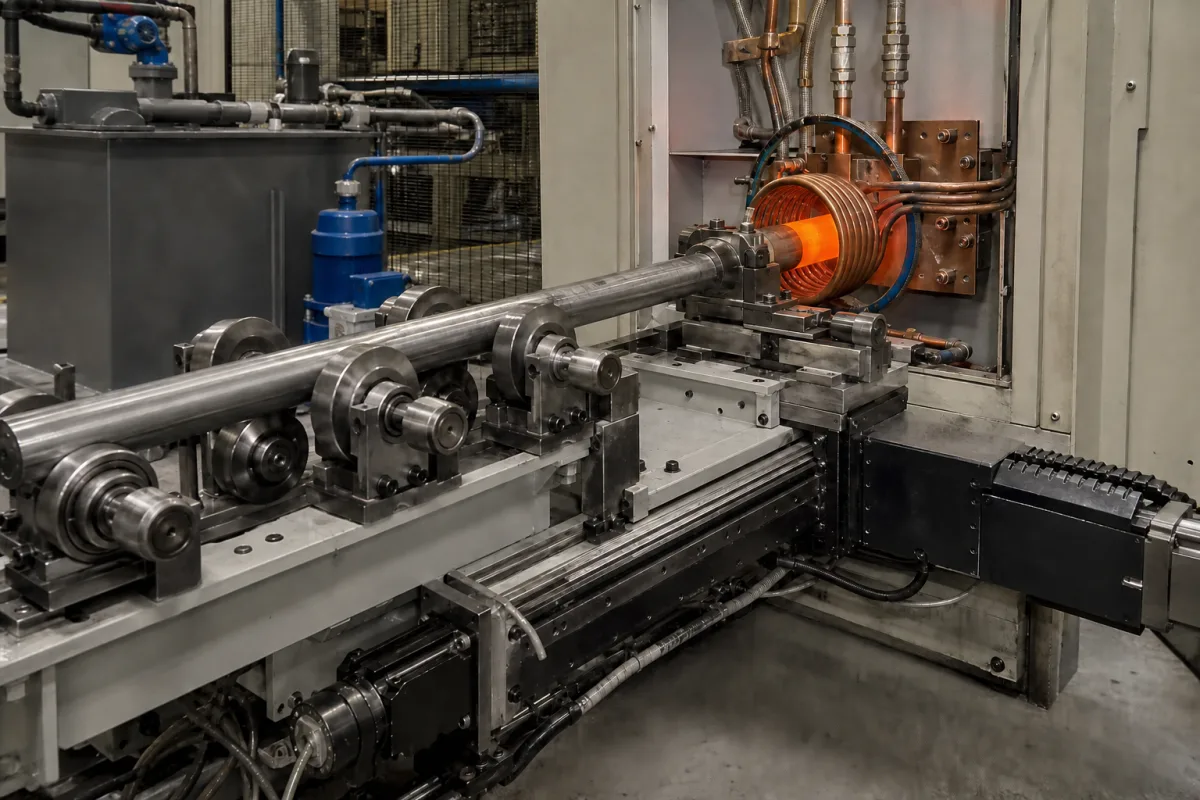
A mechanical system within an induction heating station that transports, positions, and manipulates workpieces through the heating process.
Product Specifications

Technical details and manufacturing context for Workpiece Handling Mechanism

Definition
The workpiece handling mechanism is an integral component of an induction heating station, responsible for the automated or semi-automated movement, precise positioning, and controlled manipulation of metal workpieces as they enter, pass through, and exit the heating zone. It ensures consistent process flow, proper alignment with the induction coil for uniform heating, and safe transfer of heated components to subsequent cooling or processing stages.
Working Principle
The mechanism typically employs a combination of conveyors (belt, roller, or chain), robotic arms, lift-and-carry systems, or specialized grippers. It is synchronized with the induction heating power supply and control system. Sensors detect workpiece presence and position, triggering the mechanism to advance, rotate, or hold the workpiece at the correct location within the electromagnetic field for the prescribed heating cycle before transferring it onward.
Common Materials
Carbon steel, Stainless steel, Aluminum alloy
Technical Parameters
  • Maximum workpiece dimensions (Length x Width x Height or Diameter x Length) that the mechanism can accommodate. (mm) Standard Spec
Components / BOM
  • Drive Motor
    Provides the primary motive power for conveyor movement or actuator motion.
    Material: Steel housing, copper windings
  • Linear Guide Rails
    Provide a low-friction, precise path for the movement of slides or carriages that hold the workpiece.
    Material: Hardened steel
  • Gripper or Fixture
    Securely holds the workpiece during transport and positioning, often designed for specific part shapes.
    Material: Heat-resistant steel or ceramic
  • Proximity Sensor
    Detects the presence and position of the workpiece to provide feedback to the control system.
    Material: Plastic housing, sensing element (inductive/capacitive)
Engineering Reasoning
0.5-2.0 m/s linear velocity, 0.1-5.0 kg payload mass, 0.05-0.5 m positioning accuracy
Exceeding 2.5 m/s velocity causes bearing seizure, exceeding 6.0 kg payload causes structural deformation >0.5 mm, exceeding 150°C ambient temperature causes lubricant breakdown
Design Rationale: Bearing seizure occurs due to exceeding PV limit (Pressure-Velocity product > 1.5 MPa·m/s), structural deformation follows Hooke's Law with yield stress of 250 MPa, lubricant breakdown follows Arrhenius equation with activation energy of 80 kJ/mol
Risk Mitigation (FMEA)
Trigger Induction field interference causing eddy currents in mechanism components
Mode: Electromagnetic heating of gripper jaws exceeding 200°C
Strategy: Implement mu-metal shielding with 0.5 mm thickness and 80 dB attenuation at 10 kHz
Trigger Accumulated positioning error exceeding 0.1 mm per 1000 cycles due to wear
Mode: Workpiece misalignment causing incomplete heating pattern
Strategy: Install laser interferometer feedback with 0.01 mm resolution and adaptive PID control with Kp=2.5, Ki=0.1, Kd=0.5

Industry Taxonomies & Aliases

Commonly used trade names and technical identifiers for Workpiece Handling Mechanism.

Applied To / Applications

This component is essential for the following industrial systems and equipment:

Industrial Ecosystem & Supply Chain DNA

Complementary Systems
Downstream Applications
Specialized Tooling

Application Fit & Sizing Matrix

Operational Limits
pressure: Atmospheric to 2 bar (for pneumatic components)
other spec: Max workpiece weight: 50 kg, Positioning accuracy: ±0.5 mm, Cycle time: 10-60 seconds
temperature: Ambient to 500°C (typical induction heating environment)
Media Compatibility
✓ Steel alloys ✓ Aluminum alloys ✓ Copper-based materials
Unsuitable: Corrosive chemical baths or abrasive slurry environments
Sizing Data Required
  • Workpiece dimensions and weight
  • Required throughput (parts/hour)
  • Induction coil geometry and clearance requirements

Reliability & Engineering Risk Analysis

Failure Mode & Root Cause
Misalignment-induced bearing failure
Cause: Improper installation, thermal expansion, or foundation settling causing shaft misalignment, leading to excessive radial loads and premature bearing wear.
Gear tooth pitting and spalling
Cause: Inadequate lubrication, contamination in lubricant, or overloading causing surface fatigue and material breakdown at gear contact points.
Maintenance Indicators
  • Unusual grinding or metallic scraping noises during operation
  • Visible vibration or wobbling in moving components during workpiece transfer
Engineering Tips
  • Implement laser alignment checks during installation and quarterly preventive maintenance to ensure shaft alignment within 0.05mm tolerance
  • Establish condition-based lubrication program using oil analysis to monitor contamination levels and maintain proper viscosity for gear systems

Compliance & Manufacturing Standards

Reference Standards
ISO 10218-2:2011 - Robots and robotic devices - Safety requirements for industrial robots - Part 2: Robot systems and integration ANSI/RIA R15.06 - Industrial Robots and Robot Systems - Safety Requirements CE Marking - Machinery Directive 2006/42/EC
Manufacturing Precision
  • Positioning Accuracy: +/-0.05mm
  • Repeatability: +/-0.02mm
Quality Inspection
  • Load Testing - Verification of maximum payload capacity and stability
  • Functional Safety Testing - Validation of safety interlocks and emergency stop systems

Factories Producing Workpiece Handling Mechanism

Verified manufacturers with capability to produce this product in China

✓ 97% Supplier Capability Match Found

S Sourcing Manager from Canada Feb 25, 2026
★★★★★
"Impressive build quality. Especially the technical reliability is very stable during long-term operation."
Technical Specifications Verified
P Procurement Specialist from United States Feb 22, 2026
★★★★☆
"As a professional in the Machinery and Equipment Manufacturing sector, I confirm this Workpiece Handling Mechanism meets all ISO standards. (Delivery took slightly longer than expected, but technical support was excellent.)"
Technical Specifications Verified
T Technical Director from United Arab Emirates Feb 19, 2026
★★★★★
"Standard OEM quality for Machinery and Equipment Manufacturing applications. The Workpiece Handling Mechanism arrived with full certification."
Technical Specifications Verified
Verification Protocol

“Feedback is collected from verified sourcing managers during RFQ (Request for Quote) and factory evaluation processes on CNFX. These reports represent historical performance data and technical audit summaries from our B2B manufacturing network.”

12 sourcing managers are analyzing this specification now. Last inquiry for Workpiece Handling Mechanism from India (37m ago).

Supply Chain Compatible Machinery & Devices

Heavy-Duty CNC Plasma Cutting Machine

Industrial machine for precision metal cutting using plasma arc technology

Explore Specs →
Automated Assembly Line System

Integrated production system for sequential component assembly operations

Explore Specs →
Automated Powder Coating System

Integrated industrial system for applying dry powder coatings to metal substrates.

Explore Specs →
Centrifugal Pump Impeller

Rotating component that transfers energy to fluid in centrifugal pumps.

Explore Specs →

Frequently Asked Questions

What materials can the workpiece handling mechanism process?

The mechanism is designed to handle workpieces made of carbon steel, stainless steel, and aluminum alloy, making it versatile for various industrial applications in machinery manufacturing.

What components are included in the BOM for this handling mechanism?

The bill of materials includes a drive motor for movement, linear guide rails for precision positioning, a gripper or fixture for secure workpiece handling, and proximity sensors for accurate detection and control.

How does this mechanism improve induction heating station efficiency?

By automating the transport, positioning, and manipulation of workpieces, it reduces manual handling, ensures consistent placement for uniform heating, and increases throughput while minimizing errors in the heating process.

Can I contact factories directly on CNFX?

CNFX is an open directory, not a transaction platform. Each factory profile provides direct contact information and production details to help you initiate direct inquiries with Chinese suppliers.

Get Quote for Workpiece Handling Mechanism

Request technical pricing, lead times, or customized specifications for Workpiece Handling Mechanism directly from verified manufacturing units.

Your business information is encrypted and only shared with verified Workpiece Handling Mechanism suppliers.

Thank you! Your message has been sent. We'll respond within 1–3 business days.

Need to Manufacture Workpiece Handling Mechanism?

Connect with verified factories specializing in this product category

Add Your Factory Contact Us
Previous Product
Workpiece Fixture
Next Product
Wrist Assembly