Editorial Technical Reference

Modular 5G Base Station Production System

This page explains how Modular 5G Base Station Production System is classified within Manufacture of Communication Equipment. Technical values and manufacturer relationships are research references; confirm the current specification and supplier evidence for each order.

Technical Definition & Core Assembly

The Modular 5G Base Station Production System is an integrated industrial production line engineered for high-volume manufacturing of 5G base station units.
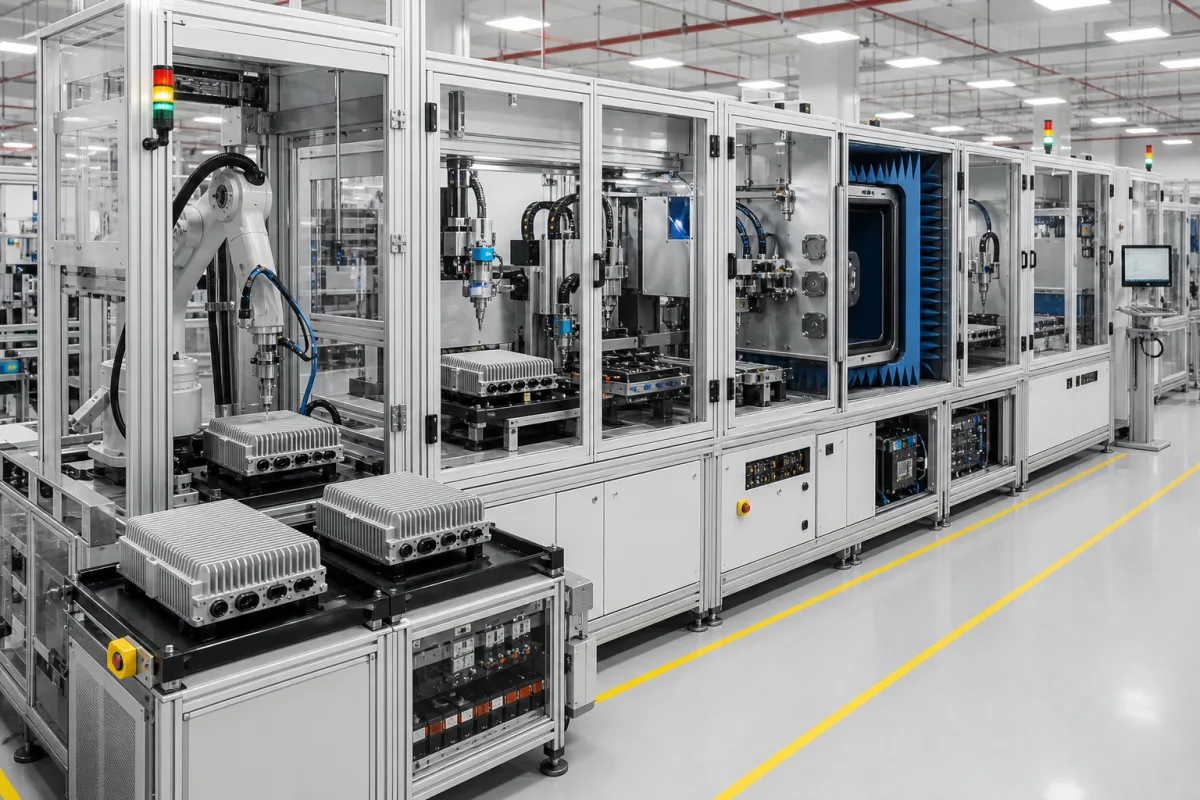
Representative product image. Confirm appearance and specifications with the manufacturer.

Product Specifications

Technical details and manufacturing context for Modular 5G Base Station Production System

Definition
The Modular 5G Base Station Production System is an integrated industrial production line engineered for high-volume manufacturing of 5G base station units. It coordinates multiple specialized modules to perform PCB assembly, RF component integration, thermal management system installation, and final enclosure assembly. The system ensures precise alignment of sensitive radio frequency components and efficient assembly of complex electronic subsystems. It is designed for scalability to accommodate different base station form factors and production volumes. The system operates on a synchronized conveyor and robotic assembly principle, where base station chassis move through sequential stations. Each station performs a specific assembly, testing, or calibration task using automated machinery, guided by a central manufacturing execution system (MES) that tracks components and ensures quality control. Key parameters include a line cycle time of 120–180 seconds per station, positioning accuracy of ±0.05 mm (ISO 230-2), conveyor speed of 0.5–2.0 meters/minute, power consumption of 45–60 kilowatts, and a footprint length of 35–50 meters. Operating conditions include a temperature range of 5–40 °C, relative humidity of 20–80% RH (non-condensing), and ingress protection ratings of IP54–IP65 (IEC 60529) for control cabinets and motors. The system requires a 3-phase supply voltage of 380–480 V AC (IEC 60038), compressed air pressure of 0.6–0.8 MPa (ISO 8573-1), and maintains a noise level of ≤75 dB(A) at the operator position (ISO 11201). Target overall equipment efficiency (OEE) after ramp-up is ≥85%. Materials used include aluminum alloy, FR-4 PCB laminate, copper RF waveguide, and thermal interface material. This directory entry provides reference values; verify model-specific specifications and standards with the legal manufacturer or supplier before procurement.
Working Principle
The system operates on a synchronized conveyor and robotic assembly principle. Base station chassis move through sequential stations, each performing a specific assembly, testing, or calibration task using automated machinery. A central manufacturing execution system (MES) tracks components and ensures quality control. The conveyor speed is adjustable from 0.5 to 2.0 meters per minute, and each station cycle takes 120–180 seconds. Robotic placement achieves positioning accuracy of ±0.05 mm. The system is designed for scalability to accommodate different base station form factors and production volumes.
Common Materials
Aluminum Alloy, FR-4 PCB Laminate, Copper RF Waveguide, Thermal Interface Material
Technical Parameters
ParameterTypical rangeNotes & selection driver
Line Cycle TimeRequired120–180 secondsTime to complete one station assembly cycle
Positioning AccuracyRequired±0.05 micrometersPrecision of robotic component placementISO 230-2
Conveyor SpeedRequired0.5–2.0 meters/minuteSpeed of the main assembly conveyor
Power ConsumptionRequired45–60 kilowattsTotal electrical power draw during operation
Footprint LengthRequired35–50 metersTotal length of the production line
Operating Temperature5–40 °CFor production environment
Relative Humidity20–80 % RHNon-condensing
Ingress Protection RatingIP54–IP65For control cabinets and motorsIEC 60529
Supply Voltage380–480 V AC3-phase, 50/60 HzIEC 60038
Compressed Air Pressure0.6–0.8 MPaFor pneumatic actuatorsISO 8573-1
Noise Level≤75 dB(A)At operator positionISO 11201
Overall Equipment Efficiency≥85 %Target OEE after ramp-up

Ranges are indicative industry figures for RFQ preparation, not a supplier commitment. Confirm every value and standard with the legal manufacturer before ordering.

Components / BOM
  • Automated Solder Paste Printer
    Applies solder paste to PCB pads for surface-mount components
    Material: Stainless Steel Frame, Ceramic Stencil
  • Pick-and-Place Robot
    Precisely places surface-mount electronic components onto PCBs
    Material: Aluminum Arm, Ceramic Nozzles
  • Reflow Oven Module
    Heats PCBs to melt solder and permanently attach components
    Material: Insulated Steel Chamber, Quartz Heating Elements
  • RF Shield Assembly Station
    Installs and seals electromagnetic interference shielding cans
    Material: Robotic Gripper, Vision System
  • Thermal Paste Dispenser
    Applies thermal interface material to heat-generating components
    Material: Precision Pump, Syringe
  • Final Test Chamber
    Performs functional and RF performance testing on completed units
    Material: RF-Shielded Enclosure, Test Probes
  • Conveyor
    Moves the chassis from station to station in step with the line cycle.
  • Manufacturing Execution System (MES)
    Tracks each unit and its components through the line and gates quality.

Industry Taxonomies & Aliases

Commonly used trade names and technical identifiers for Modular 5G Base Station Production System.

Industrial Ecosystem & Supply Chain Structure

Complementary Systems
Downstream Applications
Specialized Tooling

Application Fit & Sizing Matrix

Operational Limits
pressure: Atmospheric (cleanroom environment)
other spec: Humidity: 30-60% RH, Particle Count: ISO Class 7 or better, Vibration: <0.5g RMS, Power Quality: ±5% voltage stability
temperature: 15-35°C (operating), 5-45°C (storage)
Media Compatibility
✓ RF components (antennas, filters) ✓ Printed circuit boards with 5G chipsets ✓ Aluminum/steel structural enclosures
Unsuitable: Corrosive chemical processing environments (e.g., acid baths, plating lines)
Sizing Data Required
  • Daily production throughput (units/day)
  • Base station model variants (size/complexity)
  • Available factory floor space (length × width × height)

Reliability & Engineering Risk Analysis

Failure Mode & Root Cause
Thermal Overload
Cause: Inadequate cooling due to dust accumulation on heat sinks, poor ventilation in enclosures, or ambient temperature exceeding design limits, leading to component degradation and system shutdown.
Corrosion and Moisture Ingress
Cause: Exposure to harsh environmental conditions (e.g., humidity, salt spray, pollutants) without proper sealing or protective coatings, resulting in electrical shorts, connector failures, and PCB damage.
Maintenance Indicators
  • Abnormal audible alarms or irregular fan noise indicating cooling system failure or overheating
  • Visible corrosion, discoloration, or moisture accumulation on connectors, PCBs, or enclosures
Engineering Tips
  • Implement predictive maintenance using thermal imaging and vibration analysis to detect early signs of overheating or mechanical wear before catastrophic failure
  • Apply conformal coatings to PCBs and use corrosion-resistant materials (e.g., stainless steel fasteners, sealed connectors) with regular environmental sealing inspections

Indicative industry ranges for design and RFQ preparation. Confirm the exact figures and applicable standard with the manufacturer before specifying.

Compliance & Manufacturing Standards

Applicable Standards
CE Marking (EU Directive 2014/53/EU for Radio Equipment)

Quoted from the published standard.

Manufacturing Precision
  • RF Connector Alignment: +/-0.05mm
  • Heat Sink Flatness: 0.15mm
Quality Inspection
  • Thermal Cycling Test (-40°C to +85°C)
  • RF Signal Integrity Test (Vector Network Analyzer)

Manufacturers of Modular 5G Base Station Production System

Manufacturer profiles associated with Modular 5G Base Station Production System.

Sourcing Modular 5G Base Station Production System from China?
Tell us your specification and target quantity — we will match it against manufacturer records and come back with the factories that fit.
Request manufacturers We manufacture this

Manufacturer listings support early research and capability understanding. They are not certification, ranking, or transaction guarantees.

Technical documentation
Request current drawings, revision history, and a signed specification sheet.
Manufacturing capability
Verify equipment lists, process limits, capacity, and representative production evidence.
Inspection readiness
Confirm test methods, calibrated equipment, sampling plans, and traceable reports.
Supplier transparency
Check the legal entity, factory address, ownership, certifications, and direct contacts.

CNFX does not score or rank suppliers. Buyers must verify all claims and documents with the legal manufacturer before ordering.

Frequently Asked Questions

What is the typical cycle time per station?

The line cycle time is 120–180 seconds per station, depending on the specific assembly task and configuration. This is a reference range; confirm the exact value for your model with the manufacturer.

What positioning accuracy does the robotic placement achieve?

The robotic component placement achieves a positioning accuracy of ±0.05 micrometers, tested according to ISO 230-2. This ensures precise alignment of sensitive RF components.

What are the environmental operating conditions?

The system operates in temperatures from 5 to 40 °C and relative humidity of 20–80% RH (non-condensing). Control cabinets and motors have ingress protection ratings of IP54–IP65 per IEC 60529.

What utilities are required for operation?

The system requires a 3-phase supply voltage of 380–480 V AC (IEC 60038) and compressed air at 0.6–0.8 MPa (ISO 8573-1). Power consumption is 45–60 kW. Verify specific requirements with the supplier.

Data Basis

Editorial classification, named public sources where available, and source-reviewed manufacturer records.

Preliminary Technical Classification
This page supports structured research, RFQ preparation, and supplier evaluation. It does not replace buyer-led supplier qualification, standards review, or technical approval.
Buyer enquiry

Request manufacturing insight for Modular 5G Base Station Production System

Ask for use case, specification boundaries, supplier type, and RFQ preparation information for this product.

Where it goes
Straight to the CNFX editorial desk, and to the manufacturer if this product is linked to a claimed profile. Nothing is broadcast to a supplier list.
Your details stay here
We do not sell or rent enquiry data, and we do not add you to a mailing list. Used only to answer this request.
No commission, no middleman
CNFX is a directory. We take no cut of any order and never negotiate on a supplier's behalf.
What we don't claim
A listing is not an endorsement. Qualify every supplier and verify every figure yourself before ordering.

Your business information is used only to process this request.

Thank you! Your message has been sent. We'll respond within 1–3 business days.
Sorry, we couldn't send your message. Please try again, or email us at contact@cnfx.com.

Need to Manufacture Modular 5G Base Station Production System?

Compare manufacturer profiles with relevant product and process capability.

Previous Product
Precision Fiber Optic Polishing Machine
Last Product
Get QuotesChat