Industry-Verified Manufacturing Data (2026)

Automated Multi-Material Vehicle Body Assembly System

Based on aggregated insights from multiple verified factory profiles within the CNFX directory, the standard Automated Multi-Material Vehicle Body Assembly System used in the Motor Vehicle Manufacturing sector typically supports operational capacities ranging from standard industrial configurations to heavy-duty production requirements.

Technical Definition & Core Assembly

A canonical Automated Multi-Material Vehicle Body Assembly System is characterized by the integration of Robotic Welding Station and Adhesive Application Module. In industrial production environments, manufacturers listed on CNFX commonly emphasize High-strength steel construction to support stable, high-cycle operation across diverse manufacturing scenarios.

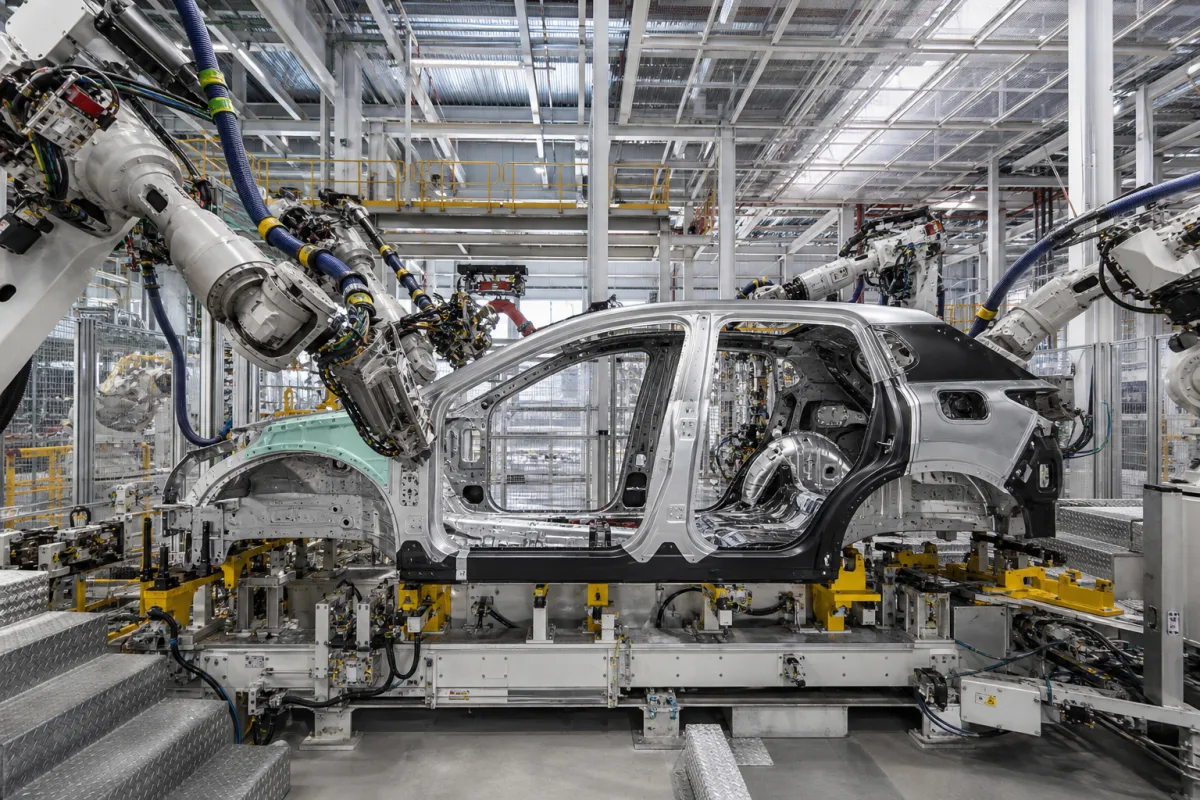
Integrated production line for assembling vehicle body structures from multiple materials
Product Specifications

Technical details and manufacturing context for Automated Multi-Material Vehicle Body Assembly System

Definition
A comprehensive industrial system designed for the automated assembly of motor vehicle bodies (coachwork) using mixed material construction. This integrated production line coordinates multiple specialized modules to handle steel, aluminum, and composite components through precise joining processes. The system enables high-volume manufacturing with consistent quality control across all assembly stages. It represents a complete industrial solution for modern vehicle body production facilities.
Working Principle
Coordinated robotic stations sequentially assemble body components through automated material handling, precise positioning, and advanced joining technologies including welding, adhesive bonding, and mechanical fastening.
Common Materials
High-strength steel, Aluminum alloys, Carbon fiber composites, Structural adhesives
Technical Parameters
  • Time to complete one full body assembly cycle (seconds) Per Request
  • Robotic positioning precision for component placement (millimeters) Per Request
Components / BOM
Engineering Reasoning
0.8-1.2 MPa clamping pressure, 0.1-0.5 mm positioning accuracy, 20-80°C ambient temperature
Clamping pressure exceeds 1.5 MPa causing material deformation, positioning error exceeds 1.0 mm causing misalignment, ambient temperature exceeds 100°C causing adhesive failure
Design Rationale: Yield strength of aluminum alloys (typically 200-400 MPa) exceeded by excessive clamping force, thermal expansion coefficient mismatch (23×10⁻⁶/°C for aluminum vs 11×10⁻⁶/°C for steel) causing stress concentrations, adhesive glass transition temperature (typically 80-120°C) exceeded
Risk Mitigation (FMEA)
Trigger Servo motor encoder feedback loss due to electromagnetic interference from welding operations
Mode: Robot arm overshoot beyond programmed path causing collision with adjacent fixtures
Strategy: Shielded encoder cables with ferrite cores, physical separation of 2 meters from welding stations, differential signal encoding
Trigger Adhesive dispensing nozzle clogging from particulate contamination exceeding 50 μm
Mode: Incomplete adhesive bead application causing structural bond failure under 15 kN shear load
Strategy: 5 μm filtration system with pressure differential monitoring, automated nozzle cleaning cycle every 100 cycles, real-time bead profile laser scanning

Industry Taxonomies & Aliases

Commonly used trade names and technical identifiers for Automated Multi-Material Vehicle Body Assembly System.

Industrial Ecosystem & Supply Chain DNA

Complementary Systems
Downstream Applications
Specialized Tooling

Application Fit & Sizing Matrix

Operational Limits
pressure: 0.5-1.2 MPa (clamping/holding systems)
other spec: Material feed rate: 2-15 m/min, Positioning accuracy: ±0.1 mm, Cycle time: 45-180 seconds per station
temperature: 15-35°C (operating environment)
Media Compatibility
✓ Aluminum alloy sheets ✓ High-strength steel components ✓ Carbon fiber reinforced polymer panels
Unsuitable: Highly corrosive chemical processing environments (e.g., acid baths, salt spray testing chambers)
Sizing Data Required
  • Annual production volume (units/year)
  • Maximum part dimensions (L×W×H in mm)
  • Material mix ratio (percentage of each material type)

Reliability & Engineering Risk Analysis

Failure Mode & Root Cause
Misalignment of robotic welding arms
Cause: Wear in servo motor encoders and harmonic drive gears leading to positional drift
Clamping fixture degradation
Cause: Fatigue failure from cyclic loading and contamination buildup in pneumatic cylinders
Maintenance Indicators
  • Inconsistent weld quality with visible spatter or incomplete fusion
  • Abnormal high-pitched whining from servo motors during positioning
Engineering Tips
  • Implement laser alignment verification at start of each shift with automated compensation
  • Establish predictive maintenance using vibration analysis on transfer system bearings and thermal monitoring on welding transformers

Compliance & Manufacturing Standards

Reference Standards
ISO 9001:2015 - Quality Management Systems ANSI/ASME B5.54-2005 - Methods for Performance Evaluation of Computer Numerically Controlled Machining Centers DIN EN 1090-1:2018 - Execution of steel structures and aluminium structures
Manufacturing Precision
  • Positional Accuracy: +/-0.05mm for robotic arm end-effectors
  • Surface Flatness: 0.2mm per meter for assembly fixture plates
Quality Inspection
  • Laser Tracker Metrology for 3D spatial accuracy verification
  • Force/Torque Sensor Calibration for robotic assembly process validation

Factories Producing Automated Multi-Material Vehicle Body Assembly System

Verified manufacturers with capability to produce this product in China

✓ 93% Supplier Capability Match Found

T Technical Director from Germany Jan 10, 2026
★★★★★
"Found 30+ suppliers for Automated Multi-Material Vehicle Body Assembly System on CNFX, but this spec remains the most cost-effective."
Technical Specifications Verified
P Project Engineer from Brazil Jan 07, 2026
★★★★☆
"The technical documentation for this Automated Multi-Material Vehicle Body Assembly System is very thorough, especially regarding Maximum Throughput (units/hour). (Delivery took slightly longer than expected, but technical support was excellent.)"
Technical Specifications Verified
S Sourcing Manager from Canada Jan 04, 2026
★★★★★
"Reliable performance in harsh Motor Vehicle Manufacturing environments. No issues with the Automated Multi-Material Vehicle Body Assembly System so far."
Technical Specifications Verified
Verification Protocol

“Feedback is collected from verified sourcing managers during RFQ (Request for Quote) and factory evaluation processes on CNFX. These reports represent historical performance data and technical audit summaries from our B2B manufacturing network.”

16 sourcing managers are analyzing this specification now. Last inquiry for Automated Multi-Material Vehicle Body Assembly System from Poland (1h ago).

Supply Chain Commonly Integrated Components

Body Drop Station

Automated station in final assembly where vehicle body is precisely lowered onto chassis frame

Explore Specs →
Interior Assembly Station

A specialized workstation within an automotive final assembly line dedicated to installing interior components into vehicle bodies.

Explore Specs →
Final Inspection Station

A specialized workstation within the automotive assembly line where completed vehicles undergo comprehensive quality checks before release.

Explore Specs →
Automated Guided Vehicle System

A flexible material handling system using self-guided vehicles to transport components and assemblies along predetermined paths within automotive final assembly lines.

Explore Specs →

Frequently Asked Questions

What materials can this automated assembly system handle?

This system is designed for multi-material vehicle body assembly, specifically handling high-strength steel, aluminum alloys, carbon fiber composites, and structural adhesives in an integrated production line.

What are the key components included in this assembly system?

The system includes an adhesive application module, automated material handling system, control and monitoring system, quality inspection station, and robotic welding station for complete vehicle body assembly.

What industries is this assembly system designed for?

This automated multi-material assembly system is specifically engineered for the manufacture of bodies (coachwork) for motor vehicles, supporting automotive manufacturers in producing modern, lightweight vehicle structures.

Can I contact factories directly on CNFX?

CNFX is an open directory, not a transaction platform. Each factory profile provides direct contact information and production details to help you initiate direct inquiries with Chinese suppliers.

Get Quote for Automated Multi-Material Vehicle Body Assembly System

Request technical pricing, lead times, or customized specifications for Automated Multi-Material Vehicle Body Assembly System directly from verified manufacturing units.

Your business information is encrypted and only shared with verified Automated Multi-Material Vehicle Body Assembly System suppliers.

Thank you! Your message has been sent. We'll respond within 1–3 business days.

Need to Manufacture Automated Multi-Material Vehicle Body Assembly System?

Connect with verified factories specializing in this product category

Add Your Factory Contact Us
Previous Product
Automated Material Handling System
Next Product
Automated Trailer Assembly System