Industry-Verified Manufacturing Data (2026)

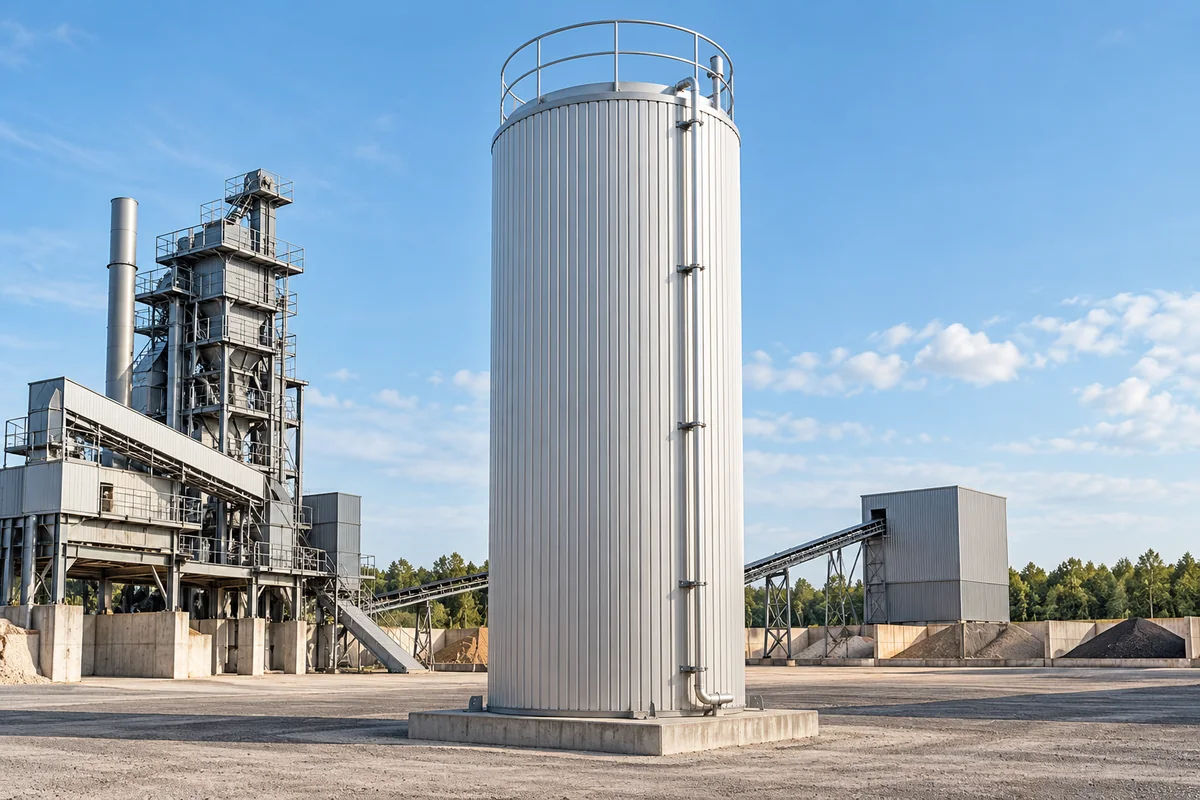
Insulated Storage Tank

Based on aggregated insights from multiple verified factory profiles within the CNFX directory, the standard Insulated Storage Tank used in the Non-Metallic Mineral Product Manufacturing sector typically supports operational capacities ranging from standard industrial configurations to heavy-duty production requirements.

Technical Definition & Core Assembly

A canonical Insulated Storage Tank is characterized by the integration of Tank Shell and Insulation Layer. In industrial production environments, manufacturers listed on CNFX commonly emphasize Carbon steel construction to support stable, high-cycle operation across diverse manufacturing scenarios.

A thermally insulated vessel designed to store asphalt at controlled temperatures within an asphalt storage and heating system.
Product Specifications

Technical details and manufacturing context for Insulated Storage Tank

Definition
The insulated storage tank is a critical component of asphalt storage and heating systems, specifically engineered to maintain asphalt at optimal temperatures (typically 150-180°C) to prevent solidification and ensure proper viscosity for subsequent handling and processing. It serves as the primary containment unit where asphalt is stored before being transferred to heating zones or distribution points.
Working Principle
The tank utilizes insulation materials (such as mineral wool or polyurethane foam) surrounding the storage chamber to minimize heat loss. It may incorporate internal heating elements (electric or thermal oil coils) or rely on external heating systems to maintain the required temperature. Temperature sensors and control systems regulate heating to keep asphalt within specified viscosity ranges.
Common Materials
Carbon steel, Stainless steel (for corrosion resistance), Mineral wool insulation, Polyurethane foam insulation
Technical Parameters
  • Tank wall thickness, typically 6-12mm depending on capacity and pressure requirements (mm) Per Request
Components / BOM
  • Tank Shell
    Primary containment structure for asphalt storage
    Material: Carbon steel
  • Insulation Layer
    Reduces heat loss to maintain temperature
    Material: Mineral wool
  • Heating Coils
    Provides heat input to maintain asphalt temperature
    Material: Stainless steel
  • Temperature Sensors
    Monitors internal temperature for control systems
    Material: Stainless steel with thermocouple
Engineering Reasoning
150-190°C, 0.3-2.0 bar internal pressure
Asphalt solidification below 140°C, tank wall stress exceeding 345 MPa yield strength at 250°C
Design Rationale: Thermal stress from ΔT>100°C differentials causing cyclic fatigue at weld joints, combined with asphalt viscosity increase below 140°C creating pump cavitation forces
Risk Mitigation (FMEA)
Trigger Insulation degradation reducing R-value below 0.35 m²·K/W
Mode: Asphalt temperature drop below 140°C causing solidification and pump seizure
Strategy: Dual-layer mineral wool insulation with 0.15 m²·K/W thermal resistance per layer and continuous temperature monitoring at 5 cm intervals
Trigger Thermal cycling exceeding 10,000 cycles between 150-190°C
Mode: Fatigue cracking at circumferential welds leading to asphalt leakage
Strategy: Stress-relieved weld design with 2.5:1 safety factor and ultrasonic testing at 1000-cycle intervals

Industry Taxonomies & Aliases

Commonly used trade names and technical identifiers for Insulated Storage Tank.

Applied To / Applications

This component is essential for the following industrial systems and equipment:

Industrial Ecosystem & Supply Chain DNA

Complementary Systems
Downstream Applications
Specialized Tooling

Application Fit & Sizing Matrix

Operational Limits
pressure: Atmospheric to 0.5 bar gauge (vented design)
other spec: Slurry concentration: Up to 70% solids by weight, Flow rate: 5-50 m³/hr transfer capability
temperature: 150°C to 200°C (maintains asphalt viscosity)
Media Compatibility
✓ Hot asphalt binder ✓ Modified asphalt polymers ✓ Asphalt emulsion storage
Unsuitable: Chlorinated solvents or strong oxidizing agents
Sizing Data Required
  • Required storage capacity (m³)
  • Maximum daily throughput (tons/day)
  • Required temperature maintenance duration (hours)

Reliability & Engineering Risk Analysis

Failure Mode & Root Cause
Corrosion Under Insulation (CUI)
Cause: Moisture ingress through damaged insulation or cladding leading to hidden corrosion of tank walls, accelerated by temperature cycling and chemical exposure.
Insulation Degradation and Loss of Thermal Efficiency
Cause: Water absorption, physical damage, or aging of insulation materials reducing thermal performance, leading to energy loss, condensation, and potential process issues.
Maintenance Indicators
  • Visible rust streaks, bulging, or wet spots on insulation cladding indicating moisture ingress and potential hidden corrosion.
  • Significant increase in energy consumption or inability to maintain temperature setpoints, suggesting insulation failure or thermal bridging.
Engineering Tips
  • Implement regular non-destructive testing (e.g., infrared thermography, ultrasonic thickness testing) to detect hidden corrosion and insulation voids before failures occur.
  • Ensure proper design and maintenance of vapor barriers, sealants, and cladding to prevent moisture ingress, and use corrosion-resistant coatings under insulation where applicable.

Compliance & Manufacturing Standards

Reference Standards
ISO 9001:2015 - Quality Management Systems ASME Boiler and Pressure Vessel Code Section VIII Division 1 EN 14015:2004 - Specification for the design and manufacture of site built, vertical, cylindrical, flat-bottomed, above ground, welded, steel tanks for the storage of liquids at ambient temperature and above
Manufacturing Precision
  • Wall Thickness: +/-5% of specified thickness
  • Circularity (Roundness): Maximum deviation of 0.5% of tank diameter
Quality Inspection
  • Vacuum Box Leak Test for all welds
  • Ultrasonic Thickness Testing for corrosion assessment

Factories Producing Insulated Storage Tank

Verified manufacturers with capability to produce this product in China

✓ 98% Supplier Capability Match Found

P Project Engineer from Singapore Jan 13, 2026
★★★★★
"Found 57+ suppliers for Insulated Storage Tank on CNFX, but this spec remains the most cost-effective."
Technical Specifications Verified
S Sourcing Manager from Germany Jan 10, 2026
★★★★★
"The technical documentation for this Insulated Storage Tank is very thorough, especially regarding technical reliability."
Technical Specifications Verified
P Procurement Specialist from Brazil Jan 07, 2026
★★★★★
"Reliable performance in harsh Non-Metallic Mineral Product Manufacturing environments. No issues with the Insulated Storage Tank so far."
Technical Specifications Verified
Verification Protocol

“Feedback is collected from verified sourcing managers during RFQ (Request for Quote) and factory evaluation processes on CNFX. These reports represent historical performance data and technical audit summaries from our B2B manufacturing network.”

10 sourcing managers are analyzing this specification now. Last inquiry for Insulated Storage Tank from Turkey (33m ago).

Supply Chain Compatible Machinery & Devices

High-Purity Fused Silica Powder

Ultra-pure amorphous silicon dioxide powder for industrial applications

Explore Specs →
Concrete Paver

A heavy construction machine used to lay and compact concrete for roads, highways, and large flat surfaces.

Explore Specs →
Concrete Batching Plant

A facility that combines various ingredients to form concrete, including cement, aggregates, water, and admixtures.

Explore Specs →
Concrete Vibrator

A construction tool used to eliminate air bubbles and ensure proper compaction of freshly poured concrete.

Explore Specs →

Frequently Asked Questions

What insulation materials are used in these asphalt storage tanks?

Our insulated storage tanks utilize mineral wool and polyurethane foam insulation to maintain precise temperature control and minimize heat loss during asphalt storage.

How does the heating system work in these insulated tanks?

The tanks feature integrated heating coils that maintain asphalt at optimal temperatures, working in conjunction with temperature sensors and insulation to ensure consistent thermal performance.

What materials are used for corrosion resistance in these tanks?

We use stainless steel components in critical areas along with carbon steel construction, providing excellent corrosion resistance for long-term durability in asphalt storage applications.

Can I contact factories directly on CNFX?

CNFX is an open directory, not a transaction platform. Each factory profile provides direct contact information and production details to help you initiate direct inquiries with Chinese suppliers.

Get Quote for Insulated Storage Tank

Request technical pricing, lead times, or customized specifications for Insulated Storage Tank directly from verified manufacturing units.

Your business information is encrypted and only shared with verified Insulated Storage Tank suppliers.

Thank you! Your message has been sent. We'll respond within 1–3 business days.

Need to Manufacture Insulated Storage Tank?

Connect with verified factories specializing in this product category

Add Your Factory Contact Us
Previous Product
Impact Crusher
Next Product
Jaw Crusher