Industry-Verified Manufacturing Data (2026)

Burners

Based on aggregated insights from multiple verified factory profiles within the CNFX directory, the standard Burners used in the Basic Metal Manufacturing sector typically supports operational capacities ranging from standard industrial configurations to heavy-duty production requirements.

Technical Definition & Core Assembly

A canonical Burners is characterized by the integration of Fuel Nozzle and Air Register. In industrial production environments, manufacturers listed on CNFX commonly emphasize Stainless steel construction to support stable, high-cycle operation across diverse manufacturing scenarios.

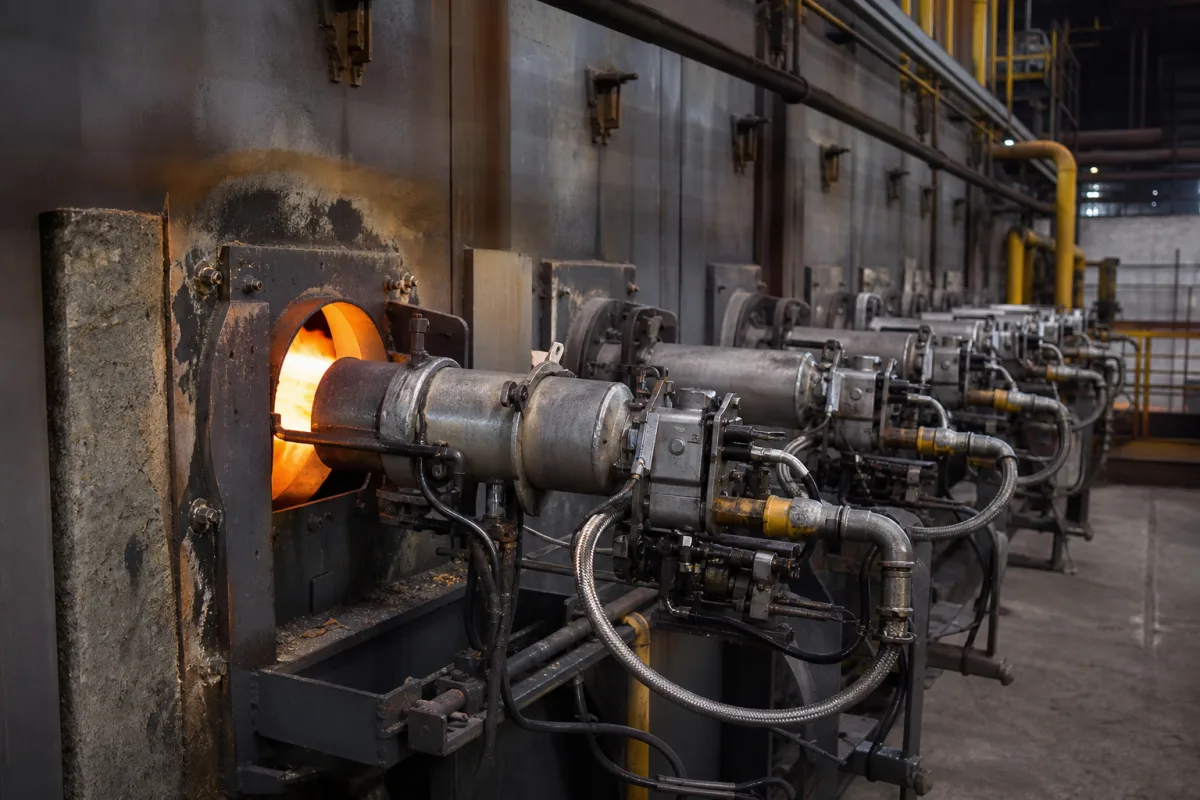
Devices that mix fuel and air to produce controlled combustion for heating purposes in industrial furnaces.
Product Specifications

Technical details and manufacturing context for Burners

Definition
Burners are critical components of reheating furnaces that precisely control the combustion process by mixing fuel (typically natural gas, oil, or other industrial fuels) with air or oxygen to generate high-temperature flames for heating metal billets, slabs, or other materials to specific temperatures before further processing.
Working Principle
Burners operate by mixing fuel and oxidizer (air or oxygen) in specific ratios, then igniting the mixture to produce a controlled flame. The combustion process releases thermal energy that is transferred to the furnace chamber and the materials being heated. Modern burners often include control systems to regulate fuel-air ratios, flame shape, and temperature for optimal efficiency and emissions control.
Common Materials
Stainless steel, Refractory ceramics, High-temperature alloys
Technical Parameters
  • Thermal capacity rating indicating the maximum heat output of the burner (kW) Per Request
Components / BOM
  • Fuel Nozzle
    Controls and directs the flow of fuel into the combustion chamber
    Material: Stainless steel
  • Air Register
    Regulates and directs the flow of combustion air
    Material: Carbon steel
  • Ignition System
    Provides spark or pilot flame to initiate combustion
    Material: Ceramic, high-temperature alloys
  • Flame Detector
    Monitors flame presence for safety and control purposes
    Material: Stainless steel, optical components
Engineering Reasoning
0.5-2.0 bar fuel pressure, 0.1-0.3 bar combustion air pressure, 800-1600°C flame temperature
Fuel pressure below 0.3 bar causes flame instability; refractory lining erosion exceeds 25mm thickness loss; flame temperature exceeds 1650°C causing NOx formation >500 ppm
Design Rationale: Thermal fatigue from cyclic heating/cooling (ΔT>300°C) causes refractory cracking; stoichiometric imbalance (air/fuel ratio deviation >±5%) produces incomplete combustion; material creep at sustained temperatures >1400°C
Risk Mitigation (FMEA)
Trigger Fuel nozzle erosion from particulate contamination (>50μm particles at 15 m/s velocity)
Mode: Flame pattern distortion causing localized refractory overheating (hotspots >1450°C)
Strategy: Dual-stage filtration (10μm primary + 2μm secondary) with differential pressure monitoring (ΔP>0.5 bar triggers maintenance)
Trigger Combustion air preheater fouling reducing heat transfer efficiency below 65%
Mode: Incomplete combustion with CO emissions >100 ppm and 3% fuel efficiency loss
Strategy: Regenerative air preheater design with automatic sootblowing at 8-hour intervals

Industry Taxonomies & Aliases

Commonly used trade names and technical identifiers for Burners.

Applied To / Applications

This component is essential for the following industrial systems and equipment:

Industrial Ecosystem & Supply Chain DNA

Complementary Systems
Downstream Applications
Specialized Tooling

Application Fit & Sizing Matrix

Operational Limits
pressure: Up to 10 bar (fuel/air supply pressure)
flow rate: 5-5000 Nm³/h (air flow capacity)
fuel type: Natural gas, propane, oil, dual-fuel options
temperature: Ambient to 2200°C (typical combustion temperature range)
Media Compatibility
✓ Natural gas combustion systems ✓ Industrial furnace heating applications ✓ Thermal oxidizer processes
Unsuitable: Explosive or oxygen-deficient atmospheres without proper safety controls
Sizing Data Required
  • Required heat output (kW or BTU/hr)
  • Available fuel type and pressure
  • Combustion air availability and temperature

Reliability & Engineering Risk Analysis

Failure Mode & Root Cause
Flame impingement
Cause: Improper air-fuel ratio causing flame contact with burner components, leading to localized overheating and material degradation.
Nozzle clogging/coking
Cause: Fuel contamination, incomplete combustion, or thermal degradation causing carbon deposits that obstruct fuel flow and disrupt flame pattern.
Maintenance Indicators
  • Yellow or flickering flame (instead of steady blue flame)
  • Unusual combustion noise (pulsing, rumbling, or whistling sounds)
Engineering Tips
  • Implement regular combustion analysis and tuning to maintain optimal air-fuel ratio (typically 10-15% excess air for natural gas burners)
  • Establish preventive nozzle cleaning schedule and install proper filtration systems (10-25 micron filters for liquid fuels, coalescing filters for gas)

Compliance & Manufacturing Standards

Reference Standards
ISO 23553-1: Safety and control devices for oil burners and oil-burning appliances ANSI Z21.1: Household Cooking Gas Appliances CE EN 267: Forced draught oil burners
Manufacturing Precision
  • Nozzle orifice diameter: +/-0.005mm
  • Flame retention head concentricity: 0.05mm TIR
Quality Inspection
  • Leak test (air or helium) at 1.5x operating pressure
  • Combustion efficiency analysis (CO2/O2 ratio measurement)

Factories Producing Burners

Verified manufacturers with capability to produce this product in China

✓ 92% Supplier Capability Match Found

S Sourcing Manager from United States Feb 09, 2026
★★★★★
"Testing the Burners now; the technical reliability results are within 1% of the laboratory datasheet."
Technical Specifications Verified
P Procurement Specialist from United Arab Emirates Feb 06, 2026
★★★★☆
"Impressive build quality. Especially the technical reliability is very stable during long-term operation. (Delivery took slightly longer than expected, but technical support was excellent.)"
Technical Specifications Verified
T Technical Director from Australia Feb 03, 2026
★★★★★
"As a professional in the Basic Metal Manufacturing sector, I confirm this Burners meets all ISO standards."
Technical Specifications Verified
Verification Protocol

“Feedback is collected from verified sourcing managers during RFQ (Request for Quote) and factory evaluation processes on CNFX. These reports represent historical performance data and technical audit summaries from our B2B manufacturing network.”

13 sourcing managers are analyzing this specification now. Last inquiry for Burners from Poland (44m ago).

Supply Chain Compatible Machinery & Devices

Vacuum Induction Melting Furnace

Industrial furnace for melting metals under vacuum using electromagnetic induction

Explore Specs →
Electroslag Remelting Furnace

Secondary refining furnace for high-quality metal ingots

Explore Specs →
Molten Metal Flow Control Valve

Precision valve for regulating molten metal flow in casting and pouring operations.

Explore Specs →
Molten Metal Temperature Measurement System

Automated system for continuous temperature monitoring of molten metals during processing.

Explore Specs →

Frequently Asked Questions

What materials are used in industrial burners for metal manufacturing to withstand extreme temperatures?

Our industrial burners utilize stainless steel for structural components, refractory ceramics for insulation and heat resistance, and specialized high-temperature alloys for critical parts exposed to direct flame and intense heat in metal processing furnaces.

What key components are included in a complete burner system BOM for metal production?

A complete burner bill of materials includes: fuel nozzle for precise fuel delivery, air register for controlled air mixing, ignition system for reliable startup, and flame detector for safety monitoring and combustion control in industrial furnace applications.

How do industrial burners optimize combustion efficiency in basic metal manufacturing?

Our burners precisely control the fuel-air mixture ratio through engineered nozzle and register designs, ensuring complete combustion with minimal waste. This maximizes thermal efficiency while maintaining consistent furnace temperatures required for metal processing operations.

Can I contact factories directly on CNFX?

CNFX is an open directory, not a transaction platform. Each factory profile provides direct contact information and production details to help you initiate direct inquiries with Chinese suppliers.

Get Quote for Burners

Request technical pricing, lead times, or customized specifications for Burners directly from verified manufacturing units.

Your business information is encrypted and only shared with verified Burners suppliers.

Thank you! Your message has been sent. We'll respond within 1–3 business days.

Need to Manufacture Burners?

Connect with verified factories specializing in this product category

Add Your Factory Contact Us
Previous Product
Burner Assembly
Next Product
Casting Core