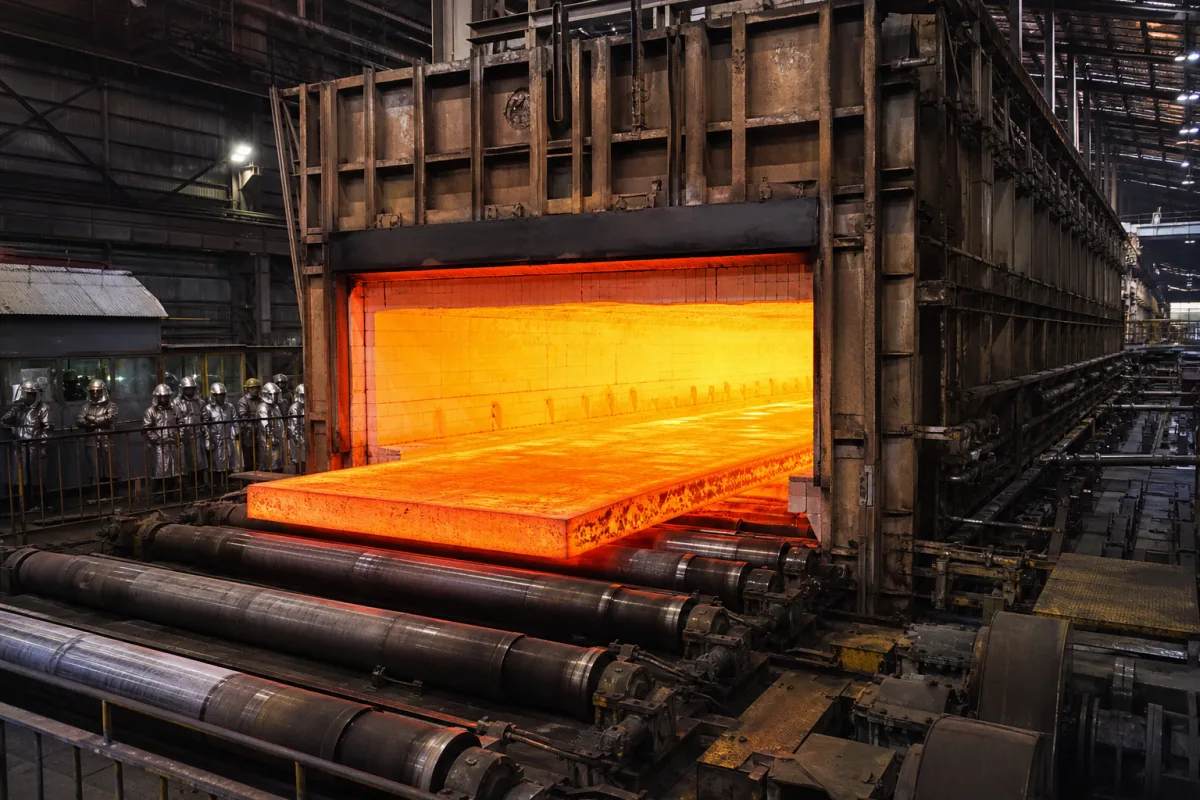
Continuous furnaces that reheat steel slabs, billets and blooms for hot rolling · Walking beam versus pusher, capacity in t/h, discharge temperature, zones and firing, fuel rate in GJ/t, low-NOx and oxyfuel retrofits, skids and insulation, and the refractory lining
A reheating furnace is the continuous, fuel-fired furnace at the entry of a hot rolling mill that heats cold or warm steel slabs, billets, blooms or beam blanks to rolling temperature as they move from the charge end through preheat, heating and soak zones to the discharge door. Ask three things first: what stock sizes, steel grades and hourly tonnage the mill needs at what discharge temperature and uniformity, whether the stock will be walked on beams or pushed along skids and how the furnace will be zoned and fired, and what fuel rate, emission limits and refractory life the design must meet.
Continuous reheating furnaces for steel slabs, billets, blooms and beam blanks ahead of hot rolling mills: walking beam and pusher furnaces with their burners, zones, stock handling, skids, refractory and controls. Batch heat-treatment furnaces (see heat treatment furnace), induction heaters, soaking pits, tunnel furnaces for thin-slab casters and furnaces for non-ferrous billets are outside this page except where compared.
CNFX editorial research · Sources checked October 11, 2026 · 5 sources
California Steel Industries lists two eight-zone, natural-gas-fired walking beam reheating furnaces feeding its 2.5 million t/y hot strip mill — one started in 1997 (Chugairo), one in 2009 (Tenova-Core) — each 38 ft 9 in wide and 137 ft 10 in long, for carbon steel slabs 7–9 in thick, 24–75 in wide, 158–441 in long and up to 30 tons. AIST reports that ANDRITZ was ordered to supply two top- and bottom-fired walking beam furnaces of 500 t/h of carbon steel slabs each to replace the pusher furnaces at ArcelorMittal Burns Harbor's 80-inch strip mill, with low-NOx burners, long unfired preheat zones, individual burner control and improved insulation including skid insulation. [1][2]
Air Products' US6290492B1 states that steel reheat furnaces heat billets, ingots and slabs to 2,000–2,300 °F for further processing, that continuous furnaces with two or more zones are used to distribute heat and control temperature, and that such furnaces fire from 20 to 400 million Btu per hour. [3]
Editorial calculation: 2,000–2,300 °F is about 1,093–1,260 °C; the CSI furnace hearth envelope of 38 ft 9 in × 137 ft 10 in is about 11.8 m × 42.0 m; and a 500 t/h furnace running 24 hours would heat about 12,000 t of slabs per day. [3][1][2]
Give the supplier the mill and its rolling schedule, stock type and size range (thickness, width, length, weight), steel grades, charge temperature (cold or hot charge), required capacity in t/h for each product, discharge temperature and allowable temperature difference across and through the piece, and the space available in the bay.
02
Set the zones, burners, fuel rate and emissions
The patent describes a typical three-zone continuous reheat furnace with a soak zone at the exit end and upper and lower heating zones toward the entrance, flue gases flowing from the soak zone back through the heating zones and out at the charge end; it states that steel reheat furnaces account for almost 30% of the NOx generated by the steel industry and proposes staging fuel-rich and fuel-lean zones with flue gases mixed above about 1,200 °F (preferably above 1,600 °F) to burn out CO. [3]
A paper on SSAB's 300 t/h walking beam slab furnace reports a prior oil rate of 440 kWh/t (1.58 GJ/t) and that a flameless oxyfuel retrofit, supplying about 75% of the combustion oxygen by high-velocity injection while keeping the existing air-fuel burners, gave 45% lower NOx, 25% lower fuel consumption, flue gas volume under 45% of air-fuel, 15–20% higher throughput and better slab temperature uniformity with no harm to surface quality. [4]
Editorial calculation: 440 kWh/t × 3.6 MJ/kWh = 1.58 GJ/t, and a 25% reduction would bring that to about 1.19 GJ/t, assuming the reduction applies to the whole furnace at the same throughput. [4]
State the fuel (natural gas, mixed gas, oil, oxygen), burner types and number per zone, top and bottom firing, recuperator or regenerative air preheat, fuel rate guarantee in GJ/t at stated capacity and charge temperature, NOx and CO limits, flue gas route, and the level 1 and level 2 control system.
03
Choose walking beam or pusher handling and plan rebuilds
Walking beam furnaces carry the stock on moving beams and can be fired from above and below; the Burns Harbor order replaced pushers with walking beam furnaces, and the patent notes that flue gases pass through openings in the walking beam support mechanism. [2][3]
A paper on Gerdau Ameristeel's Midlothian section mill describes rebuilding an existing walking beam furnace that could not meet production: the handling equipment, skids, steel, refractory, combustion system and controls were replaced, only the understructure mechanism retained, a new 45 ft section added at the charge end, the furnace rezoned and new level 1 and level 2 automation installed, for more production with less maintenance and fuel. [5]
Say whether the furnace is new or a rebuild, the handling type (walking beam, walking hearth, pusher), charging and discharging machines, skid and beam insulation, and the outage window for a rebuild.
04
Know the reheating furnace parts
This is a functional reference built from the sources cited; it is not one maker's design.
Part
Role
Fix in the order
Preheat zone
Unfired or lightly fired; recovers flue gas heat. [2][3]
Fill the specification fields with values for your mill
A reheating furnace enquiry needs values from your mill and products. The table explains each field, gives published values where a reviewed source states them, and says what to obtain from the supplier.
These companies list refractory products for reheating furnaces. They supply lining materials, not complete furnaces.
China Firebrick
Manufacturing site to be confirmed for the order
Lists high alumina cement in its reheating furnace products category, among refractory products for ladles, EAF, BOF and tundishes. Ask for the data sheet and the lining zone it is offered for.
Lists high alumina bricks and chromite sand in its reheating furnace products category. Ask for brick grade, data sheet and the lining zone it is offered for.
Explore company information and manufacturing capabilities, then discuss the scope of your project with a relevant supplier.
Share this page
Compiled and source-reviewed by the CNFX editorial team.
Published product pages show what a company offers, not tested performance. Confirm the legal seller, material data sheets and scope for your order. How we source and review
· Page last updated 13 October 2026
Buyer questions
What temperature do steel reheating furnaces reach?
A patent gives 2,000–2,300 °F (about 1,093–1,260 °C) for reheating steel billets, ingots and slabs. [3]
Why replace pusher furnaces with walking beam furnaces?
One mill's replacement walking beam furnaces add top and bottom firing, low-NOx burners, unfired preheat zones and better insulation. [2]
How much fuel does a slab reheating furnace use?
One 300 t/h walking beam furnace used 440 kWh/t (1.58 GJ/t) before an oxyfuel retrofit cut fuel by 25%. [4]
Can an old reheating furnace be rebuilt instead of replaced?
One section mill kept only the understructure, replaced the rest, extended the furnace by 45 ft and rezoned it. [5]
Sources and what still needs a direct check
Sources checked 2026-10-11. California Steel's sheet and the AIST note describe specific mills' furnaces; the SSAB and Gerdau papers report single projects; the Air Products patent describes a method. Values for your furnace must come from the supplier offered.