Industry-Verified Manufacturing Data (2026)

Continuous Casting Mold Oscillation Table

Based on aggregated insights from multiple verified factory profiles within the CNFX directory, the standard Continuous Casting Mold Oscillation Table used in the Basic Metal Manufacturing sector typically supports operational capacities ranging from standard industrial configurations to heavy-duty production requirements.

Technical Definition & Core Assembly

A canonical Continuous Casting Mold Oscillation Table is characterized by the integration of Oscillation Actuator and Oscillation Table. In industrial production environments, manufacturers listed on CNFX commonly emphasize High-strength steel construction to support stable, high-cycle operation across diverse manufacturing scenarios.

Industrial table providing controlled oscillation to continuous casting molds

Product Specifications

Technical details and manufacturing context for Continuous Casting Mold Oscillation Table

Definition
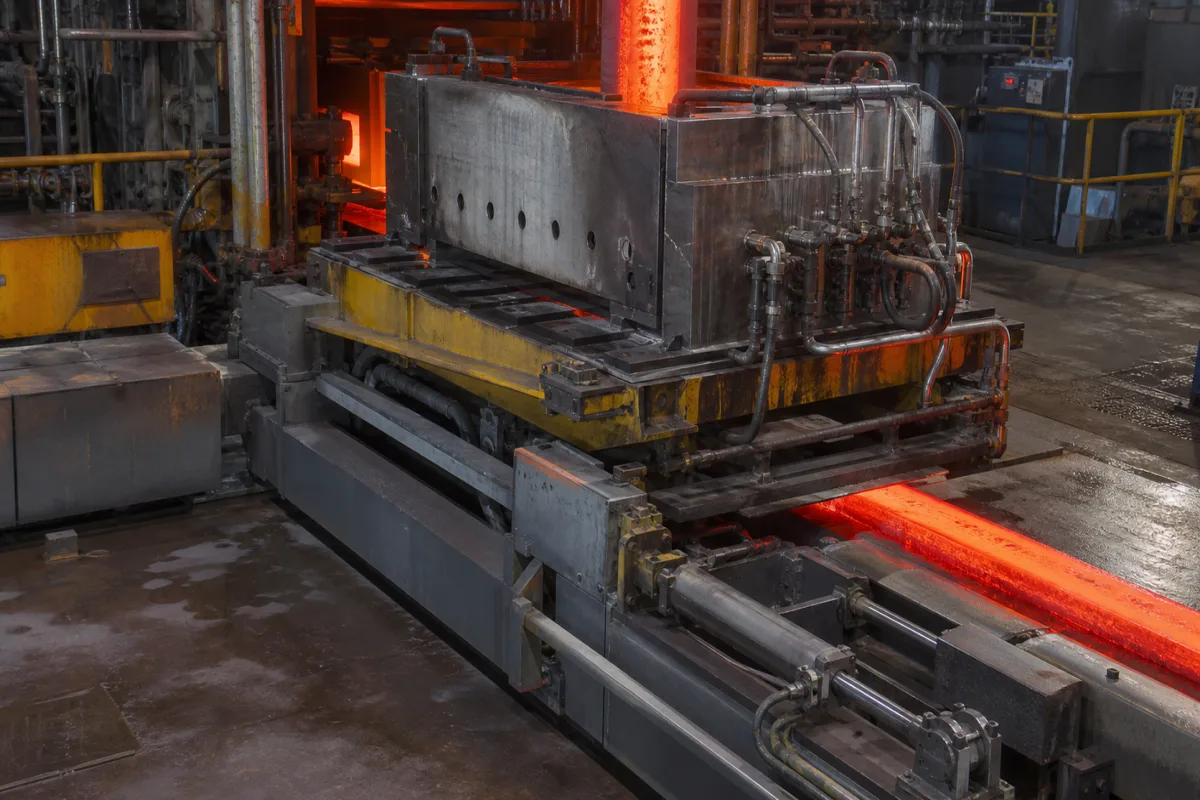
A precision industrial machine that generates controlled oscillatory motion for continuous casting molds. It prevents sticking between the solidifying metal shell and the mold wall, ensuring smooth withdrawal of cast products. The oscillation improves surface quality and reduces breakout incidents in continuous casting operations. This standalone device is essential for maintaining consistent casting quality in steel and non-ferrous metal production.
Working Principle
Uses hydraulic or electromechanical actuators to generate precise sinusoidal or non-sinusoidal oscillation patterns transmitted to the mold assembly through a rigid table structure
Common Materials
High-strength steel, Hardened alloy steel, Bronze bushings
Technical Parameters
  • Peak-to-peak oscillation displacement (mm) Standard Spec
  • Frequency of mold oscillation cycles (Hz) Standard Spec
Components / BOM
  • Oscillation Actuator
    Generates controlled oscillatory motion
    Material: High-strength steel
  • Oscillation Table
    Platform for mounting and supporting the mold
    Material: Hardened alloy steel
  • Guide System
    Ensures precise linear motion of the table
    Material: Hardened steel with bronze bushings
  • Control System
    Regulates oscillation parameters and patterns
    Material: Electronic components in steel enclosure
  • Hydraulic Power Unit Optional
    Provides hydraulic power for oscillation (if hydraulic type)
    Material: Steel with hydraulic components
Engineering Reasoning
0.1-10.0 mm stroke amplitude at 50-400 cycles/min frequency
Exceeding 12.0 mm stroke amplitude or 450 cycles/min frequency causes structural resonance
Design Rationale: Resonant vibration exceeding material fatigue limit (S-N curve for AISI 4140 steel at 10^7 cycles: 480 MPa)
Risk Mitigation (FMEA)
Trigger Hydraulic fluid contamination exceeding ISO 4406 18/16/13 cleanliness level
Mode: Servo valve spool sticking causing oscillation amplitude deviation >±0.2 mm
Strategy: Install dual 3-micron absolute filtration with differential pressure monitoring
Trigger Bearing lubrication failure at temperature >120°C
Mode: Guide roller seizure inducing lateral mold misalignment >1.5 mm
Strategy: Implement forced-air cooling with PT100 temperature sensors and automatic grease injection at 100°C

Industry Taxonomies & Aliases

Commonly used trade names and technical identifiers for Continuous Casting Mold Oscillation Table.

Industrial Ecosystem & Supply Chain DNA

Complementary Systems
Downstream Applications
Specialized Tooling

Application Fit & Sizing Matrix

Operational Limits
pressure: Hydraulic system: 150-250 bar, Lubrication system: 3-10 bar
flow rate: Hydraulic oil: 50-200 L/min, Lubrication: 2-10 L/min
temperature: Ambient to 150°C (mold cooling water temperature range)
stroke length: ±2 to ±15 mm
slurry concentration: Mold powder/lubricant: 5-25% solids by weight
oscillation frequency: 50-400 cycles/min
Media Compatibility
✓ Continuous casting steel molds (carbon, stainless, alloy steels) ✓ Copper-based mold plates with nickel plating ✓ Mold flux powders and synthetic lubricants
Unsuitable: High-chloride or acidic cooling water environments (causes corrosion and scaling)
Sizing Data Required
  • Mold dimensions and weight (width, thickness, length, total mass)
  • Required oscillation pattern (sinusoidal/non-sinusoidal, frequency, stroke, negative strip time)
  • Casting speed and strand withdrawal requirements (mm/min to m/min)

Reliability & Engineering Risk Analysis

Failure Mode & Root Cause
Bearing fatigue and seizure
Cause: High cyclic loading from oscillation forces combined with inadequate lubrication leads to metal fatigue, overheating, and eventual seizure of bearings in the drive mechanism.
Guide rail wear and misalignment
Cause: Continuous abrasive contact between mold and guide rails, exacerbated by thermal expansion and contamination from casting lubricants, causes accelerated wear and loss of precise alignment critical for oscillation accuracy.
Maintenance Indicators
  • Audible grinding or knocking sounds during oscillation cycles, indicating bearing failure or rail misalignment
  • Visible metal shavings or excessive lubricant leakage around oscillation drive components, signaling abnormal wear or seal failure
Engineering Tips
  • Implement automated lubrication monitoring with real-time pressure and flow sensors to ensure optimal bearing lubrication under high-temperature operating conditions
  • Establish laser alignment verification protocols for guide rails during scheduled downtimes, combined with thermal compensation adjustments to maintain oscillation precision across operating temperature ranges

Compliance & Manufacturing Standards

Reference Standards
ISO 9001:2015 Quality Management Systems ASTM A370 Standard Test Methods and Definitions for Mechanical Testing of Steel Products CE Machinery Directive 2006/42/EC
Manufacturing Precision
  • Flatness: ≤0.1mm per meter
  • Parallelism of oscillation tracks: ±0.05mm
Quality Inspection
  • Dye Penetrant Testing (PT) for surface crack detection
  • Hardness testing (e.g., Brinell or Rockwell) for wear resistance verification

Factories Producing Continuous Casting Mold Oscillation Table

Verified manufacturers with capability to produce this product in China

✓ 97% Supplier Capability Match Found

P Project Engineer from Canada Feb 23, 2026
★★★★★
"The technical documentation for this Continuous Casting Mold Oscillation Table is very thorough, especially regarding Oscillation Frequency (Hz)."
Technical Specifications Verified
S Sourcing Manager from United States Feb 20, 2026
★★★★★
"Reliable performance in harsh Basic Metal Manufacturing environments. No issues with the Continuous Casting Mold Oscillation Table so far."
Technical Specifications Verified
P Procurement Specialist from United Arab Emirates Feb 17, 2026
★★★★★
"Testing the Continuous Casting Mold Oscillation Table now; the Oscillation Frequency (Hz) results are within 1% of the laboratory datasheet."
Technical Specifications Verified
Verification Protocol

“Feedback is collected from verified sourcing managers during RFQ (Request for Quote) and factory evaluation processes on CNFX. These reports represent historical performance data and technical audit summaries from our B2B manufacturing network.”

18 sourcing managers are analyzing this specification now. Last inquiry for Continuous Casting Mold Oscillation Table from Mexico (1h ago).

Supply Chain Commonly Integrated Components

Signal Processor

Electronic device that conditions, amplifies, filters, and converts raw sensor signals into standardized outputs for temperature measurement systems

Explore Specs →
Purge Air System

A system that provides controlled airflow to clear optical paths and protect sensors in molten metal temperature measurement applications.

Explore Specs →
Degassing Chamber

A specialized vessel within a molten metal degassing system where dissolved gases are removed from molten metal through controlled processes.

Explore Specs →
Gas Control System

A system that regulates and controls the flow, pressure, and composition of gases used in molten metal degassing processes.

Explore Specs →

Frequently Asked Questions

What is the maximum load capacity of this oscillation table?

The maximum load capacity is specified in tonnes, designed to handle the weight of continuous casting molds and associated components in industrial foundry applications.

What materials are used in the construction of the oscillation table?

The table is constructed from high-strength steel and hardened alloy steel for durability, with bronze bushings in the guide system to ensure smooth, low-friction operation.

What components are included in the Bill of Materials (BOM)?

The BOM includes a Control System, Guide System, Hydraulic Power Unit, Oscillation Actuator, and the Oscillation Table itself, providing a complete solution for mold oscillation.

Can I contact factories directly on CNFX?

CNFX is an open directory, not a transaction platform. Each factory profile provides direct contact information and production details to help you initiate direct inquiries with Chinese suppliers.

Get Quote for Continuous Casting Mold Oscillation Table

Request technical pricing, lead times, or customized specifications for Continuous Casting Mold Oscillation Table directly from verified manufacturing units.

Your business information is encrypted and only shared with verified Continuous Casting Mold Oscillation Table suppliers.

Thank you! Your message has been sent. We'll respond within 1–3 business days.

Need to Manufacture Continuous Casting Mold Oscillation Table?

Connect with verified factories specializing in this product category

Add Your Factory Contact Us
Previous Product
Continuous Casting Mold Oscillation Mechanism
Next Product
Continuous Casting Mold Oscillator