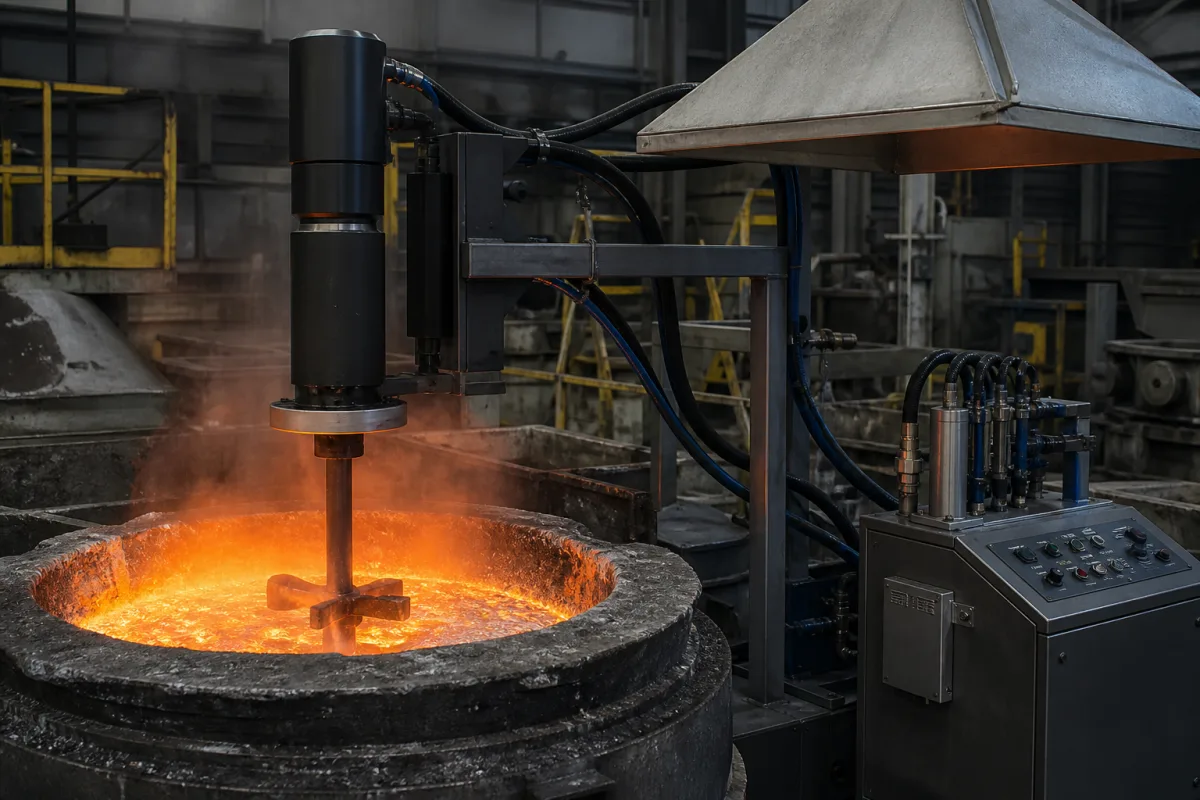
Molten aluminium degassing system (rotary degasser)
Rotary degassing of aluminium · Rotor size and speed, purge gas flow, treatment time and batch size, density index targets
A molten metal degassing system for aluminium injects an inert purge gas — nitrogen, argon or a mix — through a spinning graphite rotor into a ladle, crucible or in-line vessel, breaking it into fine bubbles that strip dissolved hydrogen and float out oxides. Ask three things first: what rotor size and speed suit your batch or flow, what gas flow and treatment time the unit uses, and what density index or hydrogen level it achieves on your alloy.
Rotary degassing and fluxing units for aluminium alloys — batch units for ladles and crucibles and in-line degassing boxes for casting lines — with rotors, shafts, gas control and lifting. Degassing tablets and lances without a rotor, filtration boxes alone and steel vacuum degassers are outside this page.
CNFX editorial research · Sources checked October 12, 2026 · 4 sources
A Foseco International patent on rotary degassing rotors states that rotors of 175–190 mm treat batches of 250–600 kg and 200–220 mm rotors 600–900 kg, with minimum speed around 300–350 rpm, preferred 400–600 rpm, gas flow of 12–30 L/min (the patent says “more usually 22-24 litres per minute”) of argon, nitrogen, their mixtures or inert gas with 1–10% chlorine, and treatment times of 1–10 minutes. Rotors of 300 mm or more for continuous treatment run at a minimum of about 225 rpm (preferred 400–450 rpm) with 30–80 L/min (“typically 60 litres per minute”), treating up to 500 kg of metal per minute with a residence time of about 2–10 minutes. Faster rotation pumps more metal and improves gas–metal contact. [1]
Jinan Hydeb's XC(P) 200 unit, a linked supplier, drives a graphite rotor immersed in a crucible or transfer ladle while feeding high-purity nitrogen or argon and fluxing agent, to remove hydrogen and oxides. [3]
Editorial note: the patent's figures are for its rotor design; ask suppliers for rotor diameter, speed, gas flow and time for your vessel size and alloy, and whether the unit can record them per treatment.
Give the supplier the alloy and scrap content, batch weight or casting flow rate, vessel type (crucible, transfer ladle, in-line box), purge gas available, flux addition, cycle time available, density index or hydrogen target, rotor and shaft material, lifting and positioning needs, and power and gas supplies.
02
Prove melt quality with density index
The Foseco patent notes that degassing effectiveness can be judged by density index before and after treatment without measuring hydrogen directly — a higher density index meaning more hydrogen — and lists the values castings "should have": wheels 5–8, cylinder head castings below 5, sand castings below 2 and vacuum or pressure die castings below 1. [1]
Kutsal and co-authors (Cevher Jant and Bayburt University, Archives of Foundry Engineering, 2026) treated A356 with 80% scrap using a side-perforated rotor, 0.1 wt% cleaning flux and 700 °C pouring, varying rotor speed (200 or 500 rpm), time (5 or 10 min) and gas flow (5 or 10 L/min). Density index — the difference between densities of reduced-pressure and air-solidified samples as a percentage — ranged from 4.35 at 200 rpm, 5 min, 5 L/min to 0.89 at 500 rpm, 10 min, 10 L/min. Raising rotor speed gave a sharp drop in density and bifilm indices; longer time and higher gas flow gave secondary gains; and tensile strength and ductility improved. [2]
Editorial calculation: density index = (air-cooled density − vacuum density) / air-cooled density × 100. Samples of 2.68 and 2.60 g/cm³ give (2.68 − 2.60) / 2.68 × 100 ≈ 3.0 — within a wheel target of 5–8 but above a sand-casting target of 2. The densities are assumed examples. [2][1]
03
Compare an in-line compact degasser with a refractory box degasser
STAS describes its ACD (Aluminium Compact Degasser) as smaller and more flexible than conventional in-line degassers built as refractory-lined steel boxes, while working on the same metallurgical principles. Because no metal is held in the machine at the end of a cast, alloy changes are easier and no heating is needed between casts; the unit operates in sealed mode with little dross, eliminates the cost of heating elements, thermocouples and refractory relining, and STAS claims more than a 60% reduction in overall operating and maintenance costs. It lists high hydrogen removal, good alkali and inclusion removal when chlorine or flux is used, chlorine elimination where required through its Flux Feeder for Degasser, and says the ACD suits batch casting or frequent alloy changes. [4]
Set this against the batch rotor sizing and density-index checks above: a ladle or crucible unit treats a batch, while an in-line unit treats metal flowing to the caster, so the choice follows the casting route. [1][2][3]
Editorial note: the 60% figure is the maker's claim and the page does not state its baseline; ask for the comparison data before using it in a cost case.
STAS ACD point
Stated value or feature
Metal held at end of cast
None (no hold-up)
Heating between casts
Not required
Atmosphere
Sealed mode; very little dross
Operating and maintenance cost
Over 60% reduction claimed
Alkali and inclusion removal
With chlorine or flux
Best fit
Batch casting; multiple alloy changes
State whether degassing is batch (ladle, crucible) or in-line, the metal flow rate and alloy-change frequency, and ask for hydrogen removal data and operating costs on the same basis.
04
Crucible and ladle units and in-line degassing boxes with filter boxes in the linked listings
Listings include stationary rotary degassing and fluxing units for crucibles and ladles and online degassing units with filter boxes for casting lines; ask each for rotor size, speed, gas flow and achieved density index.
05
Graphite rotor, shaft drive, gas control, flux feeder and lift of a rotary degasser
Capacity, gas flow, rotor speed, power and rotor material values for a degassing quotation
Published values in this table come from the Foseco patent, the Kutsal et al. study, STAS and Jinan Hydeb; where none states a value, the row says what to obtain from the supplier.
2 companies list this product among what they make. Company figures are quoted from each
company's own website; every card states where the relationship came from.
Jinan Hydeb Thermal Tech Co., Ltd.
Manufacturing site to be confirmed for the order
Lists stationary rotary degassing and fluxing units with graphite rotors for crucibles and ladles.
Explore company information and manufacturing capabilities, then discuss the scope of your project with a relevant supplier.
Share this page
Compiled and source-reviewed by the CNFX editorial team.
Each manufacturer above links to the page on that company's own website where the product is listed, with the date we checked it. How we source and review
· Page last updated 13 October 2026
Buyer questions
What rotor speed is used for aluminium degassing?
A Foseco patent prefers 400–600 rpm for 175–220 mm rotors; a 2026 A356 study saw a sharp drop in density index when rotor speed rose from 200 to 500 rpm, with longer time and higher gas flow giving “additional but secondary” reductions. [1][2]
How much gas does rotary degassing use?
The Foseco patent gives 12–30 L/min for batch rotors and 30–80 L/min for large in-line rotors. [1]
As the difference between air-solidified and reduced-pressure sample densities, divided by the air-solidified density, times 100. [2]
What is the advantage of a compact in-line degasser?
STAS says its ACD holds no metal at the end of a cast, needs no heating between casts and suits batch casting with frequent alloy changes, and it claims over 60% lower operating and maintenance costs than conventional box degassers. [4]
Sources and what still needs a direct check
Sources checked 2026-10-12. The Foseco patent describes a degassing equipment maker's rotor design and practice; Kutsal et al. is an open-access peer-reviewed study; Jinan Hydeb is a linked supplier.