Industry-Verified Manufacturing Data (2026)

Discharge Conveyor

Based on aggregated insights from multiple verified factory profiles within the CNFX directory, the standard Discharge Conveyor used in the Basic Metal Manufacturing sector typically supports operational capacities ranging from standard industrial configurations to heavy-duty production requirements.

Technical Definition & Core Assembly

A canonical Discharge Conveyor is characterized by the integration of Conveyor Belt and Drive Pulley. In industrial production environments, manufacturers listed on CNFX commonly emphasize Rubber conveyor belt construction to support stable, high-cycle operation across diverse manufacturing scenarios.

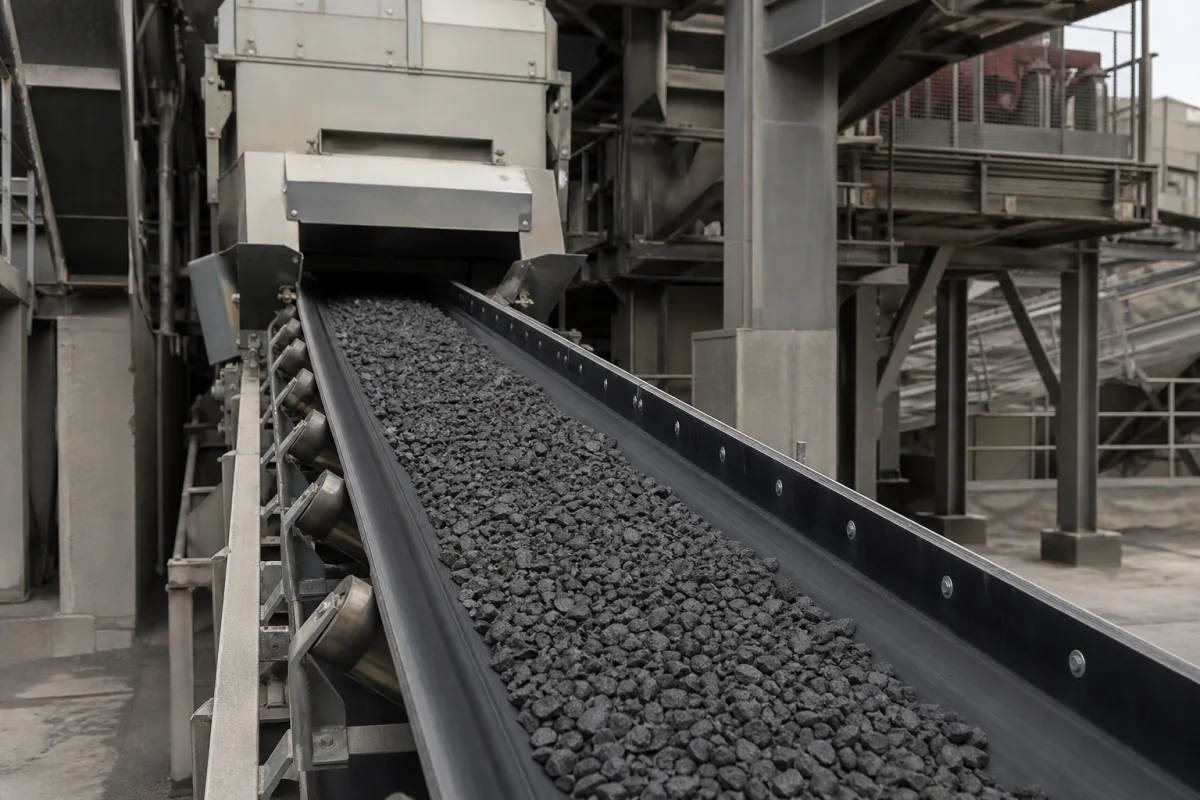
A conveyor system that transports crushed slag away from the crushing equipment in a slag processing system.
Product Specifications

Technical details and manufacturing context for Discharge Conveyor

Definition
The discharge conveyor is a critical component of the Slag Crushing System responsible for transporting crushed slag material from the crushing chamber or screening equipment to the next processing stage or storage area. It ensures continuous material flow, prevents system backups, and maintains operational efficiency in industrial slag processing operations.
Working Principle
The discharge conveyor operates by moving a continuous belt or chain system that carries crushed slag material. Powered by an electric motor through a gear reduction system, the conveyor belt moves at a controlled speed to transport material from the discharge point of the crusher to designated collection or processing areas, typically using friction between the material and moving surface for transportation.
Common Materials
Rubber conveyor belt, Steel frame, Carbon steel rollers
Technical Parameters
  • Belt width ranging from 500-2000mm depending on system capacity requirements (mm) Standard Spec
Components / BOM
  • Conveyor Belt
    Carries and transports crushed slag material along the conveyor path
    Material: Rubber with steel cord reinforcement
  • Drive Pulley
    Provides motive force to move the conveyor belt through friction
    Material: Carbon steel with rubber lagging
  • Idler Rollers
    Support the conveyor belt and maintain proper belt alignment and tension
    Material: Steel with sealed bearings
  • Drive Motor
    Provides rotational power to the drive pulley through reduction gearbox
    Material: Cast iron housing with copper windings
  • Frame Structure
    Provides structural support and mounting for all conveyor components
    Material: Structural steel
Engineering Reasoning
0.5-2.5 m/s belt speed, 15-75 tons/hour capacity, 0.75-1.5 kW motor power
Belt slip exceeding 5% differential between drive pulley and belt surface velocity, material buildup exceeding 150 mm above belt edges, bearing temperature exceeding 90°C
Design Rationale: Belt-slip-induced thermal degradation of rubber compounds at friction coefficients below 0.25, material adhesion exceeding 3.5 kPa shear strength of belt surface, lubricant breakdown at 90°C causing bearing seizure
Risk Mitigation (FMEA)
Trigger Material adhesion exceeding belt surface shear strength of 3.5 kPa
Mode: Belt tracking deviation exceeding ±25 mm from centerline
Strategy: Install polyurethane scraper blades at 45° contact angle with 150 N spring tension
Trigger Impact loading exceeding 2.5 times nominal capacity for >3 seconds
Mode: Idler roller bearing cage fracture at 1800 rpm
Strategy: Implement load cell monitoring with automatic feed rate reduction at 85% capacity threshold

Industry Taxonomies & Aliases

Commonly used trade names and technical identifiers for Discharge Conveyor.

Applied To / Applications

This component is essential for the following industrial systems and equipment:

Industrial Ecosystem & Supply Chain DNA

Complementary Systems
Downstream Applications
Specialized Tooling

Application Fit & Sizing Matrix

Operational Limits
pressure: Atmospheric pressure only (not a pressure vessel)
flow rate: 5 to 500 tons/hour depending on conveyor width and speed
temperature: Ambient to 150°C (302°F) for standard models; high-temperature variants available up to 400°C (752°F)
slurry concentration: Up to 70% solids by weight for standard models; specialized designs for higher concentrations
Media Compatibility
✓ Crushed slag (granulated or air-cooled) ✓ Bottom ash from coal combustion ✓ Foundry sand and casting residues
Unsuitable: Highly corrosive acidic slurries (pH < 4) without specialized lining
Sizing Data Required
  • Required throughput (tons/hour)
  • Maximum particle size (mm)
  • Conveyor incline angle (degrees)

Reliability & Engineering Risk Analysis

Failure Mode & Root Cause
Bearing seizure
Cause: Inadequate lubrication leading to overheating and metal-to-metal contact, often exacerbated by contamination from conveyed material ingress.
Belt misalignment and edge wear
Cause: Improper tracking adjustment, worn or damaged idlers, or uneven loading causing the belt to run off-center and contact structural components.
Maintenance Indicators
  • Abnormal high-pitched squealing or grinding noise from the drive or tail section, indicating bearing distress or severe misalignment.
  • Visible material spillage along the conveyor path or excessive dust generation at transfer points, signaling belt damage, seal failure, or structural integrity issues.
Engineering Tips
  • Implement a precision lubrication program using the correct grease type and quantity for bearings, coupled with regular infrared thermography inspections to detect early-stage overheating.
  • Install and maintain automatic belt tracking systems with real-time monitoring, and perform routine laser alignment checks on pulleys and idlers to prevent edge wear and premature belt failure.

Compliance & Manufacturing Standards

Reference Standards
ISO 5049-1:1994 - Continuous mechanical handling equipment - Safety code for belt conveyors ANSI/CEMA 402-2003 - Belt Conveyors DIN 22101:2011 - Continuous conveyors - Belt conveyors for bulk materials - Basis for calculation and dimensioning
Manufacturing Precision
  • Belt alignment: +/- 3 mm over 10 m length
  • Roller concentricity: +/- 0.05 mm
Quality Inspection
  • Non-destructive testing (NDT) for weld integrity
  • Load testing to 125% of rated capacity

Factories Producing Discharge Conveyor

Verified manufacturers with capability to produce this product in China

✓ 96% Supplier Capability Match Found

P Procurement Specialist from Australia Jan 23, 2026
★★★★★
"Impressive build quality. Especially the technical reliability is very stable during long-term operation."
Technical Specifications Verified
T Technical Director from Singapore Jan 20, 2026
★★★★★
"As a professional in the Basic Metal Manufacturing sector, I confirm this Discharge Conveyor meets all ISO standards."
Technical Specifications Verified
P Project Engineer from Germany Jan 17, 2026
★★★★★
"Standard OEM quality for Basic Metal Manufacturing applications. The Discharge Conveyor arrived with full certification."
Technical Specifications Verified
Verification Protocol

“Feedback is collected from verified sourcing managers during RFQ (Request for Quote) and factory evaluation processes on CNFX. These reports represent historical performance data and technical audit summaries from our B2B manufacturing network.”

15 sourcing managers are analyzing this specification now. Last inquiry for Discharge Conveyor from Turkey (1h ago).

Supply Chain Compatible Machinery & Devices

Electromagnetic Induction Heater

Industrial heating device using electromagnetic induction for metal processing

Explore Specs →
Vacuum Induction Melting Furnace

Industrial furnace for melting metals under vacuum using electromagnetic induction

Explore Specs →
Electroslag Remelting Furnace

Secondary refining furnace for high-quality metal ingots

Explore Specs →
Molten Metal Flow Control Valve

Precision valve for regulating molten metal flow in casting and pouring operations.

Explore Specs →

Frequently Asked Questions

What materials are used in the construction of this discharge conveyor?

This discharge conveyor features a durable rubber conveyor belt, a robust steel frame for structural integrity, and carbon steel rollers designed to withstand the abrasive nature of crushed slag in basic metal manufacturing environments.

What are the main components in the discharge conveyor's bill of materials?

The key components include the conveyor belt, drive pulley for power transmission, idler rollers for belt support, a drive motor for operation, and the frame structure that provides the conveyor's foundational support and alignment.

How does this conveyor system integrate into slag processing operations?

This discharge conveyor is specifically designed to transport crushed slag away from crushing equipment, ensuring continuous material flow in slag processing systems while minimizing downtime and maintaining operational efficiency in basic metal manufacturing facilities.

Can I contact factories directly on CNFX?

CNFX is an open directory, not a transaction platform. Each factory profile provides direct contact information and production details to help you initiate direct inquiries with Chinese suppliers.

Get Quote for Discharge Conveyor

Request technical pricing, lead times, or customized specifications for Discharge Conveyor directly from verified manufacturing units.

Your business information is encrypted and only shared with verified Discharge Conveyor suppliers.

Thank you! Your message has been sent. We'll respond within 1–3 business days.

Need to Manufacture Discharge Conveyor?

Connect with verified factories specializing in this product category

Add Your Factory Contact Us
Previous Product
Direct Reduction Shaft Furnace
Next Product
Discharge System