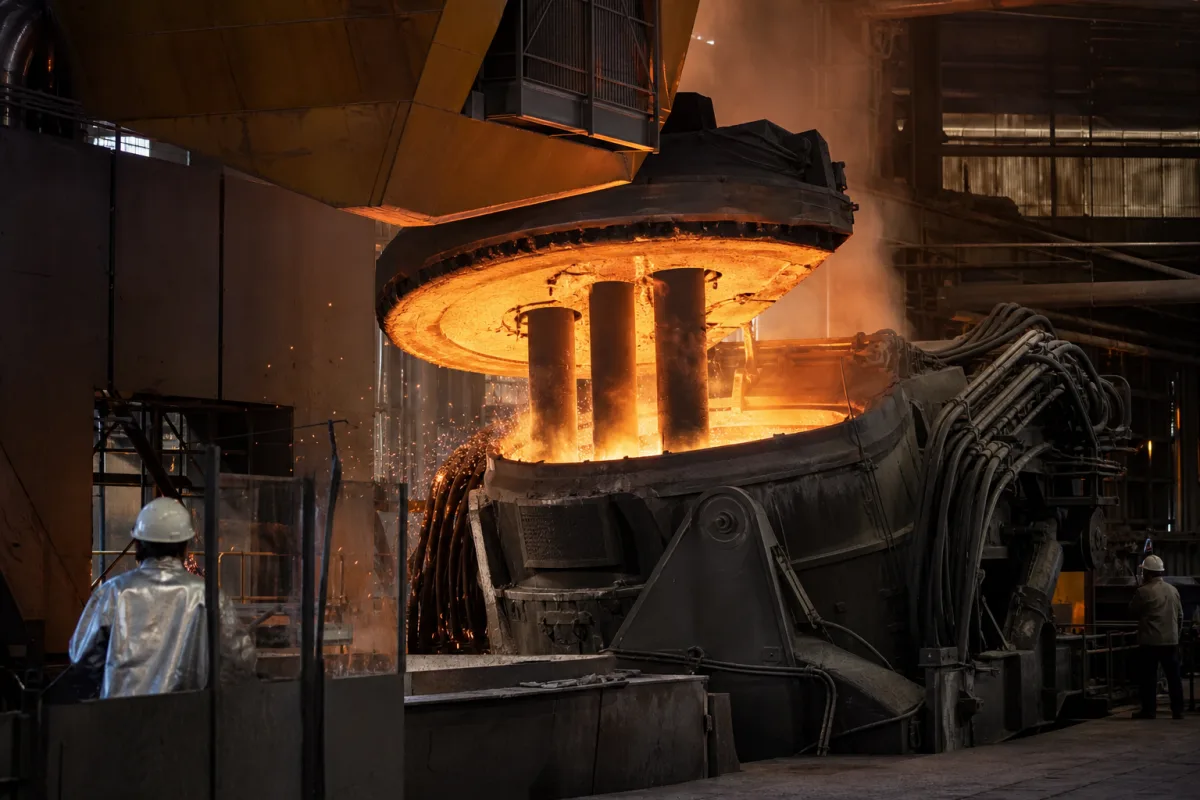
Steelmaking · Power, chemical energy, slag practice and furnace design
An EAF melts scrap or direct-reduced iron with arcs from graphite electrodes, helped by oxygen and carbon injection. Energy per tonne, tap-to-tap time and electrode use depend as much on slag practice, injection and charge preheating as on transformer size. Specify the operating practice with the furnace.
AC and DC electric arc furnaces for steelmaking from scrap, direct-reduced iron or hot metal, with their transformer, electrode, injection and off-gas systems. Ladle refining furnaces, submerged arc (ferroalloy) furnaces and induction furnaces are outside this page.
CNFX editorial research · Sources checked October 11, 2026 · 8 sources
An NPTEL steelmaking lecture (Indian Institute of Technology course) summarises EAF development: power consumption fell from 630 to 290 kWh per tonne, tap-to-tap time from 180 to 40 minutes and electrode consumption "from arounf [sic] 6.2 kg/ton to as low as 1.2 kg/ton" over the period shown, developments strongly supported by secondary steelmaking. [1]
These are trend figures from the lecture's chart, not guarantees for a given furnace and charge. Ask suppliers for reference furnaces with your charge mix and their measured energy, electrode and refractory consumption.
Give the supplier the charge mix (scrap grades, DRI or hot metal share), target tap weight and steel grades, the grid connection and short-circuit power, and the downstream ladle furnace and caster rate.
02
Use chemical energy, foamy slag and injection
The lecture states that "In recent years the chemical energy supply amounts to 35% to 40% of the total energy in most of the modern EAFs"; its sources include oxidation reactions and post-combustion. Foamy slag covers the arc so that more energy goes to the bath rather than the walls; carbon and oxygen are injected to foam the slag when bath carbon is low; the lecture states "Typically carbon injection rates for slag foaming are 2.5 to 5 kg/ ton of steel", and 5–10 kg/t in high-powered furnaces. [3][4][5]
Oxygen injection must be controlled to keep iron oxidation, and so yield loss, down; injectors work in five modes (hold, burner, soft lancing for post-combustion, supersonic lancing for decarburisation and foaming, carbon injection). Fixed shell-mounted injectors avoid the splashing and repairs of slag-door lances. [5][6]
03
Consider scrap preheating and bottom stirring
According to the lecture, scrap preheating with furnace waste heat can cut energy by 40–60 kWh per tonne depending on preheat temperature, electrode consumption by 0.3–0.36 kg per tonne, refractory by 0.9–1.4 kg per tonne and tap-to-tap time by 5–8 minutes; it is economical only when waste heat is used. [4]
Argon or nitrogen bottom stirring, through plugs in contact with the melt or embedded in porous refractory, removes temperature and concentration gradients, shortens tap-to-tap time and reduces refractory, electrode and power consumption. [3]
04
Choose the furnace design features
The lecture describes larger-diameter hearths for bigger charges and lower heat losses; split-shell construction so the upper shell can be changed quickly; high-power and ultra-high-power transformers; eccentric bottom tapping to cut tap time, temperature loss and slag carry-over; and DC arc furnaces as an alternative to AC. [2]
Ask how each feature is matched to your charge, power supply and downstream ladle furnace, and what auxiliary systems (water-cooled panels, off-gas and dust handling, electrode regulation) are included.
05
AC and DC furnaces, top or continuous charging, and auxiliaries
CHNZBTECH and ANCORE between them list AC and DC electric arc furnaces, top-charging and continuous-charging furnaces, and furnace auxiliaries. [7][8]
CHNZBTECH lists EAFs, top-charging EAFs, submerged arc furnaces and auxiliaries such as water-cooled cables and dust chambers; ANCORE describes turnkey EAF solutions with a team from Xi'an Electric Furnace Research Institute; China Electric (Shanghai) lists its HX series EAF and LF ladle furnaces; Hani lists EAF steelmaking equipment. Capacities and references are suppliers' own claims. [7][8]
06
Shell, transformer, cooled panels, injection, tapping, stirring and off-gas
Each row links back to the lecture section that describes it; panel cooling has no figure in these sources.
Part
Role
Fix in the order
Shell and hearth
Hold charge and bath; split shell eases repair. [2]
Capacity, transformer, electrodes, energy and tap-to-tap for the quotation
Charge mix, tap weight and grid data come from your melt shop. The NPTEL trend figures in the middle column describe the industry, not the furnace being offered.
11 companies list this product among what they make. Company figures are quoted from each
company's own website; every card states where the relationship came from.
CHNZBTECH
Manufacturing site to be confirmed for the order
Lists EAFs, top-charging EAFs, submerged arc furnaces and EAF auxiliaries.
Explore company information and manufacturing capabilities, then discuss the scope of your project with a relevant supplier.
Share this page
Compiled and source-reviewed by the CNFX editorial team.
Each manufacturer above links to the page on that company's own website where the product is listed, with the date we checked it. How we source and review
· Page last updated 13 October 2026
Buyer questions
How much electricity does an electric arc furnace use per tonne?
It depends on charge and practice; the NPTEL lecture shows industry consumption falling from 630 to 290 kWh/t as chemical energy, foamy slag and other techniques were adopted. [1]
What is foamy slag in an EAF?
A foamed slag layer covers the arc so more energy reaches the bath; carbon and oxygen injection create it; NPTEL states "Typically carbon injection rates for slag foaming are 2.5 to 5 kg/ ton of steel". [3][4]
Does scrap preheating save energy?
The lecture gives 40–60 kWh/t savings plus lower electrode and refractory use, when furnace waste heat is used. [4]
Sources and what still needs a direct check
Sources checked 2026-10-11. NPTEL is the Indian government's online engineering course platform; the lecture on developments in EAF steelmaking is from an IIT course. Its figures describe industry trends, not guaranteed values. Supplier pages describe their own offers.