Aluminium extrusion presses · Force, billet size and pressure on the billet; billet, container and die-exit temperatures
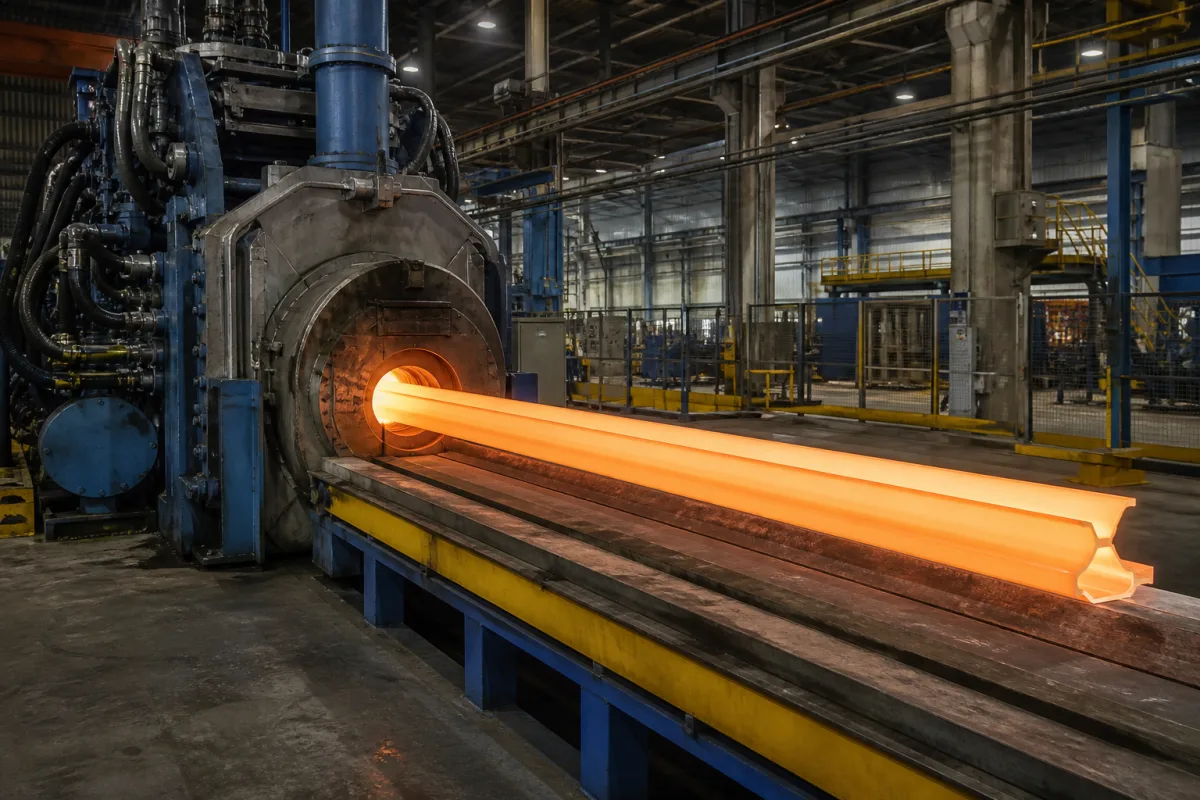
An aluminium extrusion press is a horizontal hydraulic press whose ram pushes a heated aluminium billet through a container and out of a shaped die to make continuous profiles. Ask three things first: how the nominal force and billet size give enough pressure on the billet for your alloy and die, whether the press is long-stroke or short-stroke, and whether the billet heater, container and run-out can hold the temperatures your alloy needs.
Direct hydraulic extrusion presses for aluminium profiles and their main assemblies (main cylinder, stem, container, die holder) as supplied with billet heaters, pullers and run-out tables. Extrusion dies as separate tooling, plastic extruders, copper and steel extrusion, and sheet-forming hydraulic presses are outside this page.
CNFX editorial research · Sources checked October 11, 2026 · 4 sources
Sailixin, a Foshan extrusion press maker, lists its long-stroke presses with a 21 MPa system pressure: 700 t with 100 × 580 mm billets and a 620 mm main piston, 1,000 t with 127 × 750 mm billets and a 750 mm piston, and 1,250 t with 135 × 750 mm billets and a 780 mm piston. It states that the extrusion stroke of a long-stroke press is twice the billet length. [1]
Its short-stroke range runs from 1,250 t with 5.5 in billets and a 750 mm piston at 26 MPa to 5,500 t with 14–15 in billets and a 1,500 mm piston at 28 MPa, with total motor power from 240 kW to 1,450 kW depending on model and motor type. Sailixin says short-stroke designs reduce non-extrusion time and shorten the machine. [2]
Editorial calculation: a 750 mm main piston at 21 MPa gives π/4 × 0.75² m² × 21 MPa ≈ 9.3 MN, about 946 tonnes-force; ask the maker how its 1,000 t nominal force is made up. Spreading 1,000 t (about 9.81 MN) over a 127 mm billet (0.0127 m²) gives about 774 MPa on the billet; the container bore is slightly larger than the billet, so the true figure is a little lower. Compare this with the pressure your die maker needs for your alloy and section. [1]
Give the supplier the alloys and tempers, profile sections with circumscribing circle and weight per metre, billet diameter and length, annual output, required nominal force, long- or short-stroke preference, run-out length, billet heater type, puller and cooling, stretcher and saw, and power supply.
02
Hold billet, container and die-exit temperatures
Rusal's data sheet for its 6063 MaxiFlow billet recommends induction preheating to about 420–480 °C depending on die shape, with a taper of 0.5 °C/cm (front hotter than back), and avoiding more than 20 minutes in tunnel-type heaters. The container should be held 25–50 °C below the billet temperature: less than that risks back-end defects, more risks heat loss and a die exit below 500 °C. [3]
Rusal gives the die exit temperature range as 500 °C minimum, 550 °C preferable and 580 °C maximum, measured by thermocouple or contactless pyrometer, followed by cooling faster than 1.5 °C/s (at least 1.0 °C/s) between 500 °C and 200 °C, which fans along the run-out table can provide and water mist may be needed for thicker or hollow sections. It recommends about 0.5% stretch for straightening, warning that over 1% may cause orange peel, and running one or two billets hotter (480–500 °C) on a new die. [3]
Alliance, a US extruder, describes heating billets to about 800–925 °F, applying a parting agent to billet and ram, using liquid nitrogen or nitrogen gas at the die, and measuring exit temperature at the platen with a target of 930 °F minimum for 6063, 6463, 6063A and 6101 and 950 °F for 6005A and 6061; the butt containing oxides from the billet skin is sheared off and discarded. [4] Editorial calculation: 930 °F is (930 − 32) × 5/9 ≈ 499 °C, in line with Rusal's 500 °C minimum, and 800–925 °F is about 427–496 °C. [4][3]
03
Long-stroke, short-stroke and complete lines
Two companies are shown below: Sailixin, whose long- and short-stroke tables are cited above, and Huanan Heavy Industry, whose card lists 600 t to 6,000 t models with stems and containers.
Listings include long- and short-stroke presses and complete lines with billet furnaces, pullers, cooling tables and stretchers; ask each for the full parameter table of the model offered.
04
Cylinder, stem, container, die holder, heater, puller and shear
The rows follow the billet from heater to butt shear; piston diameter and container bore are the two figures that tie the press back to the pressure calculation above.
2 companies list this product among what they make. Company figures are quoted from each
company's own website; every card states where the relationship came from.
Foshan Sailixin Machinery Manufacturing Co., Ltd.
Manufacturing site to be confirmed for the order
Lists long- and short-stroke aluminium extrusion presses from 700 t with billet furnaces, pullers and cooling tables.
Explore company information and manufacturing capabilities, then discuss the scope of your project with a relevant supplier.
Share this page
Compiled and source-reviewed by the CNFX editorial team.
Each manufacturer above links to the page on that company's own website where the product is listed, with the date we checked it. How we source and review
· Page last updated 13 October 2026
Buyer questions
What billet size goes with a 1,000 t extrusion press?
Sailixin's 1,000 t long-stroke press takes 127 × 750 mm billets with a 750 mm main piston at 21 MPa. [1]
What temperature should aluminium billets be?
Rusal recommends about 420–480 °C for its 6063 billet with induction heating; Alliance heats billets to about 800–925 °F. [3][4]
What is the right die exit temperature for 6063?
Rusal gives 500 °C minimum, 550 °C preferable and 580 °C maximum; Alliance targets at least 930 °F. [3][4]
What is a short-stroke extrusion press?
A design that Sailixin says reduces non-extrusion time and shortens the machine; its range runs from 1,250 t to 5,500 t. [2]
Sources and what still needs a direct check
Sources checked 2026-10-11. Sailixin is a press maker publishing its own model tables; Rusal is a billet producer giving processing advice for its alloy; Alliance is an extruder describing its process. Values are those companies' figures, not standard limits.