Descaling high-pressure pump units · Descaling pressure range, plunger size vs pressure and flow, drive power, API 674 plunger pumps
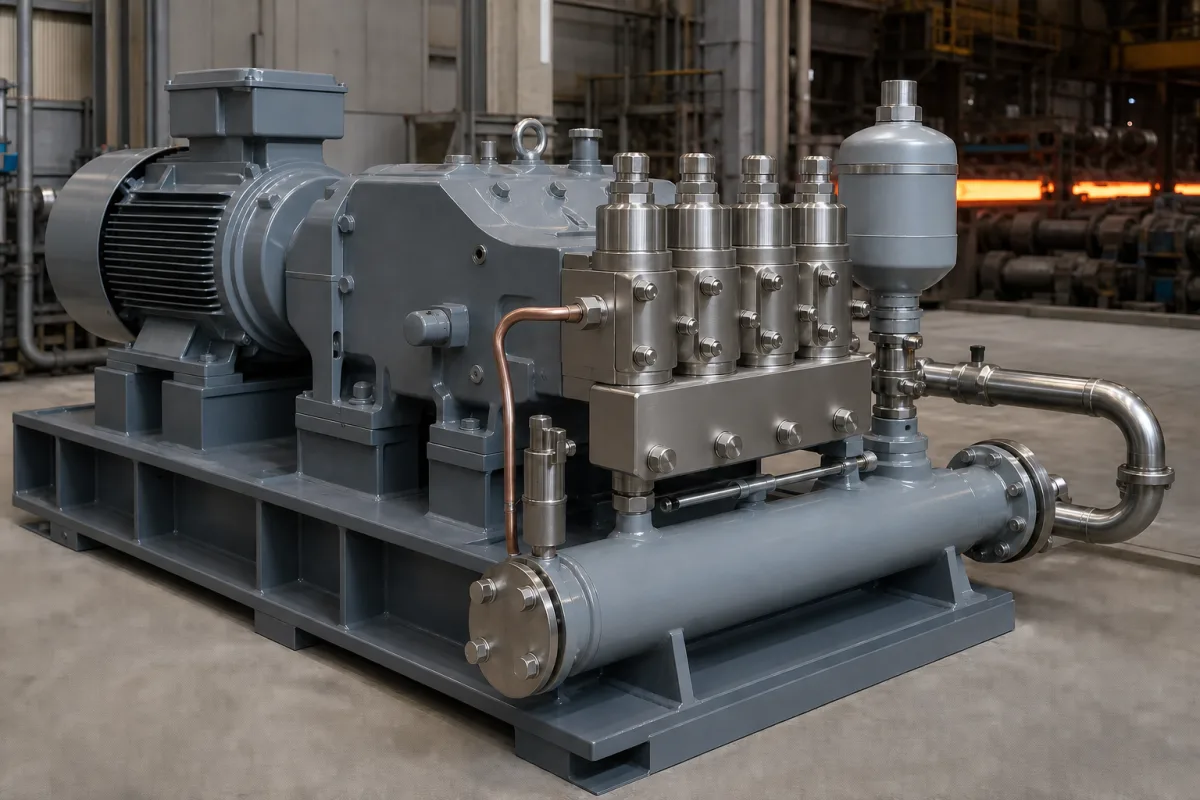
A descaling high-pressure pump unit is a motor-driven plunger pump on a skid that supplies high-pressure water to the spray headers that strip scale from slabs, billets and strip before and during hot rolling, as with the multi-plunger pump, gearbox, motor and pulsation vessel pictured beside a mill. Ask three things first: the pressure and flow the descaling headers need, the plunger size and speed that deliver them, and the drive power and duty rating of the unit.
Plunger (reciprocating) pump units supplying high-pressure water to descaling headers in hot rolling and forging. Descaling nozzles and headers themselves, water-jet cleaning units, hydraulic power units for machine actuators (see hydraulic pump) and general process pumps (see industrial pumps) are outside this page.
CNFX editorial research · Sources checked October 12, 2026 · 5 sources
Lechler describes hydro-mechanical descaling as jets from special nozzles on spray headers in a descaling box through which the slab, strip, billet or bloom travels, with working pressures from 80 to 450 bar. It treats the impact with which the water strikes the surface, given in N/mm², as the main measure of a descaling nozzle's efficiency, and says the nozzle parameters and arrangement both strongly influence descaling performance. [1]
WOMA describes its 03-series plunger pumps, with operating pressures up to 250 bar and flow up to about 400 l/min, as specialists for descaling; within that series the Type 1003 is rated at 150 bar and 257 l/min, needs 60 kW driving power and weighs 255 kg without accessories. [2]
Editorial calculation: 1 bar = 0.1 MPa, so Lechler's 80–450 bar range is 8–45 MPa, and the WOMA 03-series' 250 bar is 25 MPa.
Give the supplier the number of descaling headers and nozzles, nozzle type and flow at the working pressure, the required pressure at the header, duty cycle (spray time per pass and passes per hour), water quality and temperature, and whether an accumulator or bypass system is used.
02
Match plunger size, speed and drive power
Elephant's DS-142 descaling plunger pump is a single-acting horizontal triplex built to API 674 (third edition), rated 117 BHP continuous and 142 BHP intermittent, with 350 rpm continuous and 425 rpm intermittent speed, 4.0 in stroke, 90% mechanical efficiency, splash lubrication and a fluid temperature range of −28 to 176 °C. Its table shows the trade-off between plunger size and pressure: a 29 mm plunger displaces 0.1953 L per revolution at up to 69 MPa, while a 38 mm plunger displaces 0.3475 L at up to 38 MPa. [3]
WOMA offers its 03-series pump heads in corrosion-resistant stainless steel or grey cast iron, uses ceramic plungers resistant to acid and alkaline liquids (or coated steel plungers for wear and temperature-shock resistance), fits integral oil cooling to its gearboxes, and provides a second shaft end so another pump can be coupled to double output. [2]
Editorial calculation: flow = displacement × speed, so the 29 mm DS-142 plunger at 350 rpm gives 0.1953 × 350 ≈ 68.4 L/min, matching the 68.5 L/min in Elephant's table. Hydraulic power at 69 MPa and 68.5 L/min is 69 × 10⁶ Pa × (68.5 ÷ 60,000) m³/s ≈ 78.8 kW; dividing by 90% mechanical efficiency gives about 87.5 kW (about 117 hp), consistent with the 117 BHP continuous rating. [3]
03
Read a pressure-by-power table for a large triplex pump
KAMAT, a German high-pressure pump maker that lists descaling among its applications, publishes a technical table for its "Triplex Plunger Pump K25000-3G": pressure max. 3185 bar, flow max. 1148 l/min, power input max. 250 kW and weight 965 kg. The table gives the maximum pressure for each variant at four drive powers, 132, 160, 200 and 250 kW, with flow based on 100 % volumetric efficiency at 20 °C. [4]
The rows in the table fall inside the 80 to 450 bar working range Lechler gives for hydro-mechanical descaling [1], and they show the same plunger trade-off as Elephant's DS-142 table [3]: at a fixed drive power, a variant with more flow reaches a lower pressure. KAMAT lists gear ratios i = 3,33 – 3,50 – 4,04 – 4,62 – 5,44, a speed range of 10-100 % depending on rod force, force-fed gear lubrication with an oil cooler above 160 kW, and availability to API 674. [4] Ask the supplier which variant and gear ratio it proposes for the header pressure and flow you need, and at what motor power.
KAMAT's larger "Quintuplex Plunger Pump K55000-5G" is listed at pressure max. 3500 bar, flow max. 1913 l/min, power input max. 550 kW and 2200 kg, with powers of 400 to 550 kW in its table. [5] Compare this with the WOMA Type 1003 at about 257 l/min and 60 kW [2] to see how far a descaling station's pump size can vary with mill flow.
Editorial calculation: hydraulic power is flow times pressure, so variant 25060 at 458 l/min and 285 bar delivers about 218 kW (458 ÷ 60,000 m³/s × 28.5 MPa), which is 87% of the 250 kW input; variants 25050 (318 l/min, 415 bar) and 25070 (623 l/min, 210 bar) give about 220 kW and 218 kW at the same input. [4]
K25000-3G variant
Q max. (l/min)
p max. at 132 kW (bar)
at 160 kW
at 200 kW
at 250 kW
25045
258
270
330
410
510
25050
318
220
265
335
415
25055
385
180
220
275
340
25060
458
155
185
230
285
25065
537
130
160
195
245
25070
623
110
135
170
210
Values are from KAMAT product pages; flow is stated at 100 % volumetric efficiency, so delivered flow will be lower.
04
Compare what suppliers offer
The supplier linked to this page lists triplex and quintuplex plunger pumps for steel descaling (dephosphorization) with oilfield pump units; its card links to the page reviewed.
Ask any supplier for the pump curve or table at your pressure and flow, plunger and packing materials, valve type, design standard, continuous and intermittent ratings, motor and gearbox, pulsation damping, suction conditions, and the spare-parts list for wear parts.
05
Trace the pump unit parts
This is a functional reference built from the sources cited; it is not one maker's specification.
Fill the specification fields with values for your mill
A descaling pump unit quotation needs values for your descaling system. The table explains each field, gives published values where a reviewed source states them, and says what to obtain from the supplier.
Field
What it means and published values
Ask the supplier for
Rated Flow Rate (L/min)
e.g. 257 l/min; up to about 400 l/min [2]; 258–623 l/min across K25000-3G variants. [4]
Explore company information and manufacturing capabilities, then discuss the scope of your project with a relevant supplier.
Share this page
Compiled and source-reviewed by the CNFX editorial team.
Published product pages show what a company offers, not tested performance. Confirm the legal seller, factory and scope for your order. How we source and review
· Page last updated 13 October 2026
Buyer questions
What pressure is used for hydraulic descaling?
Lechler gives a working pressure range of 80 to 450 bar for hydro-mechanical descaling. [1]
Why do smaller plungers give higher pressure?
Elephant's DS-142 table shows the trade-off: a 29 mm plunger displaces 0.1953 L per revolution at up to 69 MPa, a 38 mm plunger 0.3475 L at up to 38 MPa. [3]
What materials suit a descaling pump head?
WOMA offers stainless steel or grey cast iron pump heads with ceramic plungers resistant to acid and alkaline liquids, or coated steel plungers. [2]
How much power does a descaling pump need?
It depends on flow and pressure. KAMAT's K25000-3G table, for example, gives variant 25060 at 458 l/min reaching 155 bar at 132 kW and 285 bar at 250 kW; hydraulic power is flow times pressure, about 218 kW at the top setting. [4]
Sources and what still needs a direct check
Sources checked 2026-10-12. Lechler makes descaling nozzles; WOMA makes high-pressure plunger pumps; Elephant is the supplier linked to this page.