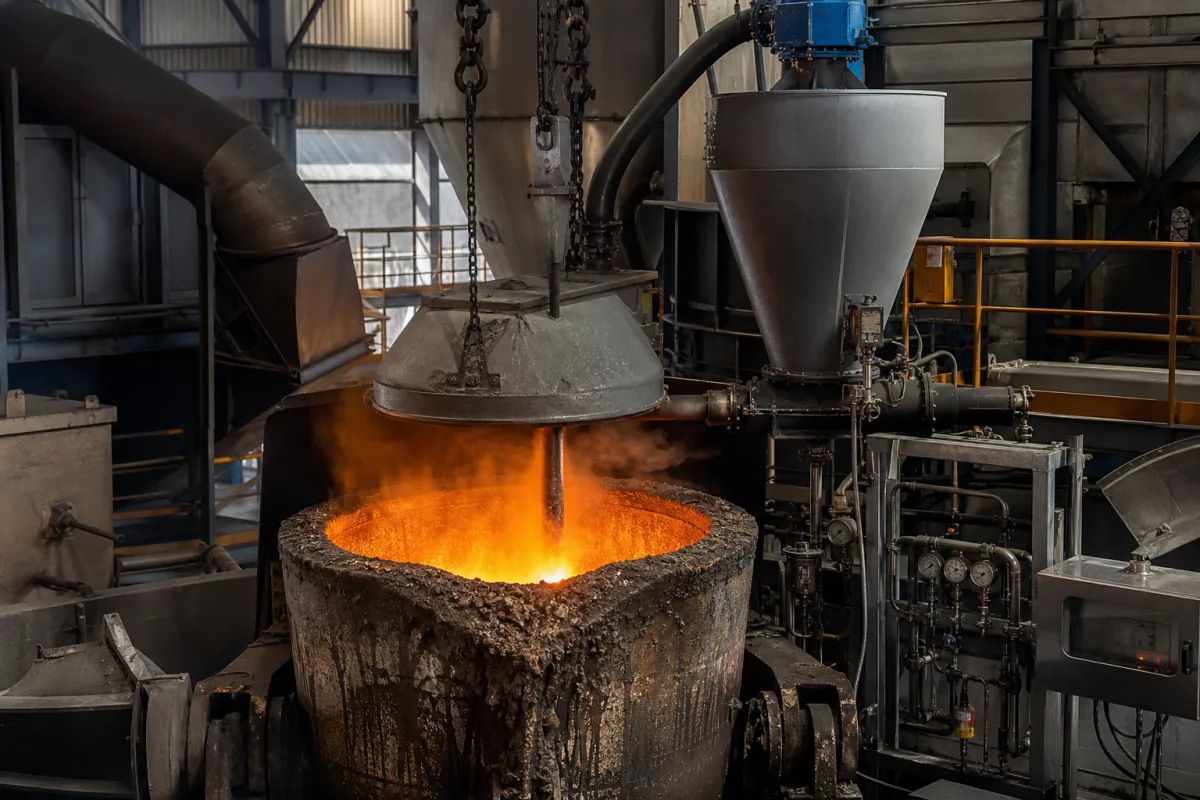
Molten metal desulfurization reactor (hot metal desulfurization station)
Hot metal desulfurization stations · Lance injection of magnesium, lime and calcium carbide into transfer ladles or torpedo cars, mono- and co-injection, treatment time, slag skimming, and fume capture with hoods and baghouses
A hot metal desulfurization station removes sulphur from molten blast furnace iron before it goes to the steelmaking furnace: a refractory lance is lowered into the transfer ladle or torpedo car, powdered reagents are injected with a carrier gas, the sulphur forms a slag that is skimmed off, and a hood draws the fume to a baghouse. Ask three things first: which vessel and hot metal tonnage the station treats, which reagents and injection system meet your sulphur target in the time available, and how slag removal and fume capture are arranged.
Hot metal (pig iron) desulfurization stations with lance injection into transfer ladles or torpedo cars, including reagent dispensers, lances, lance carriages, skimmers and fume hoods. Mechanical stirring (KR) units, ladle furnaces and secondary steel desulfurization are outside this page except where compared.
CNFX editorial research · Sources checked October 12, 2026 · 4 sources
Choose reagents, injection system and treatment time
EPA's AP-42 Section 12.5 (Iron and Steel Production) explains that sulphur in molten iron is sometimes reduced before charging into the steelmaking furnace by adding reagents that form a floating slag which is skimmed off, either in the torpedo car between the blast furnace and BOF or in the transfer ladle at a station in the BOF shop. AP-42 names the reagents as powdered calcium carbide (CaC2) and calcium carbonate (CaCO3) or salt-coated magnesium granules, injected through a lance with high-pressure nitrogen; treatment lasts about 5 to 30 minutes depending on injection rate, hot metal chemistry and target sulphur. [1]
European patent EP 2 297 366 describes desulfurization stations in which a lance lowered into the transfer ladle injects a controlled amount of powdered reagents such as magnesium, lime and calcium carbide, turning sulphur into insoluble sulphides that collect in the slag to be raked off. It explains that the process must finish without delay to avoid interrupting downstream continuous casting, which led to dual-port lances and dual-lance stations, and describes co-injection from separate pressurised injectors, mono-injection of a pre-mixed reagent, and combinations. [2]
A plant study by Schrama and co-authors with Tata Steel (8th European Oxygen Steelmaking Conference, 2018) describes the two co-injection stations at Port Talbot, which inject magnesium and lime. Dissolved magnesium reacts with sulphur to form MgS, which rises to the slag and reacts with lime to form the more stable CaS; about 5% of the sulphur is removed by direct reaction with lime. The paper measures efficiency as specific magnesium consumption, the mass of magnesium injected per mass of sulphur removed, and its calculation works from an addition of 0.045% Mg (0.45 kg per tonne of hot metal). [3]
Editorial note: give the supplier the hot metal tonnage per ladle, arrival and target sulphur, temperature, cycle time available, reagent supply preference and the existing ladle and crane arrangement.
Give the supplier the vessel type and capacity (transfer ladle or torpedo car), hot metal throughput, arrival and target sulphur, temperature, treatment time available, reagents and injection mode (mono or co-injection), lance type and changing arrangement, slag skimming method, fume extraction capacity and baghouse, building and crane interfaces, and automation and data needs.
02
Capture fume and handle slag
AP-42 states that desulfurization emissions come from the reaction of the injected reagents and the turbulence of injection; AP-42 lists iron oxides, calcium oxides and oxides of the injected compound among the pollutants emitted, and says they may be collected by a hood over the ladle vented to a baghouse. Its emission factors give 0.55 kg of particulate per megagram of hot metal uncontrolled (torpedo ladle desulfurization with CaC2 and CaCO3) and about 0.0045 kg/Mg controlled by a baghouse. [1]
The same study names iron loss during slag skimming as one of the major costs of desulphurisation, from metal trapped in the slag emulsion or entrained while skimming. Port Talbot added KAlF4 to the magnesium to make the slag more fluid, and iron losses fell, but magnesium reagent consumption rose by roughly 20%. The authors attribute 11–14 points of that rise to the reagent's magnesium content falling from 97% to 90% and to fluorine reacting with magnesium to form MgF2. [3]
Editorial calculation: treating a 300 t ladle at 0.55 kg/Mg would release about 165 kg of particulate uncontrolled, against about 1.4 kg with a baghouse at 0.0045 kg/Mg; ask the supplier for the hood capture design and fan capacity behind its emission guarantee. [1]
Editorial calculation: at the paper's 0.45 kg Mg per tonne, a 300 t ladle takes about 135 kg of magnesium (300 × 0.45); a 20% rise would add about 27 kg per ladle. Your figure depends on arrival and target sulphur. [3]
03
Compare KR stirring, magnesium mono-injection and co-injection
A paper in the proceedings of the 46th Steelmaking Seminar of ABM (2015), written by engineers of a desulfurization plant builder, compares three hot metal desulfurization methods on metallurgy, efficiency, costs and overall performance: the Kanbara Reactor (KR), which uses only lime as reagent; magnesium mono-injection (MMI), which uses only magnesium; and co-injection of magnesium with lime or CaC2. The authors combine data from the literature with their own engineering experience. [4]
The paper states that KR reaches low sulphur concentrations, given as "(> 10 ppm)", and has lower reagent costs, but that higher iron loss and heavy wear give it the highest operational costs. MMI is very fast because magnesium is reactive, yet resulfurization means "sulfur levels below 50 ppm cannot be reached". The authors conclude that co-injection of magnesium and lime reaches low sulphur, desulfurizes fast, and they rank it first of the three on flexibility and cost effectiveness. [4]
Editorial note: this comparison sits beside the injection stations described above; ask each bidder which method it offers, and for the final sulphur, treatment time, reagent consumption and iron loss it will guarantee for your arrival sulphur and ladle size.
04
What sits around the ladle: injectors, lance carriage, baghouse and skimmer
Every unit in this table appears in the AP-42 account or in EP 2 297 366; the injectors and lance decide whether the station can run mono-injection or co-injection.
Sulphur guarantee, treatment time and vessel size in the station enquiry
Arrival and target sulphur drive both the reagent consumption and the treatment time a bidder can guarantee, so those rows anchor the rest of the enquiry.
Explore company information and manufacturing capabilities, then discuss the scope of your project with a relevant supplier.
Share this page
Compiled and source-reviewed by the CNFX editorial team.
Each manufacturer above links to the page on that company's own website where the product is listed, with the date we checked it. How we source and review
· Page last updated 13 October 2026
Buyer questions
What reagents are used for hot metal desulfurization?
Powdered calcium carbide and calcium carbonate or salt-coated magnesium (EPA AP-42); EP 2 297 366 describes co-injecting magnesium with lime or carbide. [1][2]
How long does hot metal desulfurization take?
About 5 to 30 minutes, depending on injection rate, chemistry and target sulphur (EPA AP-42). [1]
How are desulfurization fumes controlled?
By a hood over the ladle vented to a baghouse; AP-42 gives 0.55 kg/Mg uncontrolled particulate. [1]
Does adding fluidising flux to desulphurisation slag cost magnesium?
A Tata Steel Port Talbot study found that adding KAlF4 cut iron losses at skimming but raised magnesium reagent consumption by roughly 20%. [3]
Is KR stirring or injection better for hot metal desulfurization?
A 2015 paper in ABM's Steelmaking Seminar proceedings finds KR reaches low sulphur at lower reagent cost but has the highest operating cost from iron loss and wear, and ranks magnesium–lime co-injection first of the three on flexibility and cost effectiveness. [4]
Sources and what still needs a direct check
Sources checked 2026-10-12. EPA's AP-42 is US government emission-factor guidance (iron and steel chapter, 1986, reformatted 1995); the European patent describes stations in its own terms.