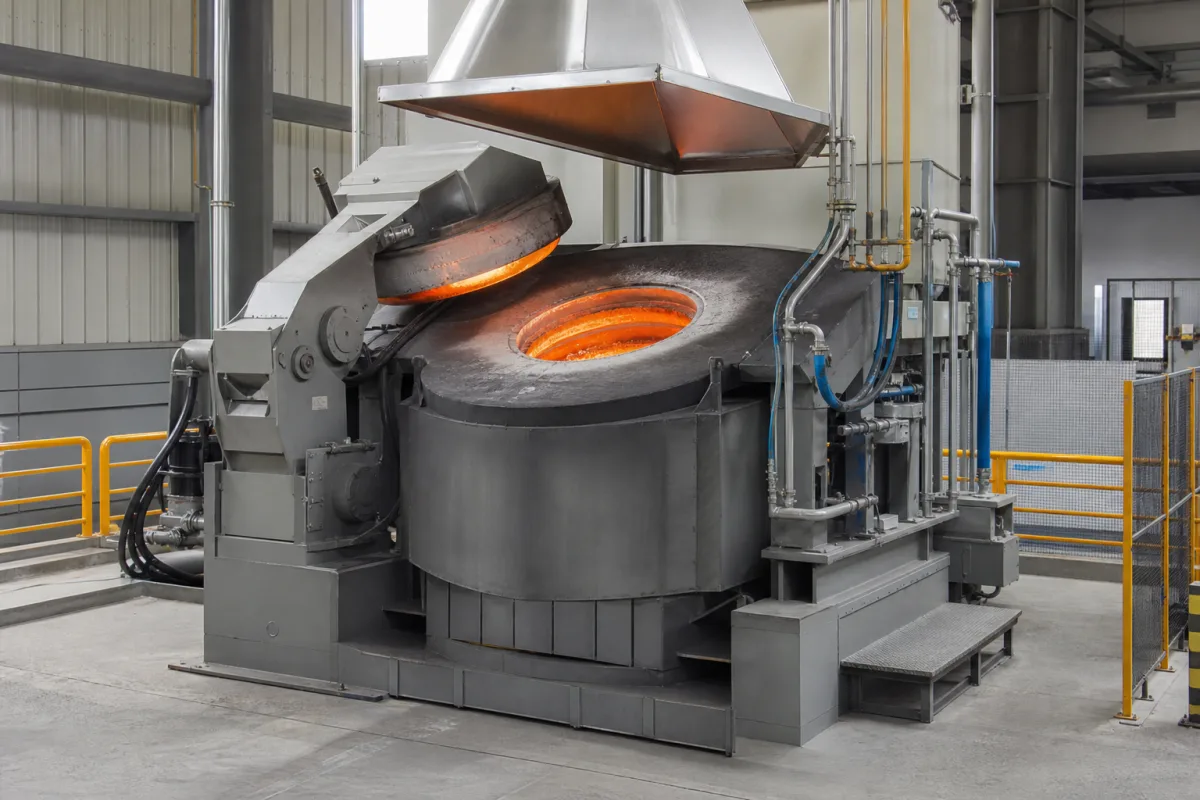
Non-ferrous metal induction melting furnace: coreless tilting furnaces for aluminium, copper and zinc alloys
Coreless induction melting of aluminium, copper, brass and zinc alloys · energy per tonne against other melters, frequency and stirring, high-alumina linings, charge make-up
A coreless induction furnace for non-ferrous metals has the same coil-around-crucible layout as one for iron, but the metal changes the rest: low-viscosity aluminium and zinc alloys can saturate a lining, iron pick-up from the lining is unwanted in them, and the lining, frequency and charge are chosen for these metals rather than for iron. The questions are the energy per tonne against other melters, how much stirring the frequency gives, which lining the alloy needs, and what the charge does to the energy bill.
Coreless induction melting furnaces built and lined for aluminium, copper, brass, bronze and zinc alloys: tilting furnace bodies with lids and fume hoods, high-alumina dry vibratable or rammed working linings, and the choice of frequency and charge for these metals. Induction melting furnaces across iron, steel and other metals, with their power supplies and foundry safety, are covered on the Induction melting furnace page; preformed oxide ceramic crucibles on the Crucible in oxide ceramic (alumina, magnesia, zirconia) page; graphite and silicon carbide crucibles on the Refractory crucible (for induction melting) page; vacuum induction melting on the Vacuum induction melting (VIM) furnace page.
CNFX editorial research · Sources checked October 12, 2026 · 5 sources
0.20–0.24 kWh/lb for aluminium: the coreless furnace against crucible, reverberatory and channel melters
EPRI's technical commentary on melting aluminium and other non-ferrous metals (December 2000) compares furnace types for heating aluminium alloys from ambient to the temperature before pouring. It notes that metal losses and energy will vary with melting temperature and alloy group. [1]
Editorial calculation: 0.20–0.24 kWh/lb × 2,204.6 lb per metric tonne ≈ 441–529 kWh per tonne of aluminium. [1] For comparison, ABP Induction gives the heat content of cast iron melted to 1,480 °C as 385 kWh/t and actual consumption in iron foundries from 570 kWh/t to over 700 kWh/t. [2]
EPRI lists the coreless furnace's advantages as being able to empty it completely to change alloy and to size it to the melting need, and its main disadvantage as refractory cracks causing premature lining failure; it describes coreless units as best used for turnings or clippings. [1] It also notes that some operators melt in coreless furnaces at night on off-peak tariffs and hold the metal in channel furnaces for daytime casting. [1] Calderys describes the coreless furnace as suited to remelting clean scrap, difficult aluminium alloys such as lithium-containing alloys, and master alloys. [5]
State the alloys, charge (ingot, returns, turnings, clean scrap), melt rate per hour, pouring temperature and whether the furnace melts only or also holds.
02
Stirring against frequency: line 60 Hz, medium 200–1,200 Hz, high above 1,200 Hz
In a coreless furnace, EPRI explains, eddy currents in the charge both heat it and stir it, and the stirring action is inversely proportional to the square root of the frequency and directly proportional to the power applied. It classes coreless furnaces as line (60 Hz), medium (200–1,200 Hz), high (over 1,200 Hz) or variable frequency. [1]
Editorial calculation from that relation: at equal power, moving from 60 Hz to 240 Hz cuts stirring to 1/√4 = one half; moving from 250 Hz to 1,000 Hz also halves it. [1] EPRI adds that replacing low-frequency furnaces with high or variable frequency units can reduce stray current and other heat losses. [1]
Allied Mineral Products calculated, for metal-fibre reinforced dry vibratable linings in a 2.6 MW furnace, that the fibres draw about 0.001 % of the power at 100 Hz and less than 0.003 % at 500 Hz, so that frequency choice does not turn such a lining into a heating load. [4]
Ask for the operating frequency or frequency range, the power at that frequency, and how the supplier expects the bath to behave with your lightest charge.
03
Working linings for aluminium: 80.3–90.7 % alumina dry vibratables rated 1,095–1,425 °C
Allied Mineral Products publishes its working-lining range for coreless furnaces melting aluminium alloys. The table gives chemistry, density and the temperature limit Allied states for each mix. [3]
Allied's article on dry vibratables for zinc and aluminium names the concerns for these low-temperature alloys: saturation of the lining by low-viscosity molten metal, hot-face strength at low temperatures, and sufficient non-wetting properties; it says they are addressed through particle sizing, minimum porosity, raw-material selection and non-wetting agents. It also notes that brittle failure is a particular problem in low-temperature melting of zinc, galvalume and aluminium alloys, and that iron is not a desirable element to pick up in aluminium or zinc alloys. [4]
Calderys lists dry vibrating mix, wet ramming mass and precast crucible as the installation methods for aluminium coreless furnaces, and supplies coil grout, spout, rings and cover materials as well as the working lining. [5] Allied's range also includes a precast crucible option alongside the vibratables. [3] For copper alloys melted at higher temperatures, ask for the lining's limit against your pouring temperature with margin; the 1,095 °C and 1,204 °C mixes above are set out for aluminium alloys.
Ask for the lining product and its data sheet, lining thickness, installation method (dry vibrated, rammed or precast), sintering schedule and the expected lining life in heats for your alloy.
04
Charge make-up: brass from copper and zinc needs up to 40 kWh/t less than brass scrap
ABP Induction's technology report on thermochemical data argues that the composition of the input materials changes the heat content of the melt and therefore the energy needed. For brass, it states that melting from the components Cu and Zn needs up to 40 kWh/t less energy than charging brass materials. [2]
The same report gives the iron-foundry example of siliconising with FeSi instead of SiC, worth up to 25 kWh/t, and recommends using the available thermochemical data for aluminium and copper alloys as well. [2] ABP states it supplies coreless and channel induction furnaces of 5 to 120 tons for ferrous and non-ferrous foundries. [2]
Editorial calculation: on a brass furnace melting 20 t a day, 40 kWh/t is up to 800 kWh a day; the saving has to be weighed against the price of copper cathode and zinc versus brass scrap. [2]
Give the charge mix you plan to use (virgin metal, own returns, purchased scrap, turnings) and ask the supplier to state the energy guarantee for that mix and the measurement basis.
05
Data to send for a non-ferrous induction melting furnace
Paste it into your enquiry below or into an email to a maker, then replace every bracket.
Metal: [alloy grades; pouring temperature; alloy changes per day]
Charge: [ingot; returns; scrap; turnings; piece size]
Output: [kg per heat; heats per shift; melt rate per hour]
Power: [kW; frequency or range; supply voltage; tariff periods]
Lining: [product; thickness; dry vibrated, rammed or precast; expected heats]
Body: [tilting method; lid; fume hood and extraction]
Cooling: [water circuit; closed or open; emergency supply]
Documents: [energy guarantee and basis; lining data sheet; electrical drawings]
Explore company information and manufacturing capabilities, then discuss the scope of your project with a relevant supplier.
Share this page
Compiled and source-reviewed by the CNFX editorial team.
Each manufacturer above links to the page on that company's own website where the product is listed, with the date we checked it. How we source and review
· Page last updated 13 October 2026
Buyer questions
How much energy does induction melting of aluminium take?
EPRI lists 0.2–0.24 kWh/lb for coreless and channel induction furnaces heating aluminium alloys to pouring temperature, about 441–529 kWh per tonne (editorial conversion). [1]
How does frequency affect stirring in a coreless furnace?
EPRI states that stirring is inversely proportional to the square root of frequency and directly proportional to power, so quadrupling frequency halves stirring at equal power. [1]
What lining is used for aluminium coreless furnaces?
Allied Mineral lists dry vibratable working linings of 80.3–90.7 % alumina with temperature limits of 1,095–1,425 °C; Calderys also lists wet ramming mass and precast crucibles. [3][5]
Sources and what still needs a direct check
Sources checked 2026-10-12. EPRI's commentary compares melting technologies for aluminium; ABP Induction's report covers charge and energy; Allied Mineral and Calderys describe linings for aluminium coreless furnaces.