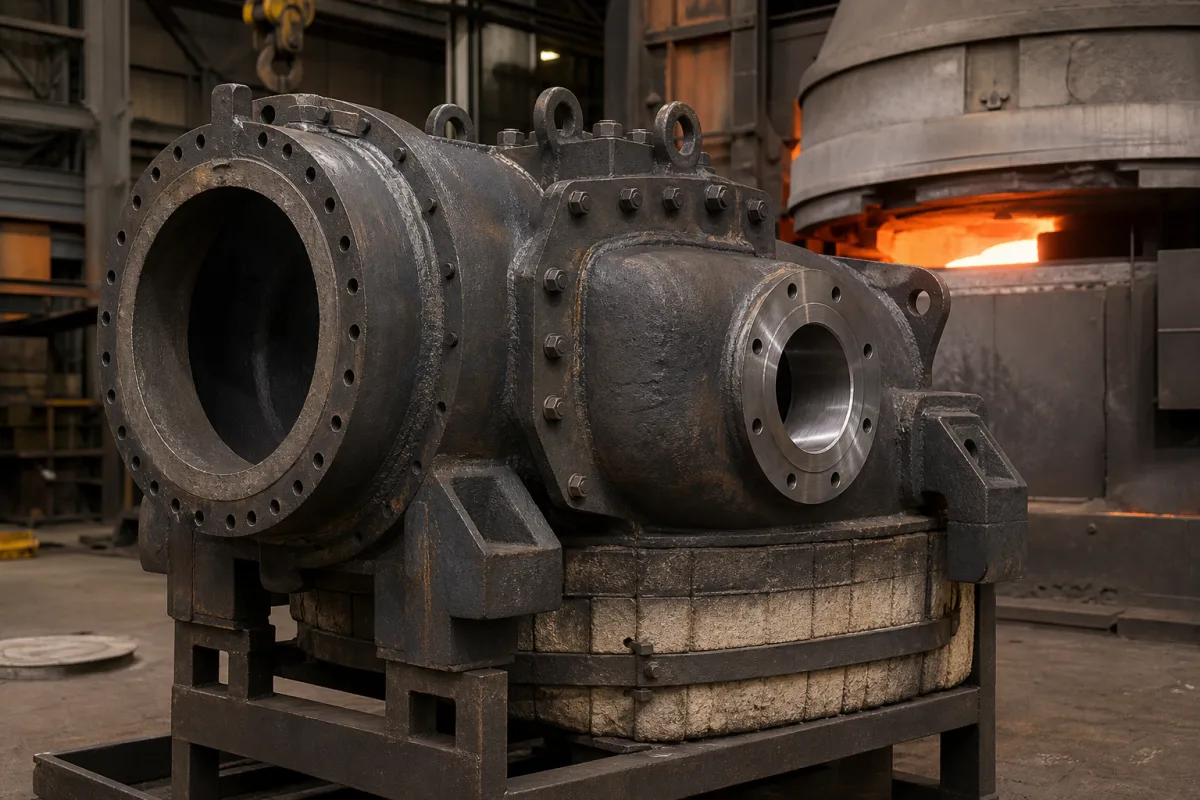
Slurry pump casing liners and wear parts (high-chrome or rubber-lined volute liner, throatbush and frame plate liner insert)
Slurry pump wet ends · high-chromium white iron or elastomer liners inside a ductile iron outer casing, the throatbush and frame plate liner insert, hardness grades of 600 and 650 HB, throatbush adjustment and liner change-out
In a lined slurry pump the pressure is held by a split ductile iron outer casing, and the slurry only touches replaceable liners inside it: a volute liner around the impeller, a throatbush at the suction eye and a frame plate liner insert behind the impeller. Each liner can be cast in high-chromium white iron or moulded in rubber or polyurethane, and the two can be mixed in one pump. The buying decisions are the liner material for the particle size and chemistry, the hardness grade of any metal parts, how the throatbush gap will be kept tight as it wears, and how the wet end will be changed out.
Wear liners and wear parts of horizontal centrifugal slurry pumps: high-chromium white iron and elastomer volute (casing) liners, throatbushes, frame plate liner inserts and cover plate liners, the ductile iron outer casing that holds them, and unlined all-metal high-chrome casings. Volute casings for clean-liquid centrifugal pumps — single and double volute, cast pressure housings, their casting route and material — are covered on the Volute casing for centrifugal pumps page. Immersion pumps for molten aluminium and zinc are covered on the Molten metal pump page. Complete pump selection, impellers sold alone and shaft seals are outside this page except where compared.
CNFX editorial research · Sources checked October 12, 2026 · 4 sources
High-chromium white iron liners: ASTM A532 Class III Type A at 600 or 650 HB
Metal slurry liners and impellers are cast in high-chromium white iron and heat treated for hardness. KSB GIW's Gasite 28G conforms to ASTM A532 Class III Type A and EN 12513 EN-GJN-HV600 (XCr23), with 24–28% chromium and 2.3–2.8% carbon against the standard's 23–30% and 2.3–3%. After heat treatment it reaches at least 600 HBN (56 HRC) with a tensile strength of 85–125 ksi, and KSB GIW recommends it for slurries between pH 4.5 and 12. [3]
Sulzer lists the same family in two hardness levels, ASTM A532 III A level 1 at a minimum of 600 HBW and level 2 at a minimum of 650 HBW, notes that erosion resistance increases with level 2, and describes both as suited to wear in alkaline and slightly acidic conditions. [4]
For hard-iron castings KSB GIW analyses each heat before pouring, pours test bars from random heats, records their tensile strength and hardness after heat treatment, and checks each casting for uniform hardness at more than one location. [3] Editorial calculation: 85–125 ksi is about 586–862 N/mm².
State the liner grade by standard and class (ASTM A532 III A, level 1 or 2, or the maker's named alloy), the minimum hardness and where it is measured, the slurry pH and chloride content, and the hardness certificates you need with each casting.
02
Elastomer-lined, metal-lined or unlined high-chrome casing for the slurry duty
Weir Minerals builds its mill circuit pumps in three wet-end arrangements: the MCR with thick elastomer liners inside a ductile iron outer casing, a metal impeller and a metal or elastomer throatbush and frame plate liner insert; the MCR-M with high-chrome iron liners inside the ductile iron outer casing and metal impeller, throatbush and frame plate liner insert; and the MCU, an all-metal unlined high-chrome iron casing with metal impeller, throatbush and frame plate liner insert. [1]
Weir gives three reasons for elastomer liners in mill discharge (cyclone feed) duty: a high-resilience elastomer that handles coarse particles and ball scats, a lighter design that is safer to maintain than heavy metal liners, and lower cost than heavy metal liners. The lined metal option keeps an outer casing that contains the slurry and allows a safe shutdown if a liner cracks, which Weir offers for plants where casing breakage from mill ball overflow is a concern. [1]
Its WBH range takes metal and elastomer wear components interchangeably in one casing, with Ultrachrome and Hyperchrome alloys, R55 rubbers and Linathane polyurethanes, and encapsulates rubber liners to prevent extrusion or blow-out. Because the liners are held inside the ductile iron outer casing, the full liner thickness can be used before replacement. [2]
The weight difference shows in the WBH outline table: a 100 QC wet end is listed at 777 kg metal-lined and 626 kg rubber-lined, a 200 SC at 3,377 and 2,861 kg, and a 300 TC at 7,241 and 5,717 kg. [2] Editorial calculation: the rubber-lined pumps are about 19%, 15% and 21% lighter respectively.
Give the supplier the largest particle size and whether grinding balls or scats can reach the pump, solids concentration, pH and temperature, and say whether the plant prefers rubber, metal or mixed liners and how heavy a single liner its lifting gear can handle.
03
Throatbush gap adjustment, liner wear-out and one-piece wet-end change-out
The throatbush wears fastest when the gap between it and the impeller opens up. Weir's WBH pump has a 4-point push-pull axial throatbush adjustment as standard, with an optional single-point device that also rotates the throatbush and can be operated with the pump running; axial adjustment keeps a minimum impeller gap for wear rate and power consumption, and rotation smooths localised wear points. [2]
On the mill circuit pumps, Weir's XA throatbush extends the total axial adjustment to up to 80–100% of the throatbush thickness, and Pre-Swirl guide vanes in the throatbush inlet are designed to reduce recirculating wear at the impeller–throatbush interface. [1]
Larger mill circuit wet ends can be changed as one piece: the throatbush is adjusted to clamp the impeller against the frame plate liner insert, the frame plate bolts are removed, and outer casing, liners and impeller come off together so the inspection can be done in the workshop. The same brochure states that its upgraded low-flow stuffing box can cut gland water consumption by up to 50% against previous MCR designs. [1]
Ask how the throatbush is adjusted (4-point, single-point, while running), how much of its thickness can be used, the wear-part set for a full change (volute liner, throatbush, frame plate liner insert, impeller), and whether the wet end can be removed in one piece.
04
Data for slurry pump wear-part supply
Paste it into your enquiry below or into an email to a maker, then replace every bracket.
Pump: [make; model and size; serial number; metal-lined, rubber-lined or unlined]
Parts: [volute liner; throatbush; frame plate liner insert; cover plate liner; impeller]
Material: [high-chrome grade and hardness level; elastomer or polyurethane type]
Slurry: [solids; largest particle; concentration; pH; temperature]
Service: [current wear life; throatbush adjustment method; change-out practice]
Documents: [hardness certificates; dimensional check against the pump's parts]
Explore company information and manufacturing capabilities, then discuss the scope of your project with a relevant supplier.
Share this page
Compiled and source-reviewed by the CNFX editorial team.
Each manufacturer above links to the page on that company's own website where the product is listed, with the date we checked it. How we source and review
· Page last updated 13 October 2026
Buyer questions
What is a throatbush in a slurry pump?
The suction-side liner that faces the impeller eye; Weir adjusts it axially to keep a minimum impeller gap and, on some pumps, rotates it to spread wear. [2]
Should slurry pump liners be rubber or high-chrome iron?
Weir lists elastomer liners for coarse particles and ball scats at lower weight and cost, and lined or unlined high-chrome iron for other duties; KSB GIW recommends its 28G high-chrome iron for slurries between pH 4.5 and 12. [1][3]
How hard are high-chrome slurry pump parts?
Sulzer lists ASTM A532 III A level 1 at a minimum of 600 HBW and level 2 at 650 HBW; KSB GIW's 28G reaches at least 600 HBN. [4][3]
How much lighter is a rubber-lined slurry pump?
In Weir's WBH table a 300 TC is 7,241 kg metal-lined and 5,717 kg rubber-lined, about 21% lighter. [2]
Sources and what still needs a direct check
Sources checked 2026-10-12. Weir Minerals (Warman), KSB GIW and Sulzer are slurry and process pump makers describing their own wet-end designs and cast grades.