Industry-Verified Manufacturing Data (2026)

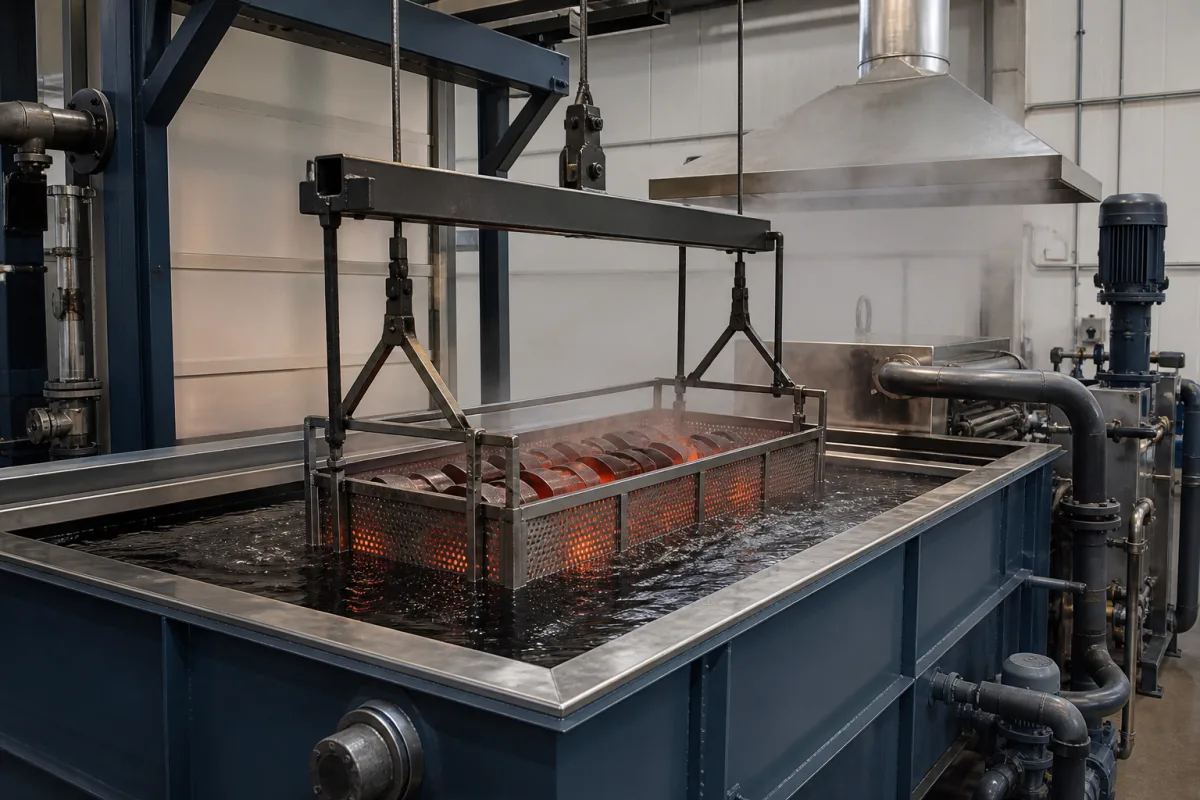
Quenching Tank

Based on aggregated insights from multiple verified factory profiles within the CNFX directory, the standard Quenching Tank used in the Basic Metal Manufacturing sector typically supports operational capacities ranging from standard industrial configurations to heavy-duty production requirements.

Technical Definition & Core Assembly

A canonical Quenching Tank is characterized by the integration of Tank Body and Agitation System. In industrial production environments, manufacturers listed on CNFX commonly emphasize Stainless Steel construction to support stable, high-cycle operation across diverse manufacturing scenarios.

A tank or vessel designed to hold quenching medium for rapid cooling of heated metal parts.
Product Specifications

Technical details and manufacturing context for Quenching Tank

Definition
The quenching tank is a critical component within the Cooling and Quenching Unit that contains the quenching medium (typically oil, water, polymer solution, or salt bath) used to rapidly cool heated metal workpieces. It facilitates controlled heat transfer to achieve desired metallurgical properties such as hardness, strength, and microstructure transformation during heat treatment processes.
Working Principle
Heated metal parts are immersed into the quenching medium contained in the tank. The medium rapidly absorbs heat from the workpiece through conduction and convection, causing controlled cooling at specific rates to achieve desired phase transformations in the metal's microstructure.
Common Materials
Stainless Steel, Carbon Steel
Technical Parameters
  • Tank dimensions (length × width × depth) (mm) Customizable
Components / BOM
  • Tank Body
    Main container structure holding quenching medium
    Material: Stainless Steel
  • Agitation System
    Circulates quenching medium for uniform cooling
    Material: Stainless Steel
  • Temperature Control System
    Maintains optimal quenching medium temperature
    Material: Various
  • Drain Valve
    Allows for emptying and cleaning of the tank
    Material: Brass or Stainless Steel
Engineering Reasoning
0.5-3.0 m³ capacity, 20-90°C temperature, 1-5 bar pressure
Material yield strength exceeded at 250 MPa stress, 120°C thermal gradient >15°C/cm, corrosion rate >0.5 mm/year
Design Rationale: Thermal stress cracking from cyclic heating/cooling exceeding material fatigue limit (S-N curve at 10⁶ cycles), galvanic corrosion between dissimilar metals (potential difference >0.25V), cavitation erosion at flow velocities >3 m/s
Risk Mitigation (FMEA)
Trigger Coolant contamination with chlorides >50 ppm
Mode: Stress corrosion cracking initiating at weld seams
Strategy: Install duplex stainless steel (UNS S32205) construction with <0.03% carbon content
Trigger Thermal cycling frequency >100 cycles/day with ΔT >200°C
Mode: Low-cycle fatigue failure at agitation impeller mounting points
Strategy: Implement finite element analysis-optimized support structure with fatigue life >10⁷ cycles at 250 MPa stress amplitude

Industry Taxonomies & Aliases

Commonly used trade names and technical identifiers for Quenching Tank.

Applied To / Applications

This component is essential for the following industrial systems and equipment:

Industrial Ecosystem & Supply Chain DNA

Complementary Systems
Downstream Applications
Specialized Tooling

Application Fit & Sizing Matrix

Operational Limits
pressure: Atmospheric to 5 bar (typically open or vented)
flow rate: 0-100 m³/hr (based on pump and agitation)
temperature: -20°C to 200°C (depending on media and insulation)
slurry concentration: Up to 40% solids by weight (for abrasive media)
Media Compatibility
✓ Polymer quenchants (e.g., PAG solutions) ✓ Water-based salt solutions ✓ Mineral oils
Unsuitable: Strong oxidizing acids (e.g., nitric acid) due to corrosion and safety hazards
Sizing Data Required
  • Maximum part dimensions and batch volume (m³)
  • Required cooling rate (°C/sec) and quench severity
  • Production throughput (parts/hour) and cycle time

Reliability & Engineering Risk Analysis

Failure Mode & Root Cause
Thermal stress cracking
Cause: Rapid temperature fluctuations between quenching cycles causing differential expansion/contraction in tank walls and welds, exacerbated by improper preheating or cooling rates.
Corrosion and chemical degradation
Cause: Continuous exposure to aggressive quenching media (oil, polymer solutions, or salt baths) combined with oxygen ingress and contaminants, leading to pitting, thinning, and eventual leakage.
Maintenance Indicators
  • Visible cracks, bulging, or discoloration on tank surfaces, especially near welds or seams.
  • Abnormal noise during operation, such as hissing (indicating leaks) or popping sounds (suggesting rapid vaporization or thermal shock).
Engineering Tips
  • Implement a controlled heating/cooling protocol to minimize thermal gradients, including gradual preheating before quenching cycles and maintaining consistent media temperature.
  • Use corrosion-resistant linings or coatings compatible with the quenching media, and regularly monitor fluid chemistry to prevent contamination buildup.

Compliance & Manufacturing Standards

Reference Standards
ISO 9001:2015 - Quality Management Systems ASTM A967 - Standard Specification for Chemical Passivation Treatments for Stainless Steel Parts CE Marking - Machinery Directive 2006/42/EC
Manufacturing Precision
  • Bore Diameter: +/-0.05mm
  • Parallelism of Mounting Surfaces: 0.2mm
Quality Inspection
  • Hydrostatic Pressure Test (1.5x operating pressure)
  • Material Composition Verification via XRF Analysis

Factories Producing Quenching Tank

Verified manufacturers with capability to produce this product in China

✓ 94% Supplier Capability Match Found

P Project Engineer from United Arab Emirates Feb 14, 2026
★★★★★
"As a professional in the Basic Metal Manufacturing sector, I confirm this Quenching Tank meets all ISO standards."
Technical Specifications Verified
S Sourcing Manager from Australia Feb 11, 2026
★★★★★
"Standard OEM quality for Basic Metal Manufacturing applications. The Quenching Tank arrived with full certification."
Technical Specifications Verified
P Procurement Specialist from Singapore Feb 08, 2026
★★★★★
"Great transparency on the Quenching Tank components. Essential for our Basic Metal Manufacturing supply chain."
Technical Specifications Verified
Verification Protocol

“Feedback is collected from verified sourcing managers during RFQ (Request for Quote) and factory evaluation processes on CNFX. These reports represent historical performance data and technical audit summaries from our B2B manufacturing network.”

8 sourcing managers are analyzing this specification now. Last inquiry for Quenching Tank from Brazil (41m ago).

Supply Chain Compatible Machinery & Devices

Continuous Casting Machine

Industrial machine for solidifying molten metal into continuous billets/blooms/slabs.

Explore Specs →
Electromagnetic Induction Heater

Industrial heating device using electromagnetic induction for metal processing

Explore Specs →
Vacuum Induction Melting Furnace

Industrial furnace for melting metals under vacuum using electromagnetic induction

Explore Specs →
Electroslag Remelting Furnace

Secondary refining furnace for high-quality metal ingots

Explore Specs →

Frequently Asked Questions

What materials are quenching tanks typically made from?

Quenching tanks are commonly constructed from stainless steel for corrosion resistance or carbon steel for durability, depending on the quenching medium and operational requirements.

What components are included in a standard quenching tank system?

A complete system includes the tank body, agitation system for uniform cooling, temperature control system to maintain optimal quenching conditions, and a drain valve for maintenance and fluid changes.

How does agitation improve quenching effectiveness?

Agitation systems circulate the quenching medium around metal parts, ensuring consistent cooling rates and preventing vapor blanket formation that can cause uneven hardening and distortion.

Can I contact factories directly on CNFX?

CNFX is an open directory, not a transaction platform. Each factory profile provides direct contact information and production details to help you initiate direct inquiries with Chinese suppliers.

Get Quote for Quenching Tank

Request technical pricing, lead times, or customized specifications for Quenching Tank directly from verified manufacturing units.

Your business information is encrypted and only shared with verified Quenching Tank suppliers.

Thank you! Your message has been sent. We'll respond within 1–3 business days.

Need to Manufacture Quenching Tank?

Connect with verified factories specializing in this product category

Add Your Factory Contact Us
Previous Product
Purge Air System
Next Product
Reaction Vessel