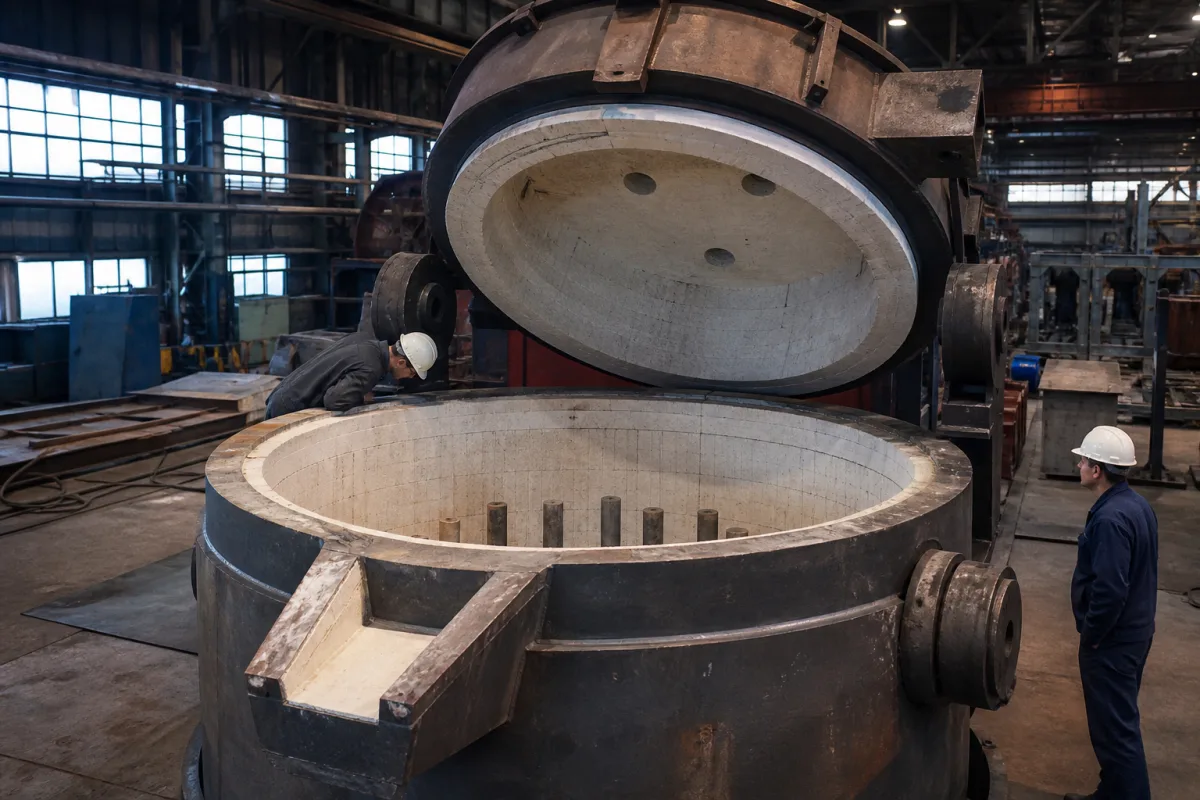
Magnesium treatment ladle: the foundry reaction vessel for ductile iron
Foundry reaction ladles for ductile iron · Tundish-cover versus sandwich treatment, magnesium recovery, sulphur pick-up of magnesium, ladle height-to-diameter
A magnesium treatment ladle is the foundry reaction vessel in which molten base iron meets a magnesium-bearing alloy, so that magnesium first combines with sulphur and the remainder leaves a residual, 0.035–0.045% for ductile iron in one supplier's guidance, needed for nodular graphite. Open sandwich ladles hold the alloy in a bottom pocket under a cover; tundish-cover ladles close the top with a lid through which the iron is poured; drum ladles take cored-wire injection. Ask three things first: which treatment method the ladle is built for, what magnesium recovery it should give, and what metal mass and proportions it holds.
Refractory-lined treatment ladles and their covers for magnesium (nodularising) and desulphurising treatment of cast iron in foundries: sandwich and pour-over ladles, tundish-cover ladles and drum ladles for cored-wire treatment. Hot metal desulfurization stations that inject reagents through lances into blast-furnace iron in transfer ladles or torpedo cars are covered on the Molten metal desulfurization reactor page. Chemical and pharmaceutical reaction vessels, steel ladles and pouring ladles used only for casting are outside this page.
CNFX editorial research · Sources checked October 12, 2026 · 3 sources
In an ASK Chemicals answer in Foundry Management & Technology, a pour-over or sandwich treatment is described as giving 30–50% magnesium recovery, less efficient than a tundish treatment process at 50–70%, and the best treatment temperature is given as around 1,454–1,482 °C (2,650–2,700 °F), because magnesium is lost faster at higher temperatures. The same answer gives 0.035–0.045% magnesium in the casting for ductile iron and 0.015–0.023% for compacted graphite iron, and names 5–6% MgFeSi as the favoured treatment alloy. [1]
Researchers from AGH University in Kraków note that vertical treatment ladles are used on the assumption that the height of the metal column must be at least twice the ladle diameter (2:1). In their foundry trial a drum ladle of about 950 kg replaced the vertical treatment ladle, receiving two 9 mm cored wires and then serving for transport and pouring; sulphur fell by 0.004% during treatment and residual magnesium averaged 0.054%. [2]
Editorial note: a tundish cover only improves recovery if the alloy pocket, dam and filling hole are sized for your tap rate and metal mass; ask the supplier for the ladle drawing with pocket volume, cover hole diameter and the metal level at full charge.
Give the supplier the treatment method (sandwich, tundish cover, cored wire), metal mass per treatment, base iron sulphur, target residual magnesium, treatment temperature, alloy type and size, crane or forklift handling, tilt or bottom pour, refractory type and preheating, and any cover, lid or fume hood required.
02
Size the magnesium addition from sulphur and recovery
The AGH papers calculate magnesium recovery as ηMg = [(0.76·ΔS + Mgr)·m] / (magnesium added), where 0.76 is the Mg/S atomic-weight ratio, ΔS the drop in sulphur during treatment, Mgr the residual magnesium and m the metal mass. With cored wire in a drum ladle they report recovery rising from 42% to 55% as wire length and treatment temperature (from about 1,460 °C) were reduced for SiMo ductile iron, and from 66% to 70% for austenitic high-nickel ductile iron, with recovery about 6% lower when a ladle was treated below full capacity. [2][3]
Editorial calculation: for 1,000 kg of iron losing 0.010% sulphur and needing 0.045% residual magnesium, the magnesium that must stay in or react with the iron is (0.76 × 0.010 + 0.045)% × 1,000 kg ≈ 0.53 kg. At 60% recovery (tundish range) that needs 0.53 / 0.60 ≈ 0.88 kg of magnesium, or about 16 kg of 5.5% MgFeSi; at 40% (sandwich range) about 1.32 kg of magnesium, or about 24 kg of alloy. [2][1] The sulphur and residual values are assumptions for the example; use your own base iron analysis.
Editorial note: the higher the base sulphur, the more magnesium the ladle consumes before nodularising, so the vessel and its alloy pocket must hold the larger addition; desulphurising the base iron first reduces the alloy needed.
03
Pocket and cover drawing, refractory and capacity to request from a foundry ladle maker
The companies linked to this product make laboratory and pharmaceutical reaction vessels, not foundry ladles. Ask any foundry ladle supplier for the drawing with pocket and cover details, refractory specification, lifting and tilting arrangement, and the design capacity.
04
Shell and trunnions, refractory lining, alloy pocket and dam, tundish cover and wire ports
Metal capacity, treatment temperature, lining and metal-column height for a magnesium treatment ladle
Pressure, stirring and sealing fields do not apply to an open pocket-treatment ladle; capacity, lining and the height-to-diameter of the metal column do. [2]
Field
What it means and published values
Ask the supplier for
Working Volume (m³)
Metal per treatment; example drum ladle about 950 kg. [2]
Explore company information and manufacturing capabilities, then discuss the scope of your project with a relevant supplier.
Share this page
Compiled and source-reviewed by the CNFX editorial team.
Each manufacturer above links to the page on that company's own website where the product is listed, with the date we checked it. How we source and review
· Page last updated 13 October 2026
Buyer questions
Which treatment ladle gives better magnesium recovery?
ASK Chemicals gives 30–50% for pour-over or sandwich treatment and 50–70% for tundish-cover treatment. [1]
How tall should a vertical treatment ladle be?
AGH researchers cite a metal height of at least twice the ladle diameter (2:1) for vertical treatment ladles. [2]
How does sulphur affect the magnesium addition?
Magnesium combines with sulphur at about 0.76 kg Mg per kg S removed before leaving residual magnesium, as in AGH's recovery formula. [2]
Sources and what still needs a direct check
Sources checked 2026-10-12. ASK Chemicals answers a foundry question in Foundry Management & Technology; the AGH University papers in Archives of Metallurgy and Materials report plant trials of magnesium treatment. Recovery ranges are as published.