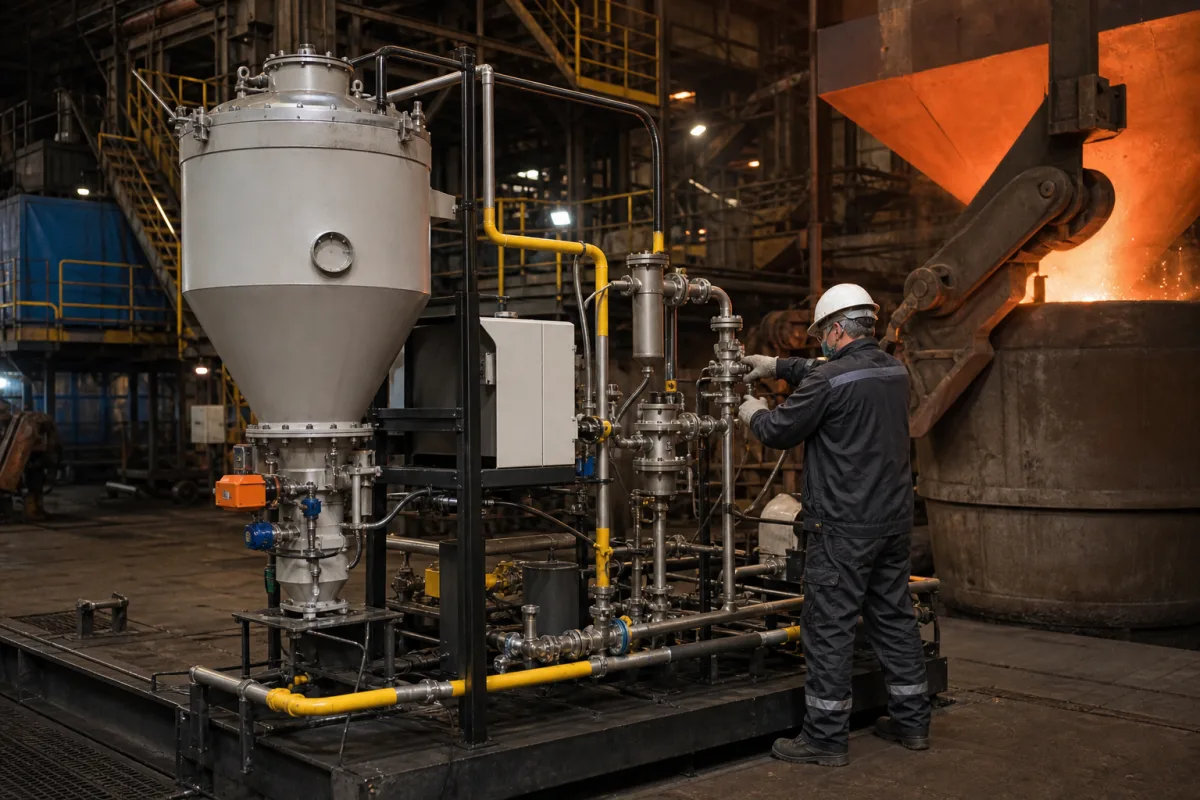
Reagent injection system for hot metal desulfurization
Hot metal desulfurization injection · Lime, carbide and magnesium dosing rates, co-injection ratio, carrier gas per kilogram
A reagent injection system for hot metal desulfurization stores powdered desulfurizing agents such as burnt lime (CaO), calcium carbide (CaC2) and magnesium granules, doses them and blows them with a carrier gas through an immersion lance into a ladle of blast-furnace iron. Ask three things first: what dosing rate range each agent has, whether the agents can be co-injected with independently controlled ratios, and how much carrier gas each kilogram of reagent needs.
Powder and granule injection systems for desulfurizing hot metal in transfer or torpedo ladles: storage, dispensers, dosing devices, conveying lines, lances and controls. Mechanical stirring (KR) desulfurization, steel ladle refining and oxygen lances are outside this page.
CNFX editorial research · Sources checked October 12, 2026 · 4 sources
Siemens VAI, describing its HM De-S system, states that CaO or CaC2 powder is dosed gravimetrically from pressure vessels and Mg granules volumetrically, then fed through a shared injection pipe and immersion lance in mono-, co- or multi-injection mode. For a station of about 1.75 million t/year with 165–180 t ladles, the CaO or CaC2 rate can be varied between 20 and 60 kg/min and Mg between 6 and 14 kg/min, taking sulfur from 200–400 ppm to 20 ppm or below. For a 250 ppm reduction Siemens gives a treatment time of 13 minutes with under 0.6 kg Mg and about 2.8 kg CaO per tonne of hot metal, producing about 9 kg slag per tonne. [1]
Primetals Technologies' 130 t station at ArcelorMittal Monlevade combines a volumetric Mg dosing device with two pistons, whose rate of 3–15 kg/min depends only on piston speed and not on system pressure, with a pressure dispenser for CaO. Co-injection runs with fully decoupled control of Mg and CaO at CaO/Mg ratios from 2:1 to 10:1; it reaches below 50 ppm sulfur, and the level 2 model predicts end sulfur within 5 ppm on average. [2]
Editorial calculation: on a 170 t ladle, Siemens' figures of 0.6 kg Mg and 2.8 kg CaO per tonne give at most 102 kg Mg and about 476 kg CaO; spread over 13 minutes that is about 7.8 kg/min Mg and 36.6 kg/min CaO — inside its stated rate ranges — at a CaO/Mg ratio of about 4.7:1, inside Primetals' 2:1–10:1 range. The ladle weight is an assumed example within Siemens' range. [1][2]
Give the supplier the ladle type and weight, annual hot metal throughput, initial and target sulfur, agents to be used (CaO, CaC2, Mg) and their grain sizes, required rates and ratios, carrier gas available and its pressure, treatment time per ladle, lance handling, dust extraction and the automation level wanted.
02
Limit carrier gas per kilogram of reagent
A Hart Metals patent on a lime-fluorspar-coke reagent with blended magnesium describes injecting it with dry nitrogen through a standard refractory-coated lance at 60–120 lb/min and a fluid density of 3–10 lb of powder per standard cubic foot of nitrogen, adding that the parameters must change with ladle size and injection depth and that Mg can be co-injected from a twin-tank system. [3]
A Thyssen Stahl patent on lime desulfurization in torpedo ladles describes earlier practice with high conveying gas rates causing considerable splashing and refractory wear: in its comparison, 75 L (STP) of gas per kg of solid limited the lime rate to 54 kg/min, a 25-minute blow. Its invention injects lime with a gas-evolving solid such as limestone at only 2–20 L (STP) of carrier gas per kg. [4]
Editorial calculation: 60–120 lb/min is about 27–54 kg/min, and 3–10 lb per standard cubic foot is roughly 21 down to 6 L of gas per kg of powder. At 75 L/kg, 54 kg/min of lime needs about 4,050 L/min (4.05 m³/min) of gas, which is why denser conveying matters. Standard-condition definitions differ between sources, so treat the conversion as approximate. [3][4]
03
A compressed-air powder injector for alloy and reducing agents
The listing reviewed describes a system that blows alloy or reducing-agent powders into molten metal with dry compressed air and adjustable feed rate; ask whether it is designed for hot metal desulfurization agents and nitrogen carrier gas.
Explore company information and manufacturing capabilities, then discuss the scope of your project with a relevant supplier.
Share this page
Compiled and source-reviewed by the CNFX editorial team.
Each manufacturer above links to the page on that company's own website where the product is listed, with the date we checked it. How we source and review
· Page last updated 13 October 2026
Buyer questions
What injection rates do desulfurization systems use?
Siemens gives 20–60 kg/min of CaO or CaC2 and 6–14 kg/min of Mg for 165–180 t ladles. [1]
What is co-injection in hot metal desulfurization?
Injecting Mg with lime or carbide in one lance; Primetals runs CaO/Mg ratios from 2:1 to 10:1 with decoupled control. [2]
How much carrier gas is needed?
A Thyssen patent uses 2–20 L per kg of agent, against 75 L/kg in an earlier method that caused splashing. [4]
How long does a desulfurization treatment take?
Siemens gives about 13 minutes for a 250 ppm sulfur reduction. [1]
Sources and what still needs a direct check
Sources checked 2026-10-12. Siemens VAI and Primetals Technologies are plant builders describing their own stations in trade press; the patents describe specific reagent and injection methods from Hart Metals and Thyssen Stahl. Values are those sources' figures, not general limits.