Deciding where a metal furnace's flue heat should go
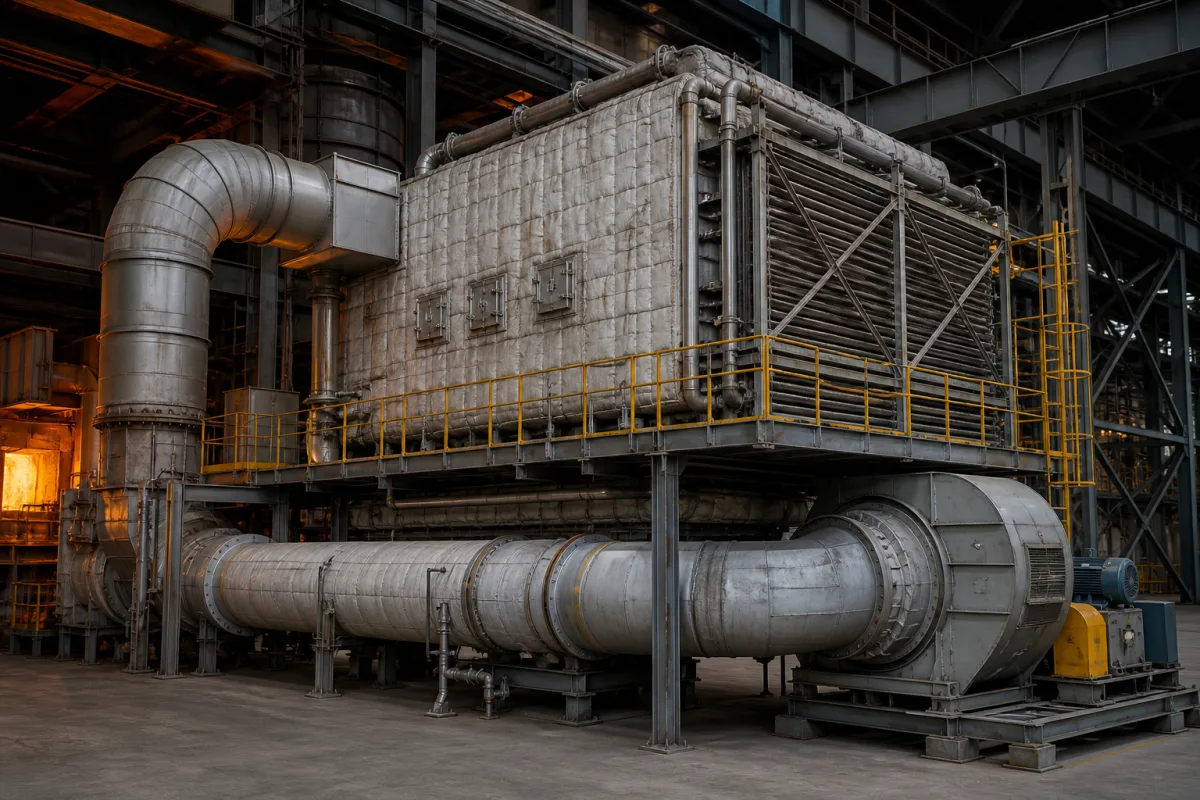
The illustrated installation takes flue gas from a furnace through an insulated heat exchanger module on a platform, with an induced-draught fan pulling it through. What the module heats, combustion air, the incoming charge, steam, or a power cycle, is the decision that sets everything else about the system. Two US Department of Energy reports, one by BCS for DOE in 2008 and one by E3M and Oak Ridge National Laboratory in 2014, set out how that choice depends on temperature, cleanliness and on-site use.
Covers the choice of use for flue-gas waste heat from metal melting and heating furnaces: temperature classes and the recovery options each supports, waste heat from aluminium melting, fouling and other barriers, and the conditions for waste-heat power generation. Combustion-air preheat savings and burner types are on Combustion System (2975); waste heat boilers, minimum outlet temperature and steam calculation on Waste Heat Boiler (3469); economizers on 9102; heat recovery from air compressors on the air compressor page.
CNFX editorial research · Sources checked October 13, 2026 · 2 sources
The BCS report for DOE divides waste heat into high (649 °C and above), medium (232–650 °C) and low (232 °C and below) quality and lists sources and uses for each.
Temperature also sets the size of the exchanger: BCS shows the required heat-exchanger area rising as the temperature difference between source and sink falls, and notes that higher temperatures bring increased chemical activity and corrosion, so the high-quality heat is not the easiest to handle.
BCS cites estimates that 20–50% of industrial energy input is lost as waste heat in exhaust gases, cooling water and hot surfaces and products.
Combustion air preheat, steam and power generation, furnace load preheating, transfer to medium- and low-temperature processes; high heat-transfer rate per unit area
Medium, 232–650 °C
Heat treating furnace 430–650 °C; drying and baking ovens 230–590 °C; steam boiler exhaust 230–480 °C; cement kiln 450–620 °C
Combustion air preheat, organic Rankine cycle power, furnace load preheating, feedwater preheating, transfer to low-temperature processes
Low, ≤ 232 °C
Exhaust gases leaving recovery devices 70–230 °C
Space heating, water preheating; few end uses, and condensation and corrosion when cooled below the dew point
ORNL's 2014 report uses the same BCS classes for low (120–230 °C) and medium (230–650 °C) heat.
02
Aluminium melting: why at least 40% leaves the stack, and where it goes
Both reports use aluminium melting to show what a recovery system is working against.
The two limits frame the job: a well-designed furnace still sends 40% or more of its fuel energy up the stack, and that stream is either clean enough to preheat combustion air or loaded enough to foul whatever is put in its way. The rotary-furnace case is the warning that temperature alone does not make heat recoverable.
ORNL notes there is very little use for hot water, hot air or cooling at these plants, which is why the options it lists return the heat to the furnace or turn it into power.
Point
Source
Reverberatory furnace exhaust can reach 1,200–1,300 °C and carry away as much as 60% of furnace energy input
BCS
The exhaust cannot fall below the aluminium pouring temperature, 650–750 °C, so at least 40% of the input is still lost as waste heat
BCS
Clean exhaust from reverb furnaces, gas generators and crucible heaters, 790–1,090 °C, with no major contaminants: prime candidates for combustion air preheat by recuperator or regenerator, or a low-temperature power cycle such as ORC
ORNL
Rotary furnace gases: relatively cold, heavily contaminated, cyclic and unpredictable flow; no accepted method of recovery
ORNL
Delacquering exhaust at about 340 °C and crucible-heater exhaust at about 790 °C: not recovered
ORNL
An abandoned recuperator from an aluminium melting furnace illustrates fouling; deposits cut heat transfer and restrict flow
BCS
Figures are for aluminium melting as described in the two reports; steel and copper furnaces have their own temperatures and contaminants.
03
Power generation last: the conditions and the numbers
ORNL sets out when a conventional steam boiler, turbine and generator on waste heat makes sense, and lists ORC, ammonia–water, supercritical CO2 and thermoelectric systems for lower temperatures.
At 25–30% conversion, each megawatt of waste heat yields 250–300 kW of electricity (Editorial calculation); the remaining 70–75% still has to be rejected or used elsewhere.
ORNL notes that conversion of waste heat to electricity is low in efficiency and places it after direct reuse; the economics then hinge on electricity price and, where demand charges are high, on peak reduction.
Condition (ORNL)
Value or requirement
Source temperature
At least 150 °C, above 315 °C preferred; above 315 °C needed for high-pressure steam
Gas quality
Relatively clean; no heavy particulates, condensable vapours or corrosive gases
Flow
Continuous or predictable
Efficiency
25–30% of heat input to electricity
Where used
Only for very large fired systems: steel reheating furnaces, process heaters, cement or lime kilns, certain steel melting furnaces
Order of choice
Only when the heat cannot be used in the process itself and other recovery (steam, hot water, cascading) cannot be justified; avoid supplementary fuel
ORNL's conditions are for conventional steam-based systems; ORC and other cycles address lower temperatures.
04
What to give a waste heat recovery supplier
Paste it into your enquiry below or into an email to a maker, then replace every bracket.
Give the furnace type and fuel, exhaust flow, temperature range and how it varies through the cycle, dust and contaminant load, dew point, the available on-site uses (combustion air, charge preheating, steam, hot water, power), and space for the exchanger and fan. Ask for the recovered heat at each use, exit temperature and fouling allowance, cleaning access, fan power, pressure drop added to the furnace, and for power options the net electrical output and conversion efficiency.
1 company lists this product among what they make. Company figures are quoted from each
company's own website; every card states where the relationship came from.
Changzhou Vrcooler Refrigeration Co., Ltd.
TBC
Changzhou Vrcooler makes coolers for air compressors, engines and generators and lists a Waste Heat Recovery category, aimed at compressor heat rather than furnace flue gas. Capacities and temperatures TBC; location TBC.
Explore company information and manufacturing capabilities, then discuss the scope of your project with a relevant supplier.
Share this page
Compiled and source-reviewed by the CNFX editorial team.
Each manufacturer above links to the page on that company's own website where the product is listed, with the date we checked it. How we source and review
· Page last updated 13 October 2026
Buyer questions
How is industrial waste heat classified?
The BCS report for DOE uses high (649 °C and above), medium (232–650 °C) and low (232 °C and below) quality, and lists sources and uses for each. [1]
Why does an aluminium melting furnace lose so much heat?
BCS explains that the exhaust cannot fall below the aluminium pouring temperature of 650–750 °C, so at least 40% of the input is lost even in a good design, and up to 60% leaves a reverberatory furnace. [1]
When is waste-heat power generation worth it?
ORNL lists clean, continuous gas above 150 °C (preferably above 315 °C) and 25–30% efficiency for steam-based systems used on very large fired systems, and advises it only when the heat cannot be used in the process or by other recovery. [2]
Can every hot exhaust be recovered?
No. ORNL notes that rotary aluminium furnace gases are cyclic and heavily contaminated, with no accepted recovery method. [2]
Sources and what still needs a direct check
Sources checked 2026-10-13. Two US Department of Energy reports: the 2008 BCS assessment of waste heat recovery and the 2014 ORNL/E3M report on potential applications and technologies.